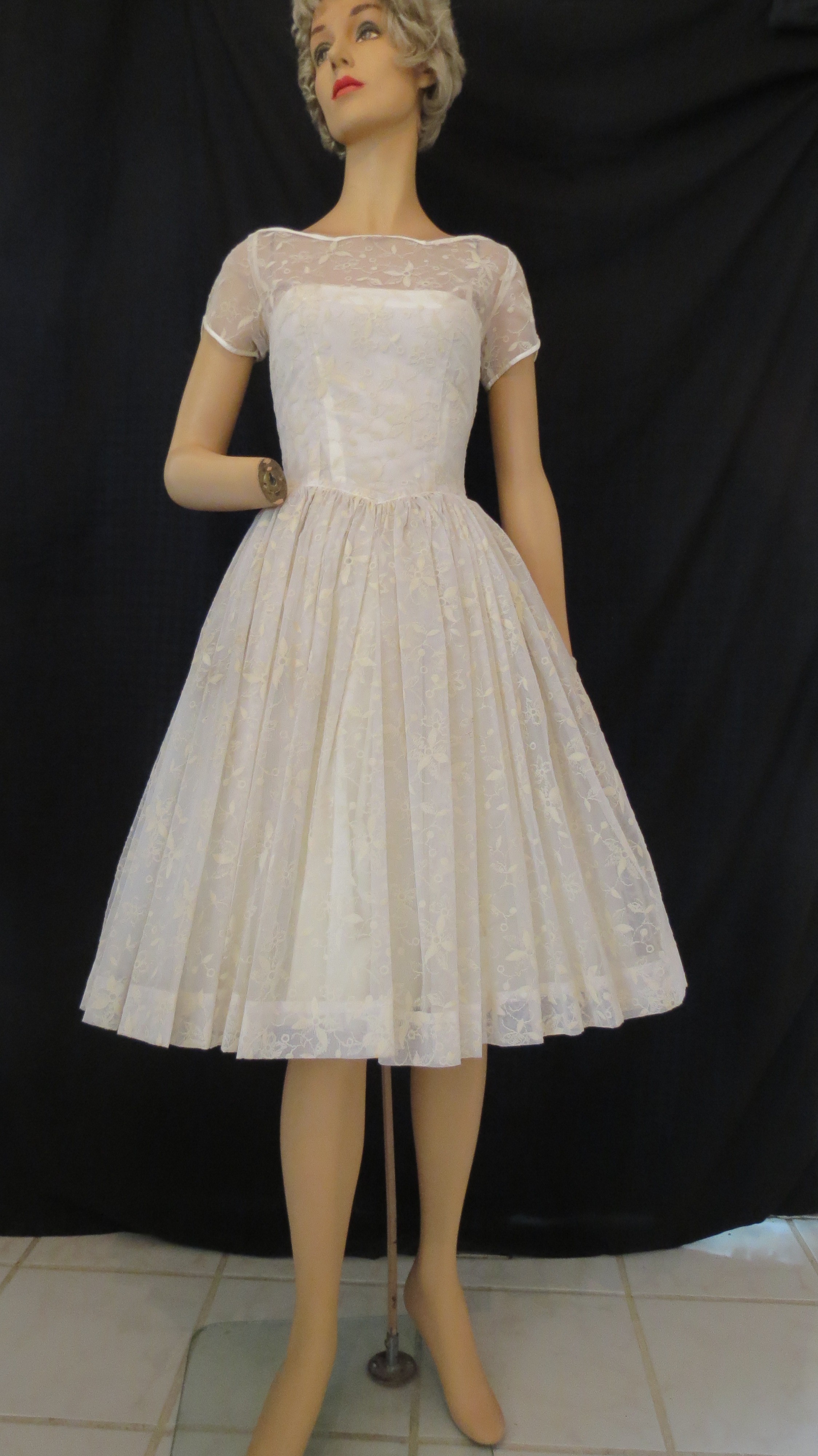
Sometime during a brief 1920’s style revival in the l960’s – 1980’s this frock was produced. It’s not a style that is flattering to everyone but, of course, Stella can pull it off perfectly. In this pure white, it may have been made as a lower-priced wedding costume alternative by some company that made bridal dresses. While obviously not high end, it’s pretty and flirty.
Love the handkerchief hemline! Can you imagine a gown in this style, made of fine silk and satin with handmade lace? During the Gatsby gilded age brides from wealthy families would have been dressed that way. Today it would make a fun Halloween or theater costume. Dresses that are obviously tied to a theme or era are always interesting whether they are true vintage, retro or modern. Of course, I always sleuth for the original evidence. More coming, so stay tuned . . . . . . . . . . . . . . . . . . . . . . . . .
Here’s Stella in a beautiful wedding suit from the 1940’s. In fact, it was the outfit she was wearing when I discovered her. Although this ensemble might have been worn for another special event, I’m sure it was a wedding dress. It’s in a heavier-weight jacquard fabric with classic bridal tailoring details such as tiny covered buttons and points at the wrists – almost midieval. Again, I suspect that it was tailor-made. The peplum and shawl collar are very Forties, plus a rare coil zipper and unusual piecing of the skirt which causes the uneven hemline.
A fabulous and fun find! Stella’s been part of the team ever since. Stay tuned for her modeling more semi-formal and long dresses . . . . . . . . . . . . . . . . . . . . . . . . . . . . . . .
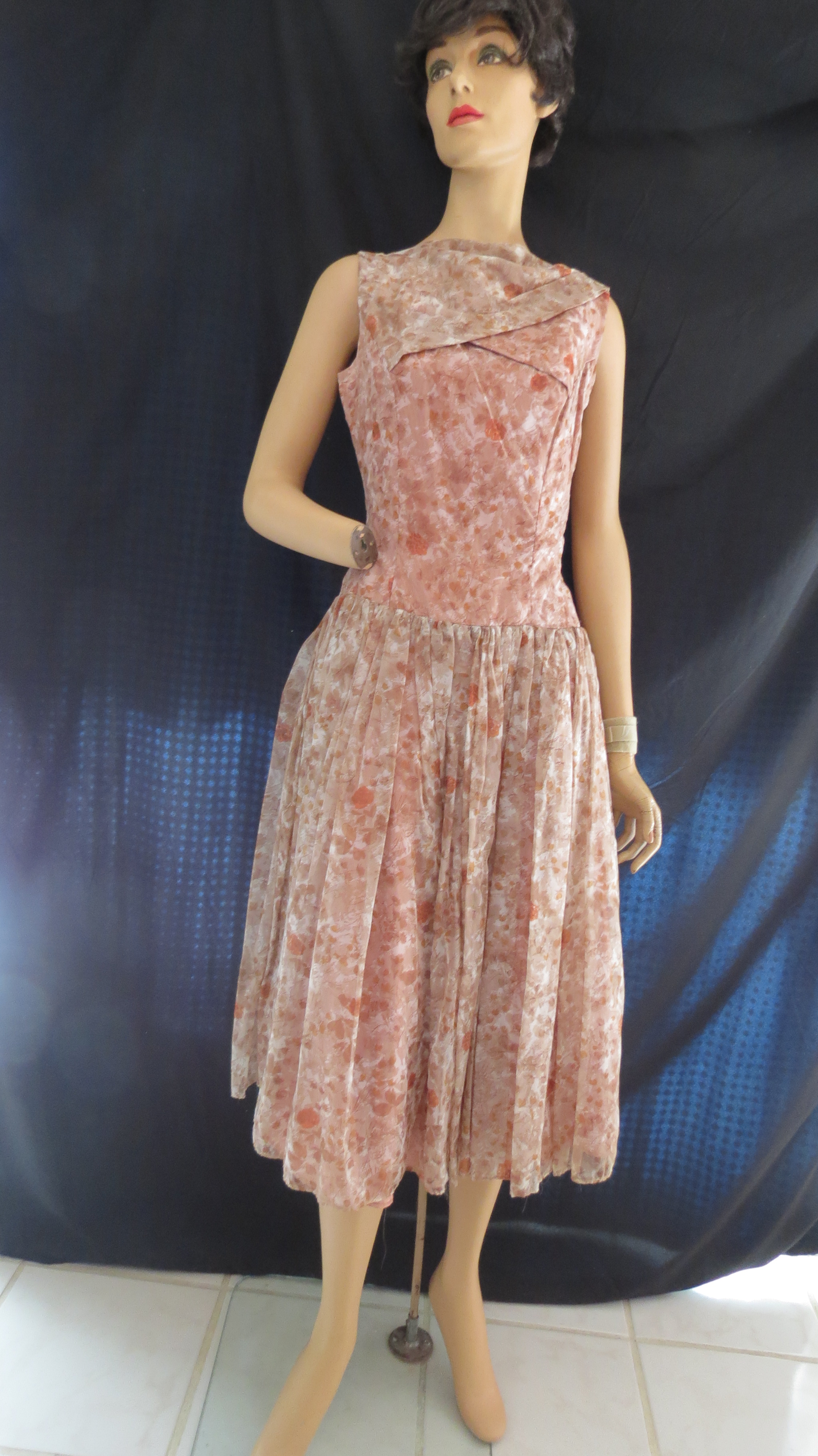
Such an interesting frock. Midi length on Stella, but she’s tall so it could have been tea or floor length on a woman of short stature. I couldn’t decide whether this dress was tailor-made or purchased at retail, but I could find no labels. I suspect that it was custom-made for a cool-weather wedding and the style really makes me think of some Wartime or Post-war bridal dresses I’ve discovered. Could also have been designed for some other special event . . . . .
Pretty mid-weight textured but glossy fabric which may be synthetic or a blend. Unusual long sleeves; but the best thing about this style is the collar. Each layer is carefully supported around the edge with wire so that it can be shaped by hand. I’ve very rarely seen this and it helped me to date the garment. It came from Australia so I may notice a British influence(?).
In striking black and white, this dress is in a Junior size styled for teenage girls and young women back in the day. Quite modest but sophisticated in textured jacquard fabric with a floor-length empire sash. Formal dresses in the dead of winter often seem to stick mostly with the “Winter” color family of black, white and jewel tones with some metallic thrown in but there’s lots of variety. Stay tuned . . . . . . . . . . . . . ..
Right about now, usually after the U.S. Thanksgiving holiday, the build-up-to-Christmas galas and formal parties seem to begin and gather momentum. This is, to my mind, the beginning of a formalwear season in the northern countries that lasts through St. Valentine’s Day and picks up speed heading into Prom, with a bump of semi-formal events around Easter and ends, more or less, with bridal events in June. I guess this is the way that humanity has amused itself during the colder months when daily outdoor activities are not generally practical.
The above frock is a beautiful example of many I have seen by Alyce Designs. Most are highly embellished, like this one. Although they are more “modern true vintage” (1970’s – 1990’s), they do have excellent tailoring unlike many garments made since the 1960’s. I believe that the company may still be making dresses, but of course I am not interested now. However, this one is old enough and well enough done that it deserves a showing. I do love the beading on sheer fabric and the nod to 1920’s style.
So, we’ll be heading into a stream of transmissions which will include clues related to semi-formal and formal events. But, evidence from new investigations comes up at random times so stay tuned . . . . . . . .
My examples of the true vintage “Party” genre wouldn’t be complete without including some frocks like these two. Not the typical type of party dress we usually think of, and certainly not the most popular styles, but conservative styles in muted colors have always been available no matter the decade or era. Even for those of us who are more flamboyant in our taste, it’s always a good idea to have at least one of these in the back of the closet because they may be the only type of dress that is appropriate for certain occasions. It could be a Celebration of Life event, a corporate gathering or meeting the prospective in-laws . . . . . . . . . your call, but sometimes we just know.
The frock on the left, by a high-quality vintage maker, is very elegant and could hardly be criticized by even the most picky person – at least not publicly – and then, who cares (unless it’s your boss). The dress on the right was much more “common” and affordable, but is still attractive and “correct”. Some picky person might balk at the sheer sleeves or say that the neckline is too low but that would be extreme (and you could also wear a neckline scarf and/or a lightweight pretty shawl if you want to be ultra demure).
So, that covers the ground, for the time being, of holiday party options and how to avoid the fashion police. Speaking of which, I will be relocating to another safehouse within the week so there will be a pause in transmissions for at least 2 or three days by the weekend but this will be temporary so stay tuned . . . . . . . . . . . . . . . . . . . . . ..
Any time there’s a special event or holiday, a true vintage little black dress will never let you down. This one is so unusual, I had to slip it into the line of bright and colorful frocks that I’ve been showing. Not an easy fit for everyone, but if you’ve got the shoulders to support the neckline and a tiny waist like Stella, it’s absolutely stunning. The drape of the bodice is genius and the fabric flower at the waist adds even more interest without any need to be flashy.
Jewelry should be sophisticated but simple. Diamond stud earrings or gold, or pearls. Absolutely NO statement necklaces to detract from that beautiful neckline and maybe no necklace at all. If more bling is desired, a delicate but luxurious bracelet or watch would be nice. Back in the day beautiful tiny watches in gold or platinum with diamonds were not unusual for those who could afford to splurge on them. Of course, a cocktail ring is always acceptable with a dress like this but, again, the jewelry should not overpower the dress, which is the star of this show. And, the show must go on. Stay tuned . . . . . . . . . . . .
These are just 3 out of my collection of lovely kitchen aprons, but perhaps a bit more interesting and seasonal than others I have, which are more generic, like a cotton gingham check without any specific theme. Many aprons, like the first one here, were specifically themed for a particular holiday or fashion era. It’s a great example, with bright color and a novelty print for Thanksgiving. Although it’s definitely trendy and targeted, it is also at least somewhat practical because of the machine-washable fabric, wraparound style, secure ties and big pocket. It could actually do the job of keeping the cook’s skirt clean. The most useful styles also covered the bodice.
The usefulness is really important, but I love the novelty print. It’s always good to play the hostess in something that also makes people smile. The two aprons following are entirely different in their purpose. These are made from a much more delicate fabric and would be best washed by hand, both because of their delicacy and because they are hand-painted. They were made for and gifted to my grandmother by a relative who at least did the painting herself, if not the sewing job. Gifts like this were common in her day, and cherished. These aprons were made not so much to protect clothing as to be pretty. Grandma might have worn them when she had her friends in for tea or a card game, maybe even for hosting an at-home cocktail party. The messy part of the hostess job would have already been done when she made the cake or other refreshments beforehand.
Aprons were much more commonly worn in decades past and were a significant part of a woman’s household wardrobe, like housedresses worn on cleaning day. Most women’s (especially married women’s) lives were organized around a routine of household duties throughout the week and each one usually required a different kind of outfit – one for cooking, one cleaning, one for tending plants, one for doing the weekly shopping. Special accessories to these outfits were needed for certain jobs, such as gloves of various kinds, hats of various kinds, nursing bras and pads to protect clothing from breast milk and burping babies. Housewives were trained to be very practical and were rewarded by Society for a job well-done. The home was their workplace and the role defined them, so their household wardrobe had a central place in their lives. For better or for worse, that was the way it was. Do we want that again? Think about it and keep your eyes on the clues . . . . . . . . . . . . . . . . . . . . . . . . . . . . . . . . . . . . . .
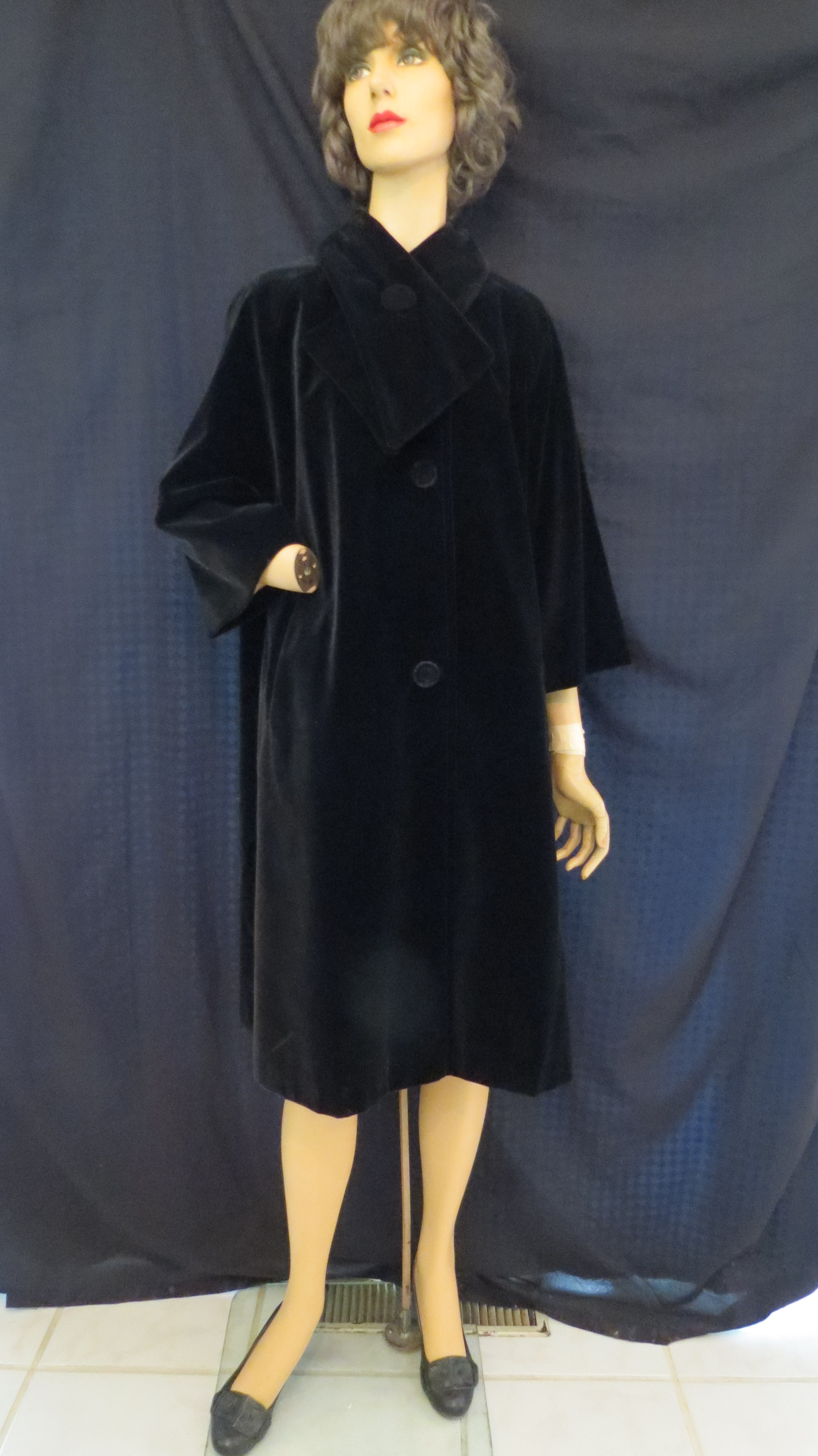
Last night I was out and about to a theater production and couldn’t reasonably drive a two block distance. Walking was the only choice, which I love, but IT WAS SO COLD!!! My warmest outerwear option, which kept me toasty and comfy, was my post-war beaver jacket from Canada. 75 years old and it’s still snuggly and beautiful. I grieve for the precious animals who (yes, WHO) were sacrificed for vanity and retail profit back in the day and will NEVER buy modern fur products. I advocate for animal rights but also celebrate those lives and gifts by preserving and enjoying elegant fashions from the past for as long as they will last.
I own many gorgeous fur and faux fur pieces made decades ago, before protective legislation and individual conscience stopped some of the fur trade and promoted humane practices. Above is one example, on the left, of an older fur jacket dyed to mimic mink. I cannot identify the fur – could be muskrat. Before the end of WWII, furs considered to be less fine were often processed this way. Other examples, such as the one on the right, are fakes – popular in the 1950’s and beyond. Some have been very convincing even since the 1950’s. Many of those made today look and even feel very authentic. The look is fun and elegant, in a vintage way, plus, as I proved last night, very practical.
Faux fur and secondhand true vintage furs are the best, the ONLY humane and progressive choice. I prefer those from the 1960’s and before. The remaining fur trade is still a blot on humanity, so we must be vigilant in our boycotting of this active market but I don’t see the enjoyment of historical fashions as being hypocritical. I will continue to show you how much I love them. Stay tuned . . . . . . . . . . . . . . . . . . . . . . . . . . . . . . . . . .
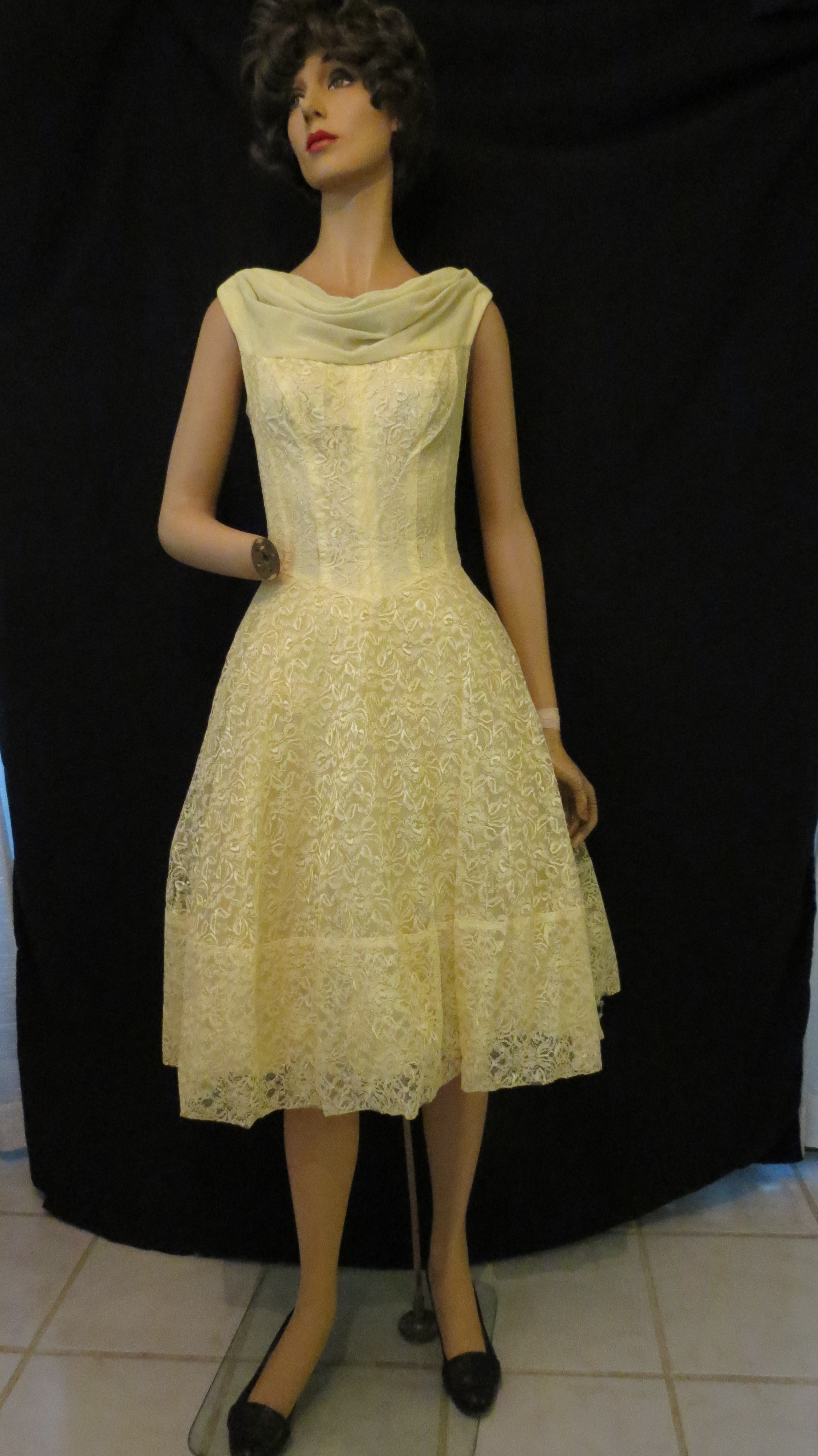
Perfect example of a Kennedy Era party dress, bought off the rack back in the day. It’s full of clues in the fabrics and construction. Lace overlay fabric which was very popular at that time, 3-layer skirt with a netting crinoline in the middle, AFLCIO Union Workers label, vintage metal zipper with a hook and eye at the neckline and at the waist, and hanging loops sewn in at the shoulder. These dresses are exceptionally well-made although they were reasonably priced. Although it’s a little short on Stella, it fits her pretty well.
I’m always thrilled to find one and each example has some unique features. In this case, the scarf attached at the right shoulder which drapes across the front neckline is a novel addition. It’s even got a detachable rhinestone brooch on the opposite shoulder, suggesting that there might be other ways to style the scarf. As worn above, it makes a tail over the left shoulder, which was a popular design element at that time and also in decades before. In any case, I’ve never seen one exactly like this. Just goes to prove that you just never know . . . . . . . . . . . . . . . . . . . . . . . .