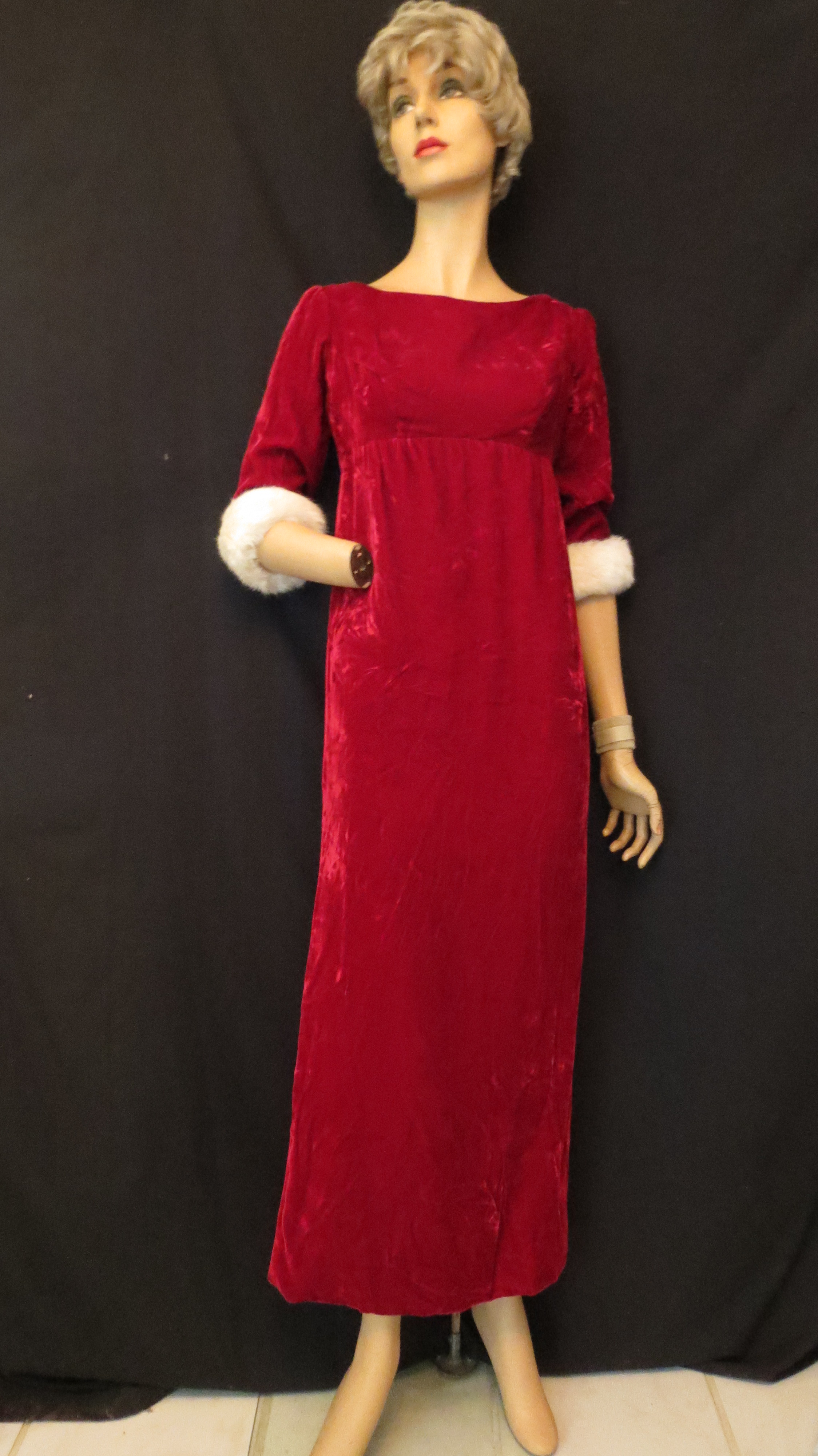
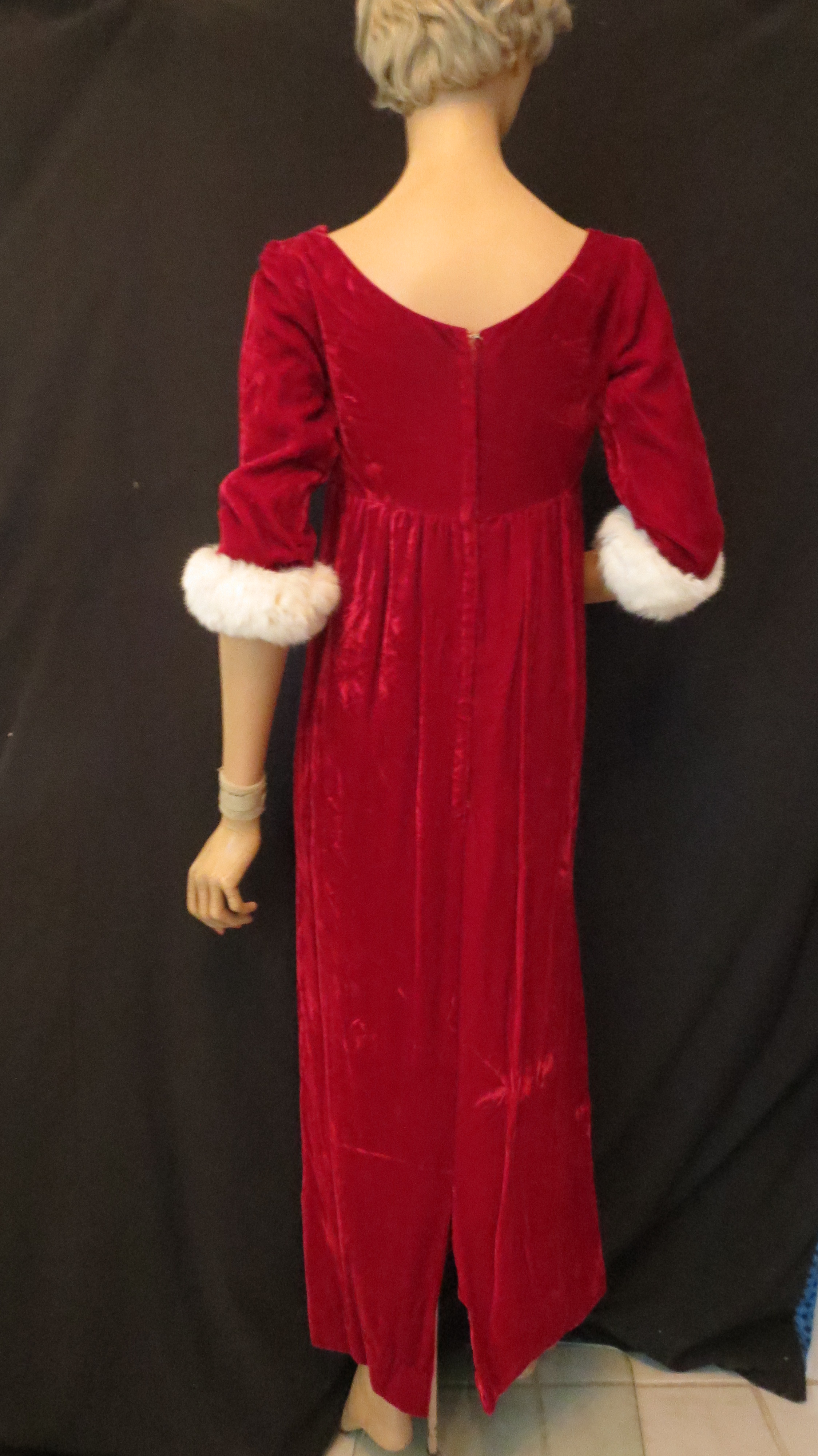
Perhaps appropriate for your intimate cocktail gathering with friends, but can you imagine anything more impractical than hosting a party wearing velvet and fur? Or dealing with Christmas morning craziness and food prep wearing this? No wonder it’s been packed away. Still, some home-based seamstress had a lot of fun planning and wearing this gown. It was the height of “fad-shion” and she must have felt like a queen. Good thing her sleeve didn’t get into the gravy or the baby’s diaper leak onto her lap.
No doubt this frock has a story but, after this short digression, it’s time to return to the LBD and it’s slightly-flashier cousins. We’ve moved into the late 1950’s – early 1960’s and it’s time to get back to some serious partying. Stay tuned . . . . . . . . . . . . . . . . .
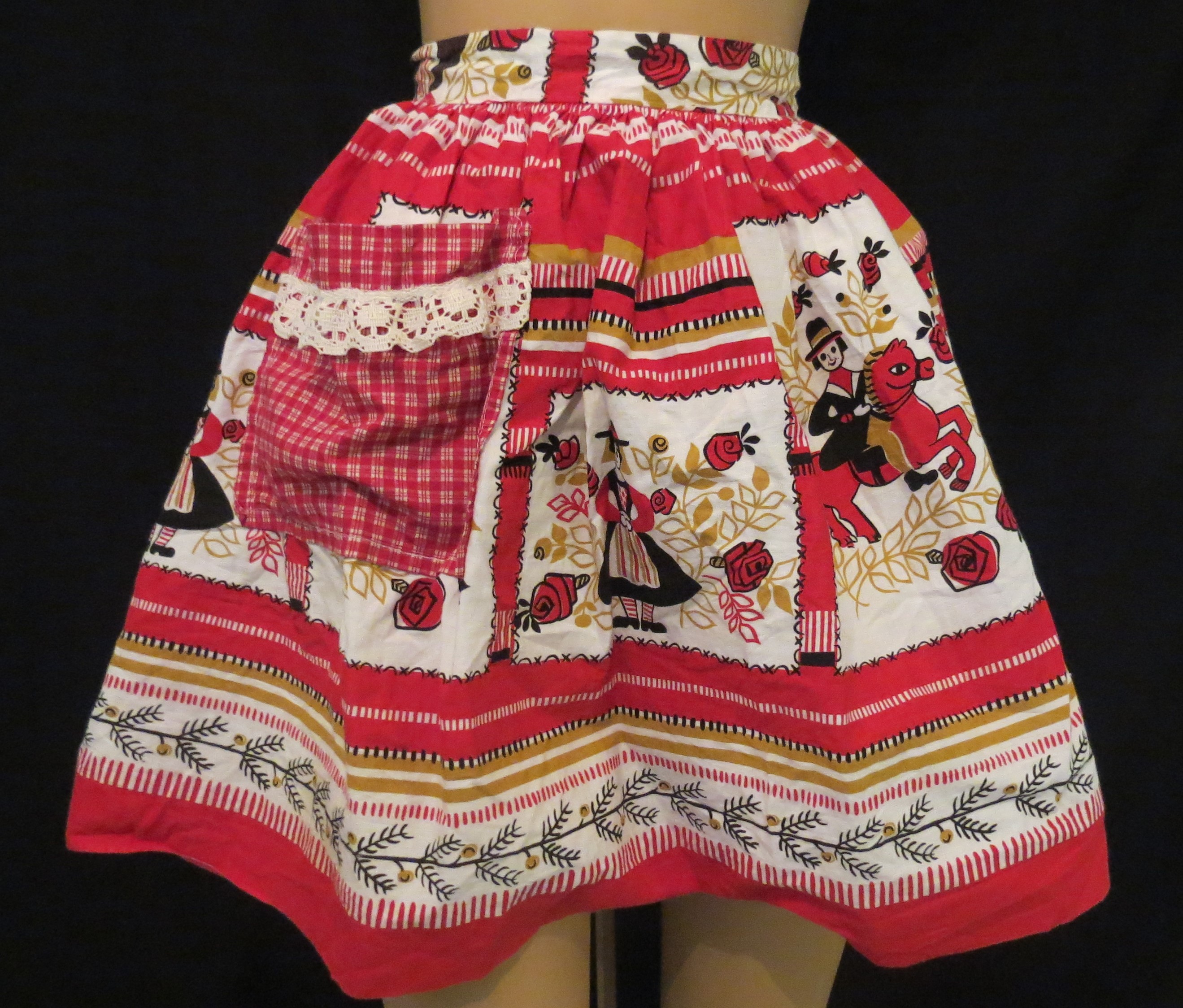
These are just 3 out of my collection of lovely kitchen aprons, but perhaps a bit more interesting and seasonal than others I have, which are more generic, like a cotton gingham check without any specific theme. Many aprons, like the first one here, were specifically themed for a particular holiday or fashion era. It’s a great example, with bright color and a novelty print for Thanksgiving. Although it’s definitely trendy and targeted, it is also at least somewhat practical because of the machine-washable fabric, wraparound style, secure ties and big pocket. It could actually do the job of keeping the cook’s skirt clean. The most useful styles also covered the bodice.
The usefulness is really important, but I love the novelty print. It’s always good to play the hostess in something that also makes people smile. The two aprons following are entirely different in their purpose. These are made from a much more delicate fabric and would be best washed by hand, both because of their delicacy and because they are hand-painted. They were made for and gifted to my grandmother by a relative who at least did the painting herself, if not the sewing job. Gifts like this were common in her day, and cherished. These aprons were made not so much to protect clothing as to be pretty. Grandma might have worn them when she had her friends in for tea or a card game, maybe even for hosting an at-home cocktail party. The messy part of the hostess job would have already been done when she made the cake or other refreshments beforehand.
Aprons were much more commonly worn in decades past and were a significant part of a woman’s household wardrobe, like housedresses worn on cleaning day. Most women’s (especially married women’s) lives were organized around a routine of household duties throughout the week and each one usually required a different kind of outfit – one for cooking, one cleaning, one for tending plants, one for doing the weekly shopping. Special accessories to these outfits were needed for certain jobs, such as gloves of various kinds, hats of various kinds, nursing bras and pads to protect clothing from breast milk and burping babies. Housewives were trained to be very practical and were rewarded by Society for a job well-done. The home was their workplace and the role defined them, so their household wardrobe had a central place in their lives. For better or for worse, that was the way it was. Do we want that again? Think about it and keep your eyes on the clues . . . . . . . . . . . . . . . . . . . . . . . . . . . . . . . . . . . . . .
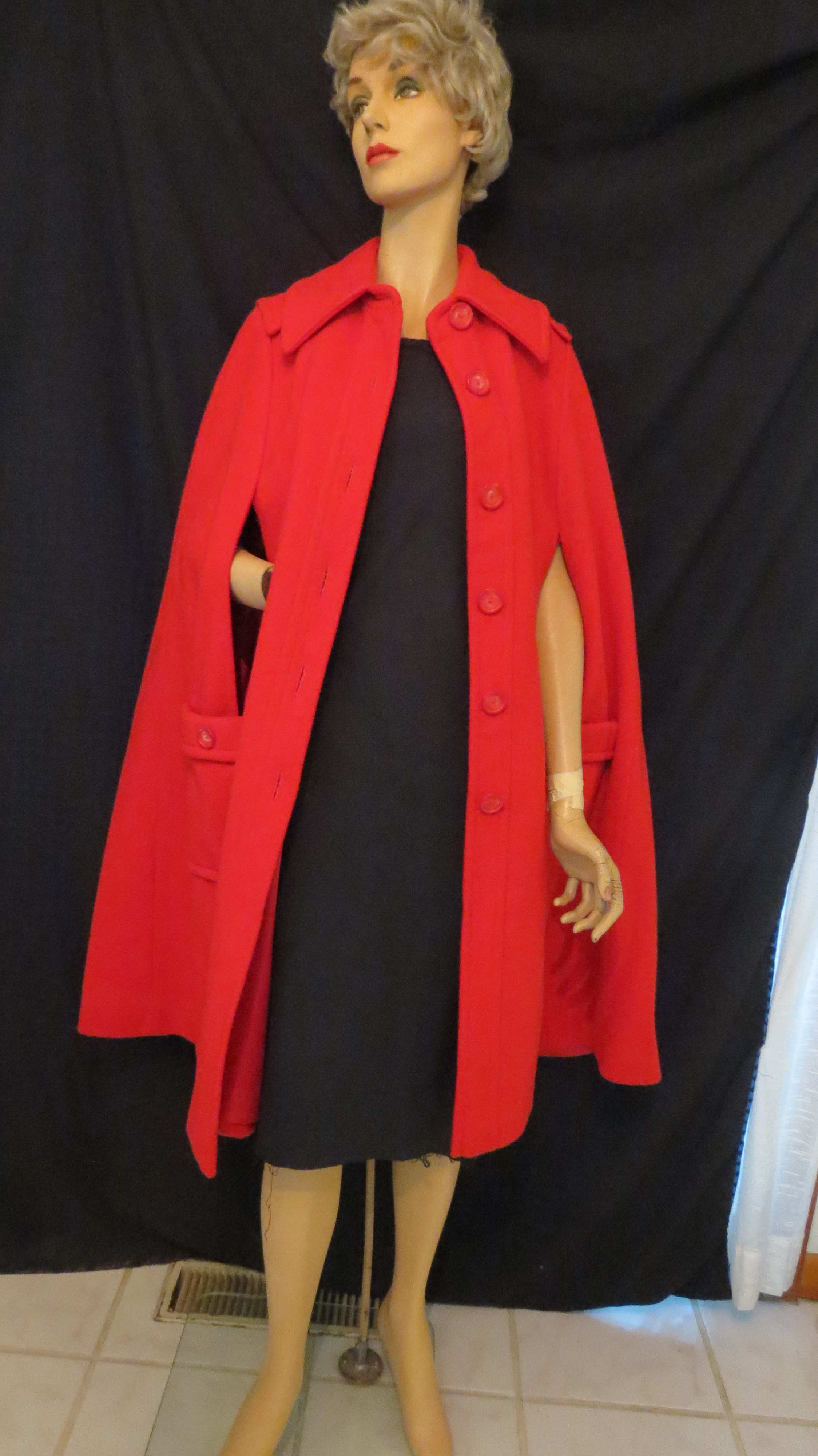
It’s still Fall, guys, but a skiff of snow on my car this morning brought me back to reality. Although we’ll have more warmish days, it’s time to get out some of the woolies. I’m not ready, yet, to throw on one of my wonderful wool coats but capes are more versatile at in-between times. Here are two of my mid-century favorites.
This beautiful red one is tailored and perfect for smart casual to business styles. It is lined and detailed like a good coat would be. Made in the decade from 1955 to 1965. The classic style makes it difficult to pinpoint a year, but there are always clues. A brand label really helps. Buttons and zippers can tell a story. If you study costume design or are a super sleuth the fabric, certain tailoring details or photos of trends published in newspapers and magazines can narrow the window to a more specific time frame. The next cute and unusual cape is a perfect example.
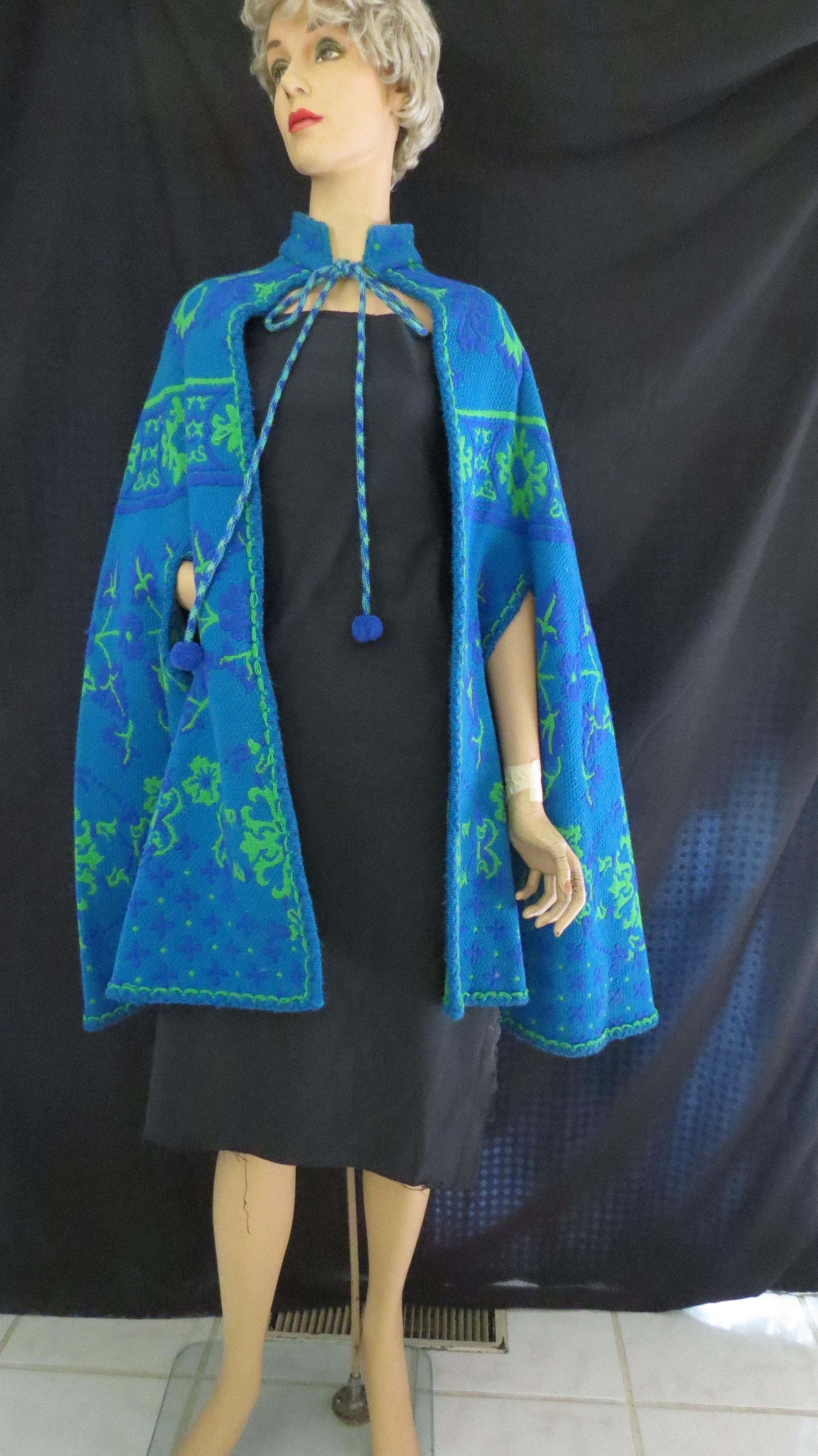
A reversible garment is so much fun! The second cape is much more casual and in a Boho style. It’s a nice, substantial wool but has no lining or pockets. The only complications to the design are the pattern woven into the fabric and the little tufted string tie at the neckline. It’s also from the same decade as the red cape but I can narrow the time period closely because of the color clue. There were one or two years from 1962 – 1964 when the blue and green color combo went viral. It was on everything from clothing to housewares and graphic design. Styles were also loosening up around then, with Mod edging in on classic and traditional. I’ll bet that this cape was made and sold during those 3 years, possibly exactly 1963.
So, these will keep me warm and the freezing temps are likely to minimize the risks of moth damage. However, it’s always a good idea to protect your treasured woolen garments since those moths can sometimes surprise you. I have more capes to show you, but that may come later in the year or even next year since we’ll be turning the New Year’s page before we know it. Stay tuned . .. . . . . . . . . . . . . . . . .
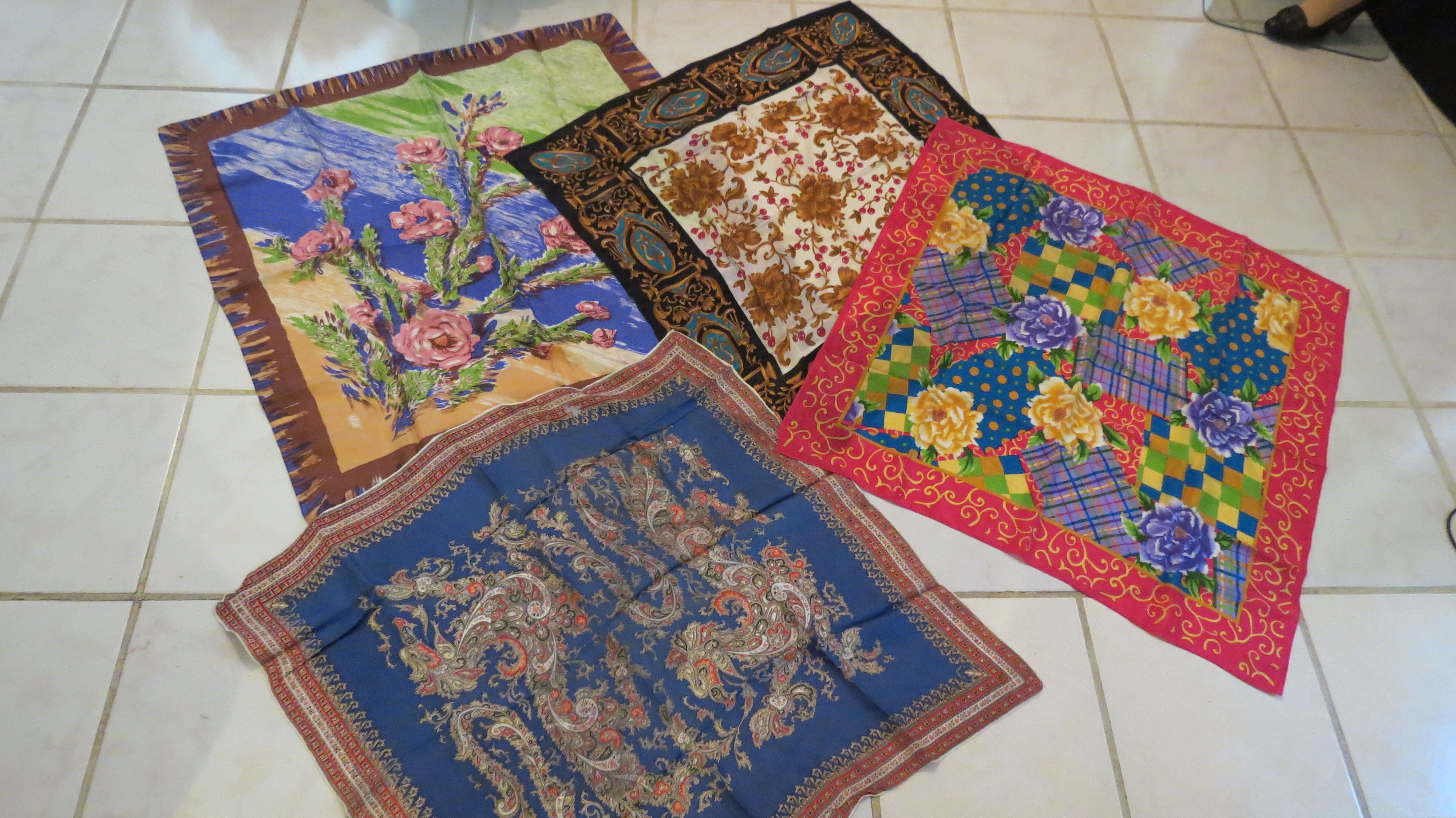
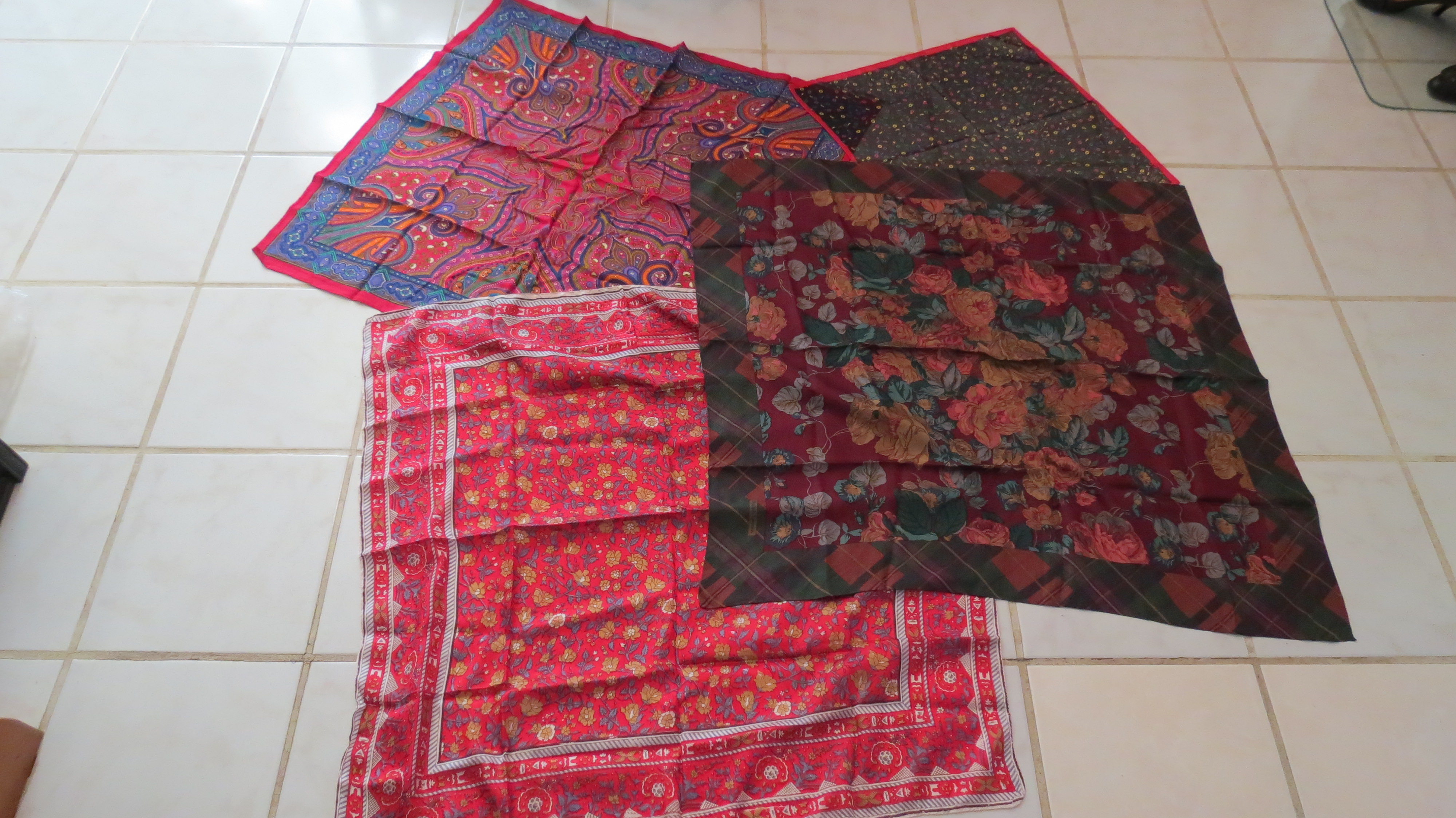
True vintage scarves are a must-have. They are generally very well-made with hand-rolled and stitched edges. Often, they are made of silk; if not, the fabric is of very good quality. Mostly, it’s the artwork on printed vintage scarves that is so wonderful. The only essential example I’m not showing here is the souvenir scarf, depicting scenes from a specific place or theme. Mid-century women collected these. Large scarves are great as capes or folded into turbans. Small scarves make cute little collars or accents on handbags or pockets. Every size in between can be worn in a gazillion variations. Lots of books and online tutorials teach you how to do this.
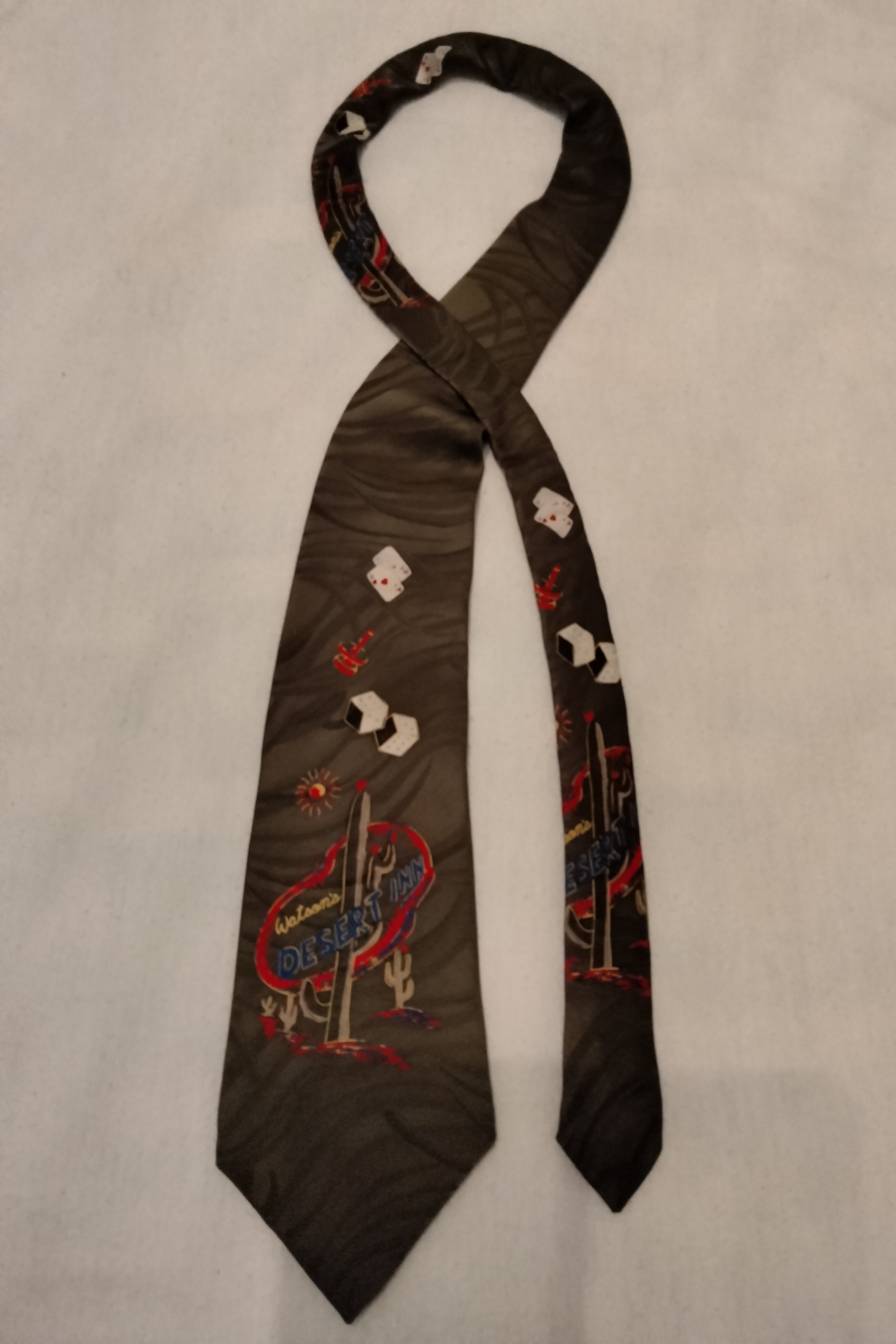
For a menswear outfit, a true vintage necktie is key. I especially love the mid-century graphics. Some 1940’s ties are truly spectacular and the only example I have of this style is a 1970’s/’80’s souvenir tie from Watson’s Desert Inn in the Canary Islands.
Scarves and ties alone can make up a vintage collector’s obsession but I prefer to use them as accessories only. As a very useful clue added to a modern or otherwise banal outfit, they can open unexpected doors. Stay tuned . . . . . . . . . . . . . . . . . . . . . . . . . . . . . . . . . . . . . .
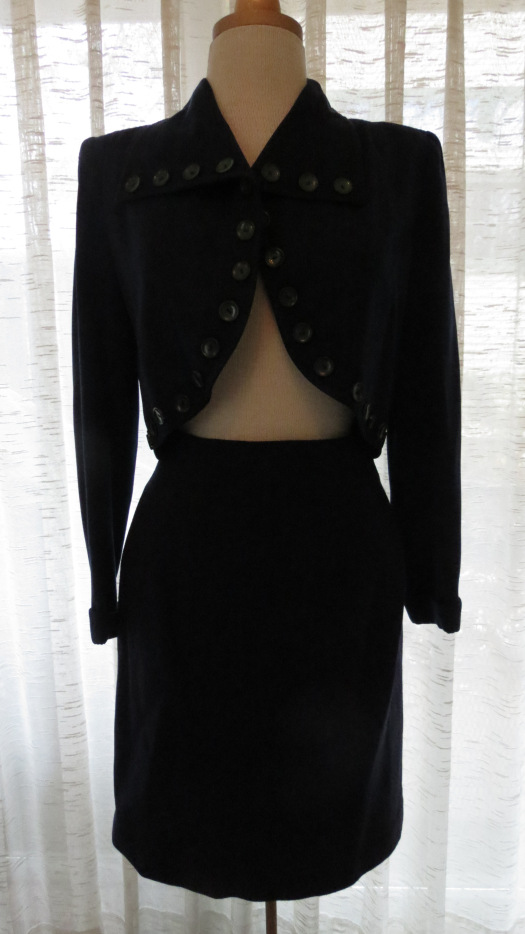
I love the apple-green button trim on this navy jacket from the 1940’s. Alas, the original skirt was lost, but I was able to find one with an almost-perfect color, fabric weave and true-to-the-era style. That is phenomenal and rare, but not impossible for the Magicvintagespy.
Aside from the cute and iconic design, these pieces are able to be worn as separates as well as a suit. The fabric, though it may be wool-based, is still 3-season and makes this find a very practical part of my wardrobe.
The only downside, if there is one, is that this material must be dry-cleaned and should be protected from moth damage. When adding true vintage clothing to your wardrobe, it’s important to remember that some fabrics which look like the today’s synthetics and blends were often made with wool years ago. The up-side, which is definite, is that wool lasts forever and the construction of these garments probably will, too!
She’d just pull out the latest edition of her McCalls Needlework magazine. And, of course, there is the Christmas Pageant, too . .. . .
I can’t believe the intricacy of these home-sewing DIY patterns. Women used to do this all the time!
Once when I was a kid, my (I thought) non-sewing grandmother did whip up a very convincing 1960’s black collarless jacket for me when I wanted to be a Beatle for Halloween. Who knew? . . .
Whether in the parade or afterward, at the big game, some high-school girl or coed strutted her stuff in this set. Sorry that I don’t know what school it was associated with, but she must have kept her letters as memorabilia. Styling and construction put it in the Sixties or Seventies.
Again, a super-seasonal find which makes it all the more fun. Won’t be a keeper in the long run, but we were approaching Halloween when this turned up. I’ve got lots of “new” things which could make dynamite costumes . . . . . . . . . . . . . . . . . . . . . . . .
Another rare find! This one was not a high-end item when it was made, but it is an iconic piece with mink-trimmed sleeves. I have a few of these garments with sleeves like this but don’t find them often.
Metallic thread on sheer black fabric, with “Autumn Haze” mink cuffs. Buttons up the back. Back in the day, companies that produced medium-priced clothing still made some “luxury” items that the average woman could afford, and they made them well.
Box bags were quite popular during the mid-century. Here’s an example from the 1960’s or 1970’s.
This one was made in Italy, where many beautiful handbags were, and still are, made. It doesn’t have a smidge of leather on it, which Italy is usually famous for, but it is still very well constructed.
After all these years, the hardware remains shiny and unblemished. The woven exterior looks almost new, as does the interior. Although it helps that this purse was used little if at all, age and storage can wreak havoc on many items – especially if they are not of good quality.
So, if you haven’t stored your treasures with care, they can deteriorate simply from sitting still while they wait for you to enjoy them. Keeping them dust-free and clean, inside and out, is important. Don’t store them in places where the temperature or humidity are too high or too low. If the item is made of natural materials, using a quality conditioning lotion made for the material once in a while will make a big difference in their appearance and durability. Lotions and sprays made for leather, skins and wicker are available. Even vinyl can be conditioned with products made for car interiors. That’s my wisdom for the day . . . . . . . . . . . . . . . . . . . . . . . . . . . . .
Look! I found another woven metal mesh Glomesh bag – this time a black one. Photographed on two different backgrounds to enhance the details. So nice to have two colors. Also, love this wonderful macrame’ bag in a similar style.
The Glomesh purses were very popular here – a real Australian company. The white bag doesn’t have a brand name inside. Sixties or early Seventies, both of these purses have survived in great condition. I will really enjoy using them!
MORGANA MARTIN, THE MAGICVINTAGESPY
BLOG: MAGICVINTAGESPY.COM
BOOK: HOW TO FIND THE BEST IN VINTAGE FASHION – AVAILABLE ON AMAZON.COM