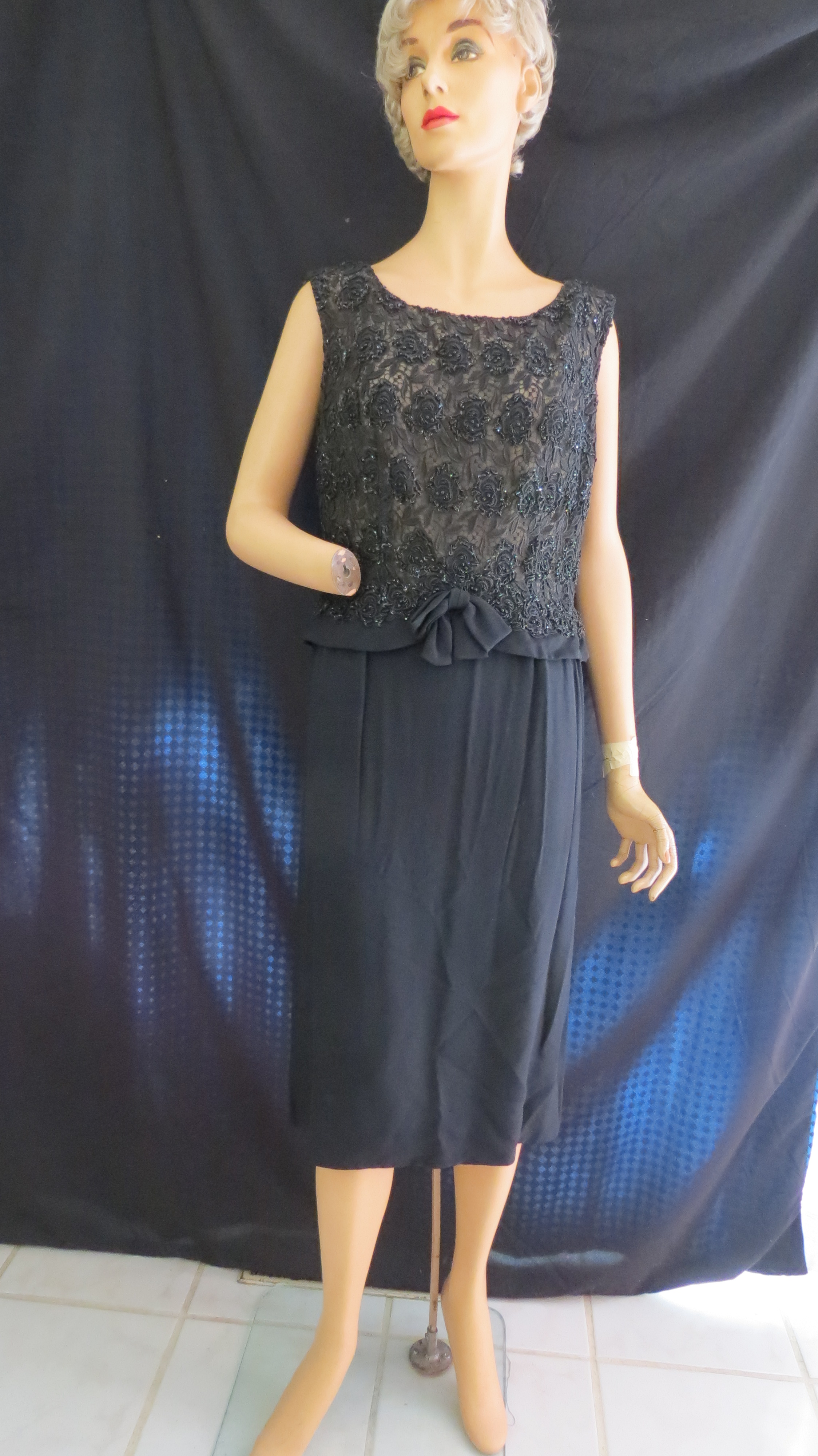
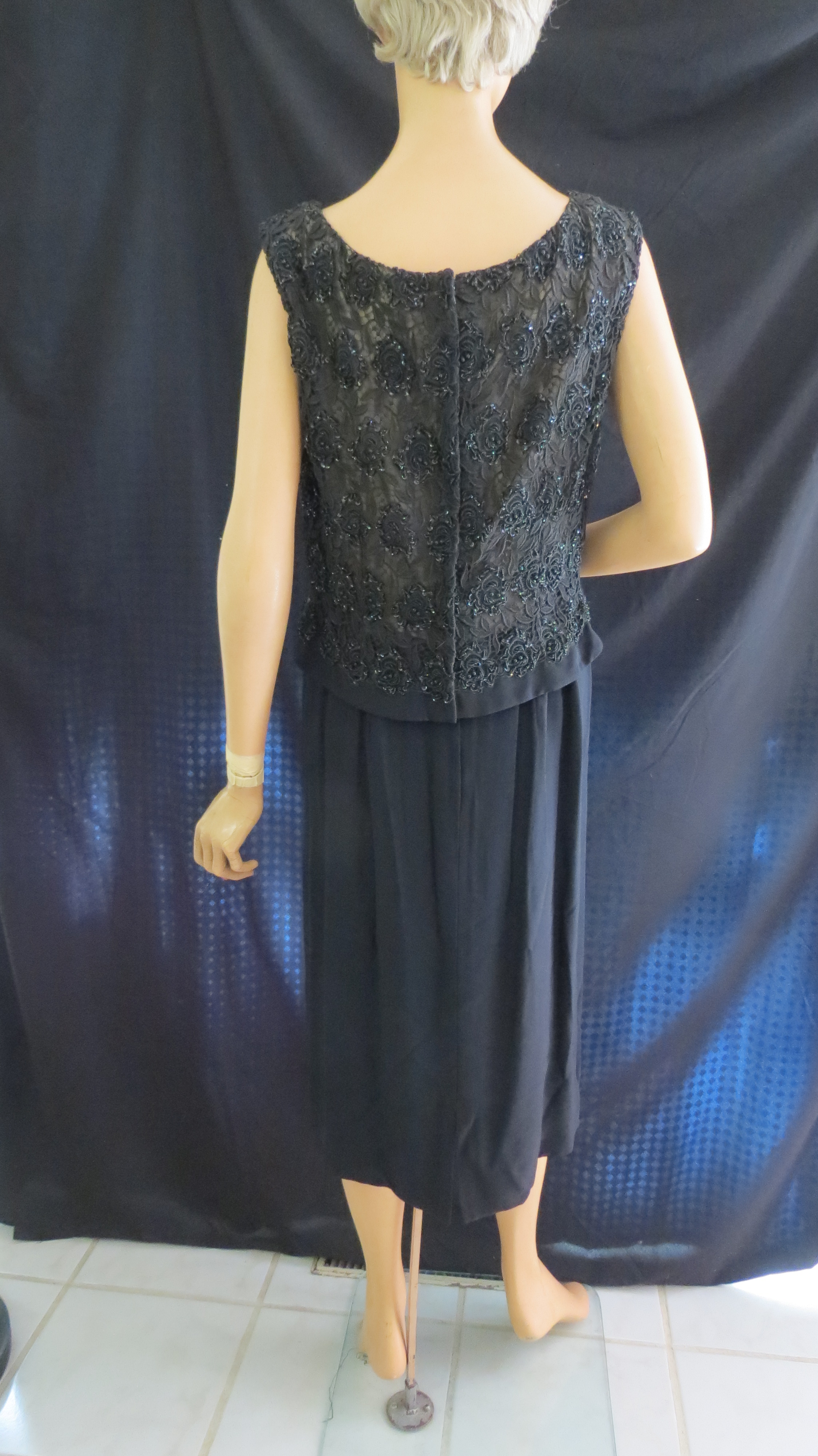
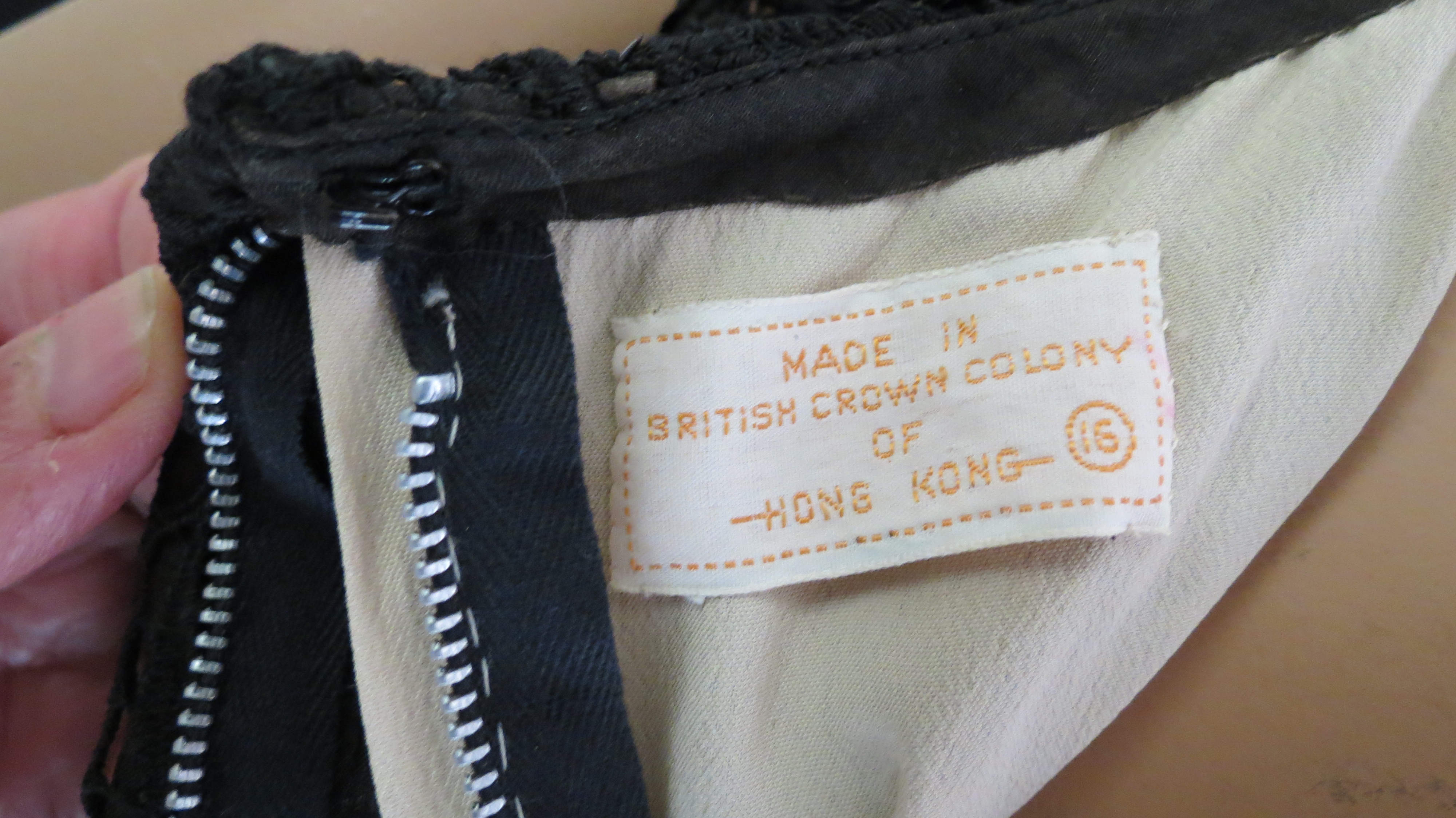
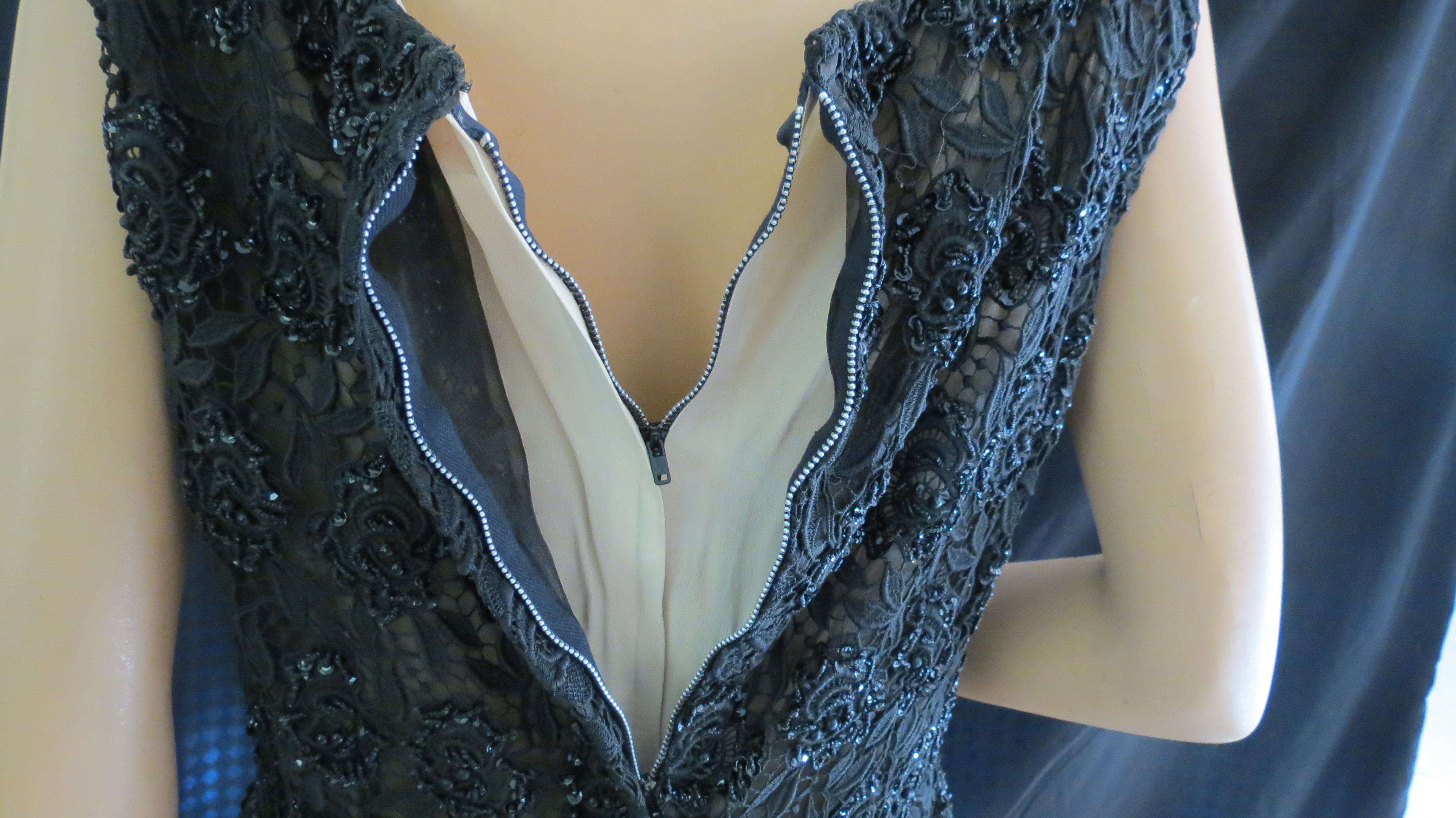
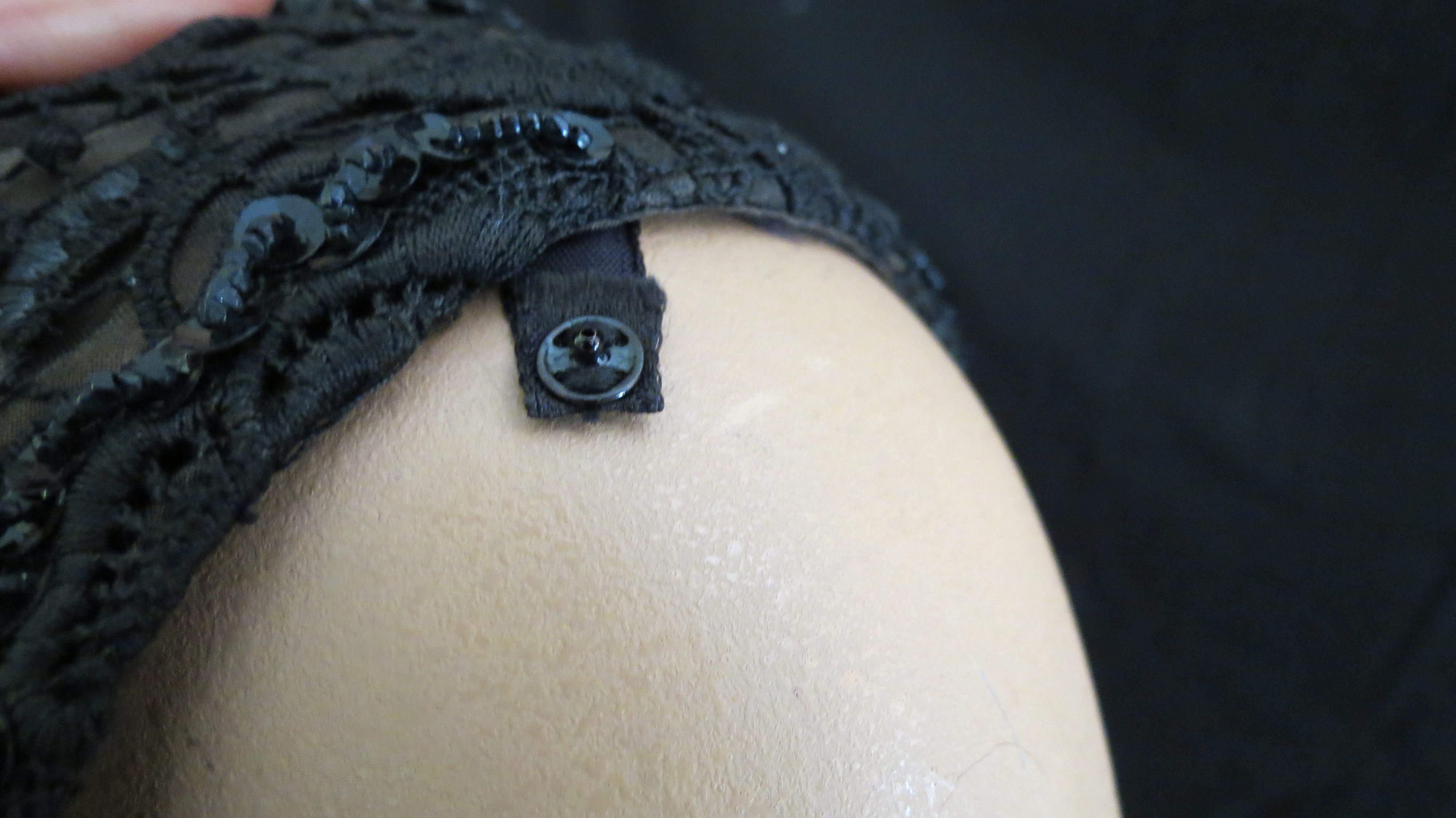
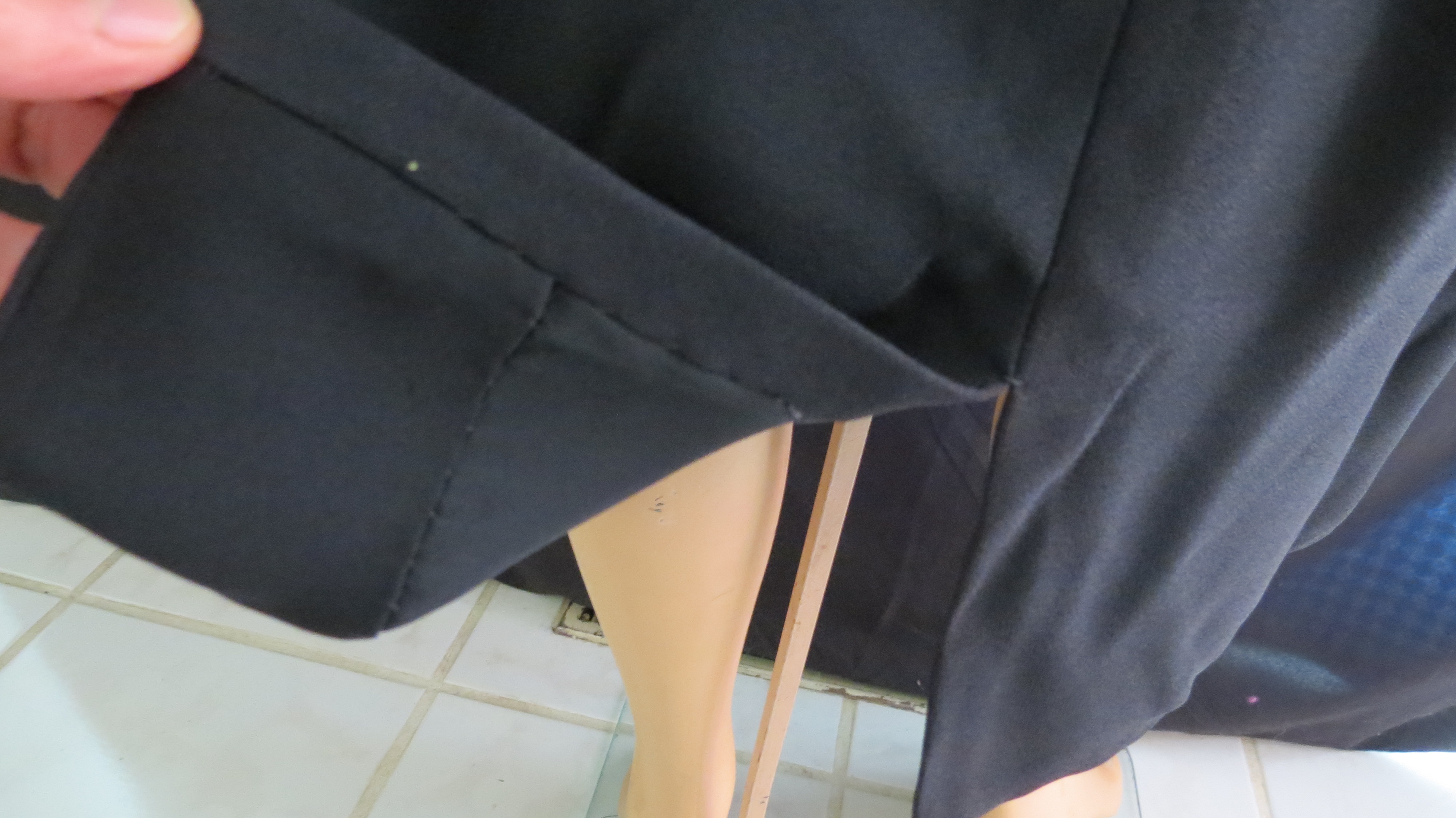
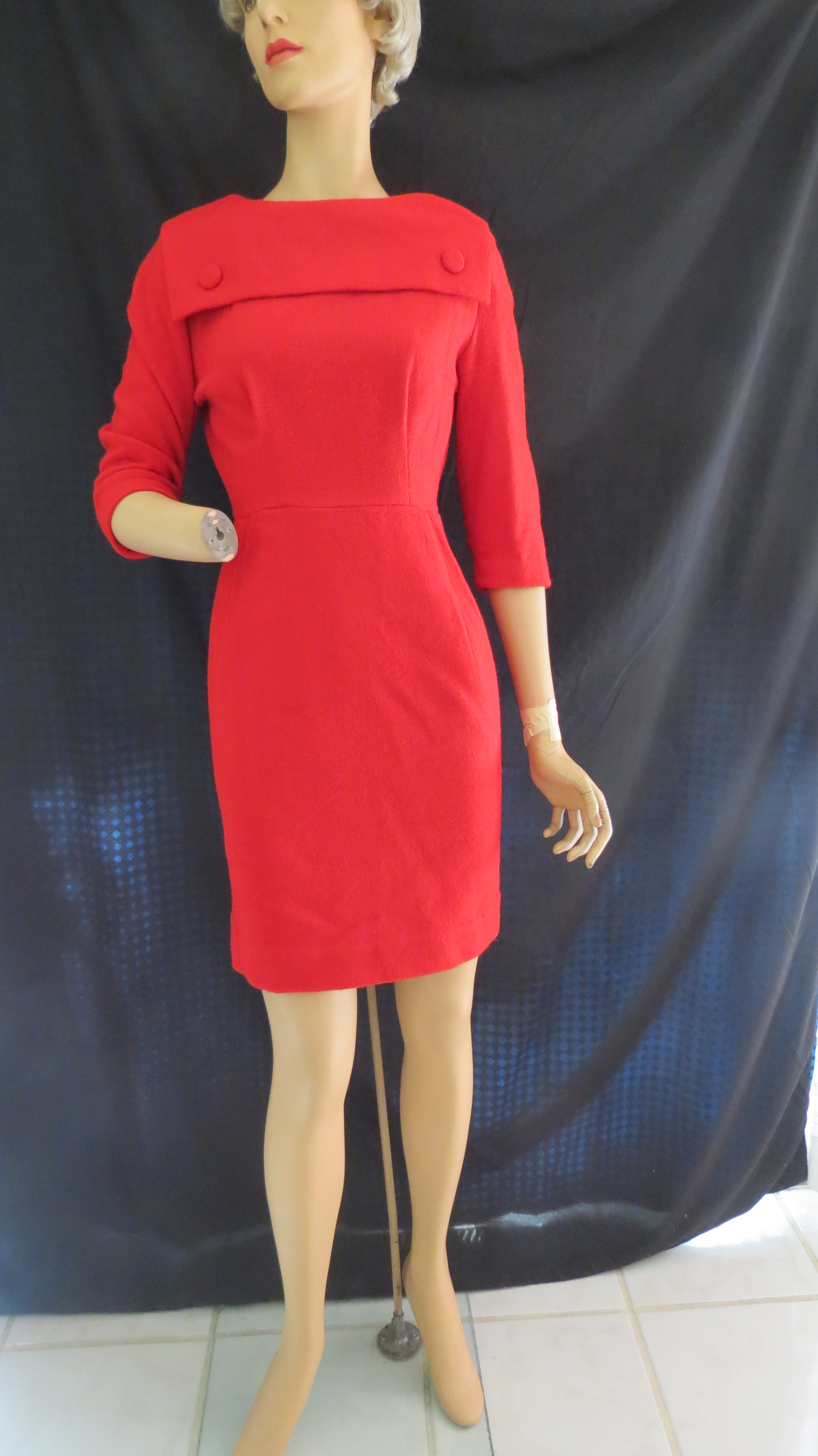
This dress is such a treat! I was so thrilled to uncover it. Look at the marvelous tailoring details and ingenious construction – A basic sheath style, with a heavily-decorated blouson top that appears to be separate, but is attached at the shoulders and fully-lined with a white silk under-blouse. Both layers close with a metal zipper. Hooks and eyes secure the neckline for good fit. The shoulders have strap-holders sewn in. The acetate skirt is also lined with black rayon and has a wide hem allowance plus a walking vent in the rear seam. Hand-finished all over.
In the ’50’s and 1960’s a woman of moderate means could save for the occasional purchase of clothing made this way and more prosperous women had closets full of nothing else. These were the standards of better-made garments during the mid-century. Now even very expensive clothing is sometimes constructed poorly and hardly ever as well as this dress is. The attention to detail and hand-done stitching made clothing fit better look more polished.
Tomorrow I’ll show you another frock from this decade. Stay tuned . . . . . . . . . . . . . . . . . . .
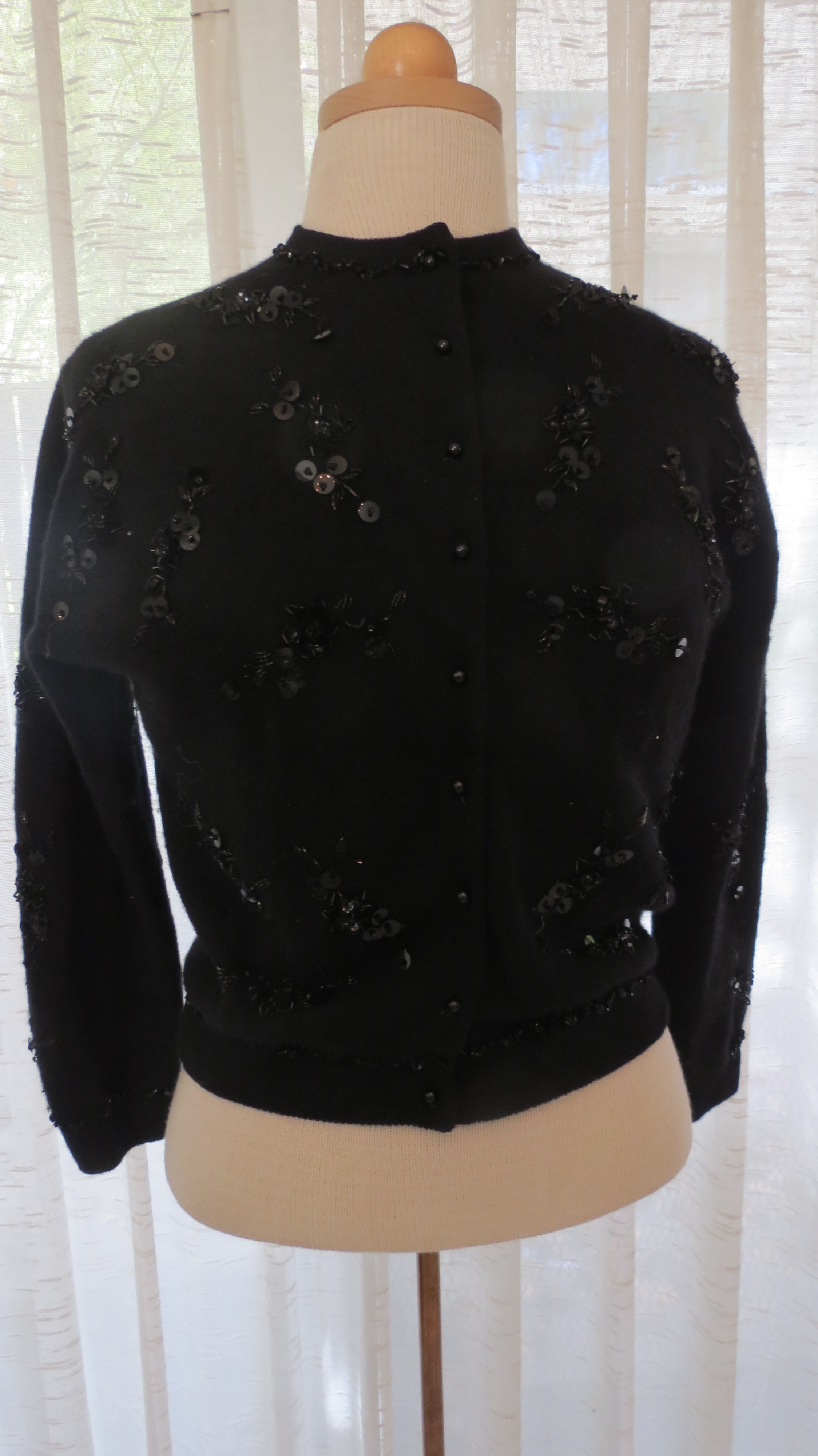
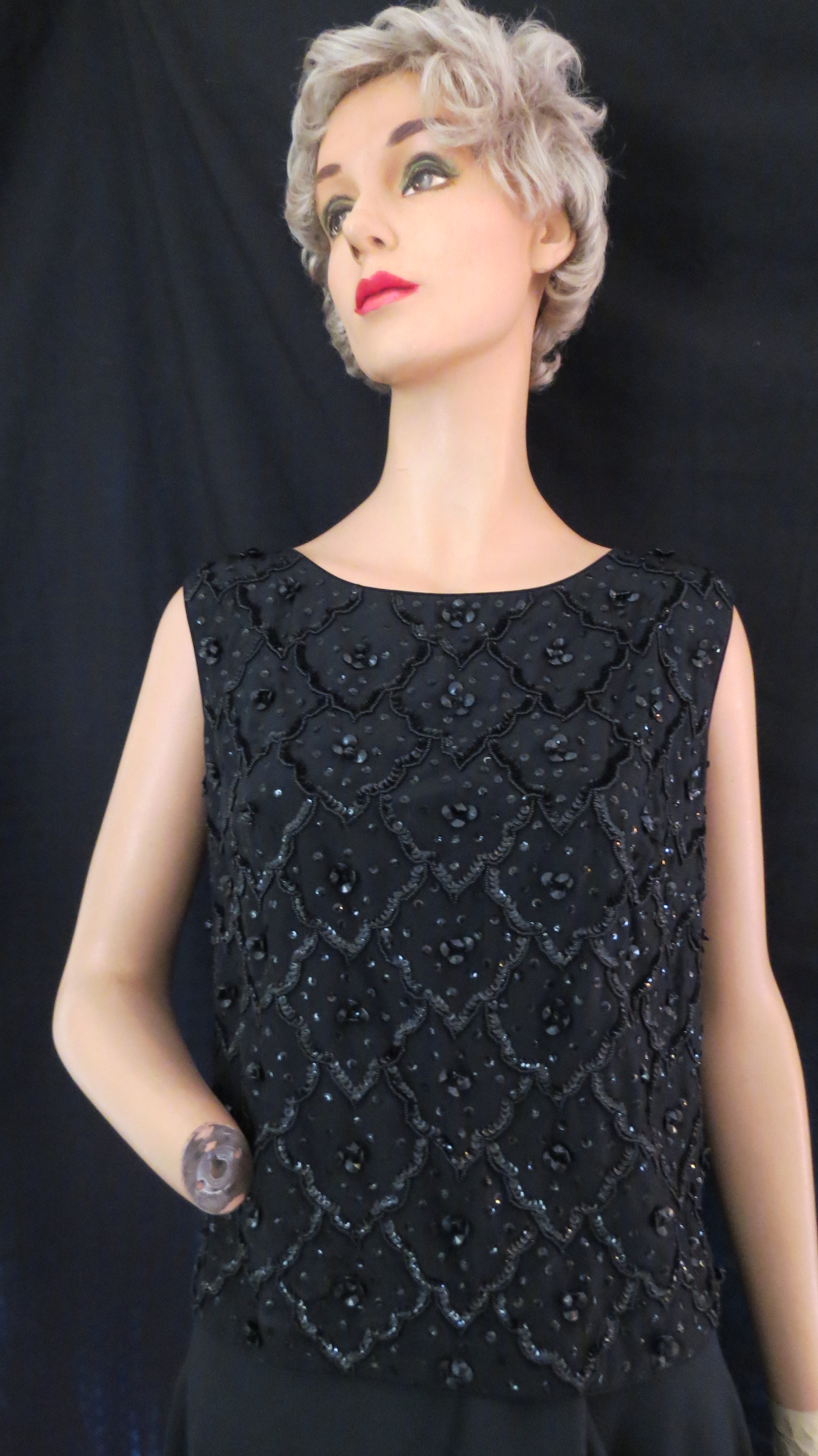
Here are two examples of the most iconic cocktail fashions of this era, which could be dressed down for a home-based cocktail party or dressed up with a well-styled skirt for a more formal type of party or event. The best were made in British Hong Kong – sweaters were made of fine lambswool or cashmere and shell blouses of rayon or silk. They would always be lined and have tiny sewn-in labels showing the bust measurement. Finer pieces had cloth labels from fine tailoring shops. These two are beautiful, but not the nicest I have discovered.
Although many tops similar to this were made in the ’80’s and ’90’s when retro “vintage” fashions became really hot, I never saw any as well-made as these are. There was a great variety of designs and types of beads; sequins, seed beads, jewels and, ribbon were all used. Like these, most were monochromatic but there were some with contrasting designs. Usually, the design was also on the back side and required some care when worn but that was not considered to be a hardship for women in the 1900’s.
Tomorrow I’ll start showing some dresses. This is a category of true vintage fashion that is a very big one! Stay tuned . . . . . . . . .
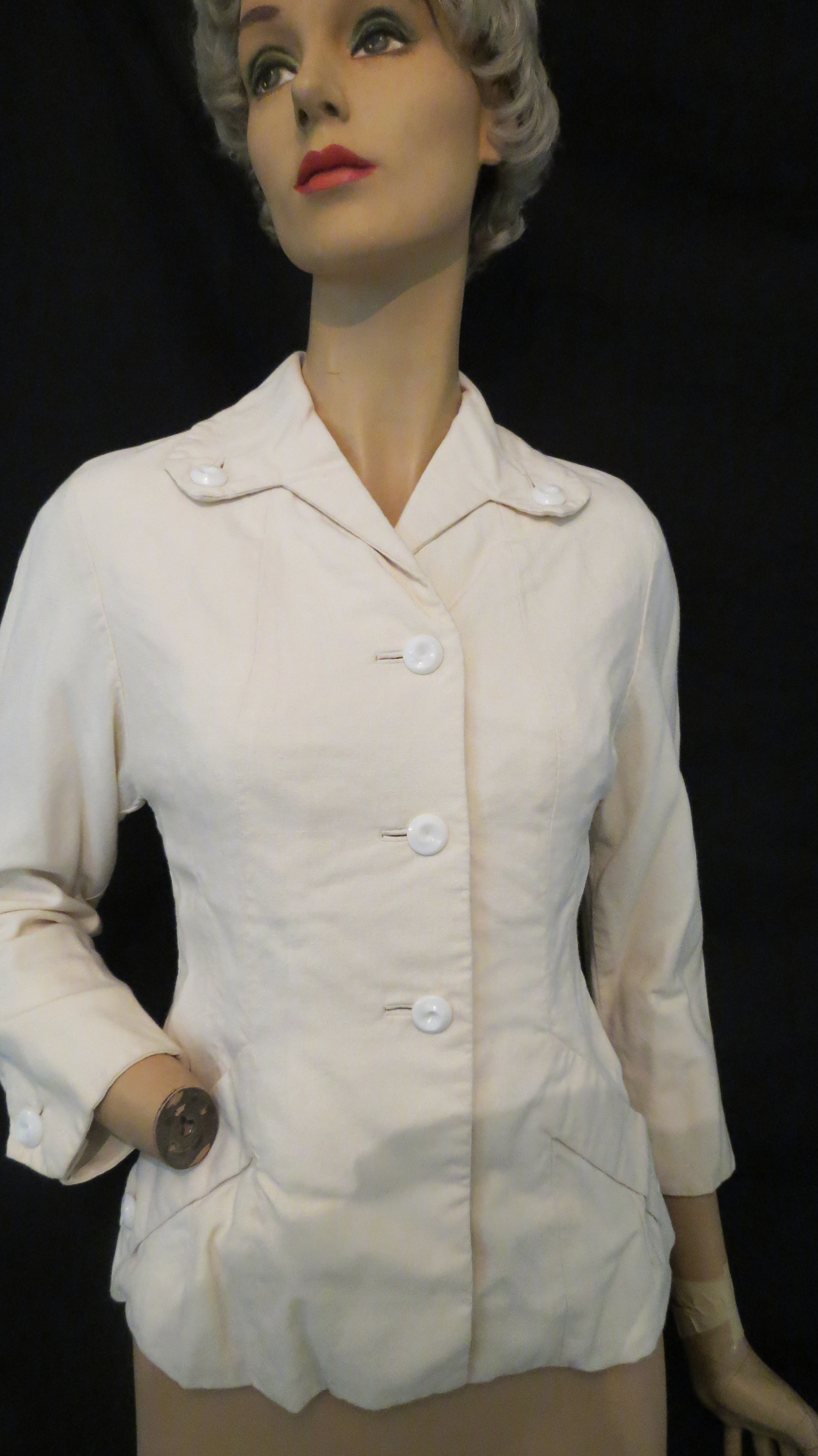
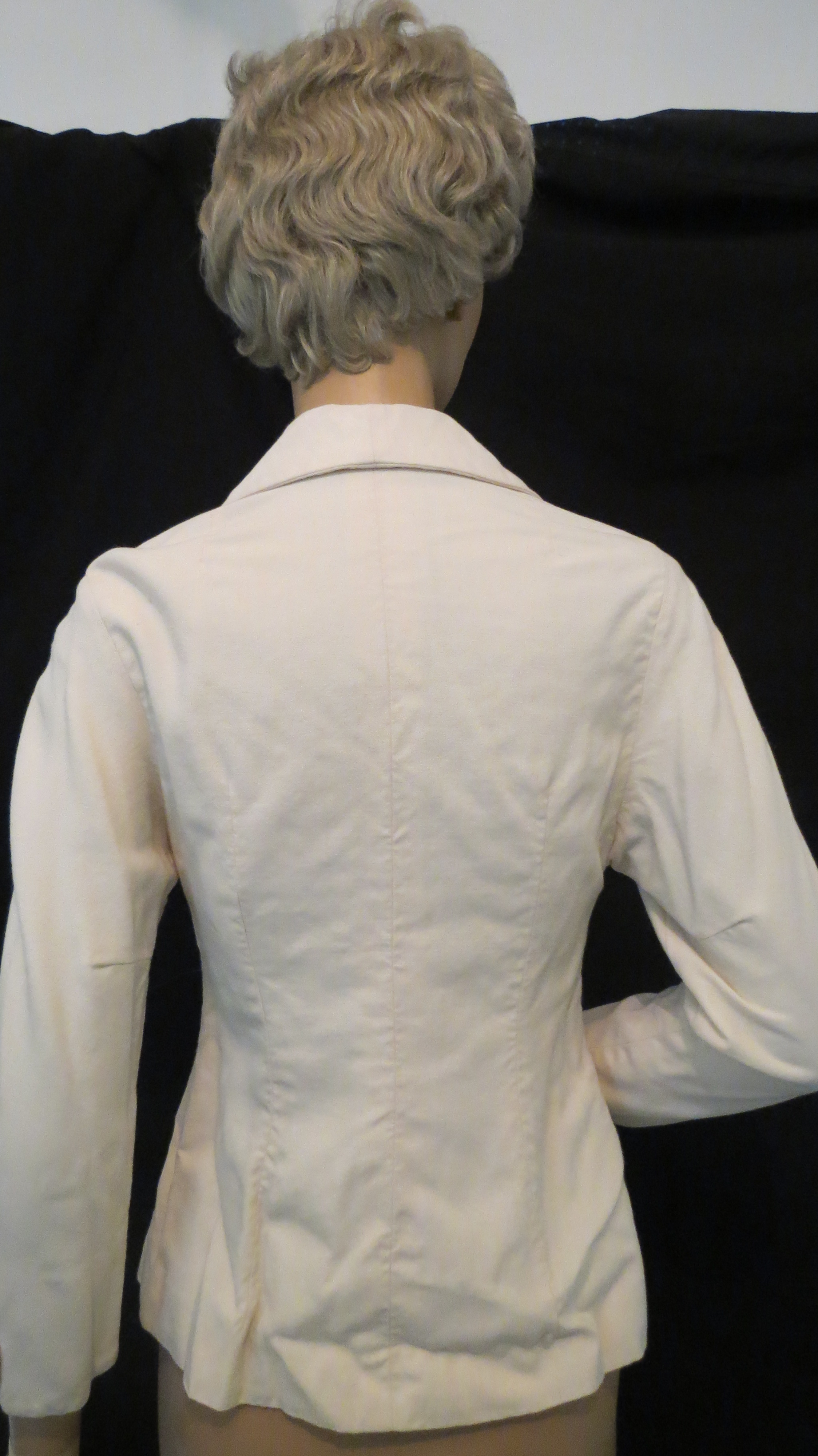
Yes, it’s still September and early for wool but this post-war 1940’s – early 1950’s jacket is perfect for the transition. It’s fairly lightweight and the winter white color can take it through 3 seasons. Almost a blazer, but the fit makes me wonder if it once had a matching skirt. Who knows. I was thrilled to discover it. This beauty can stand alone.
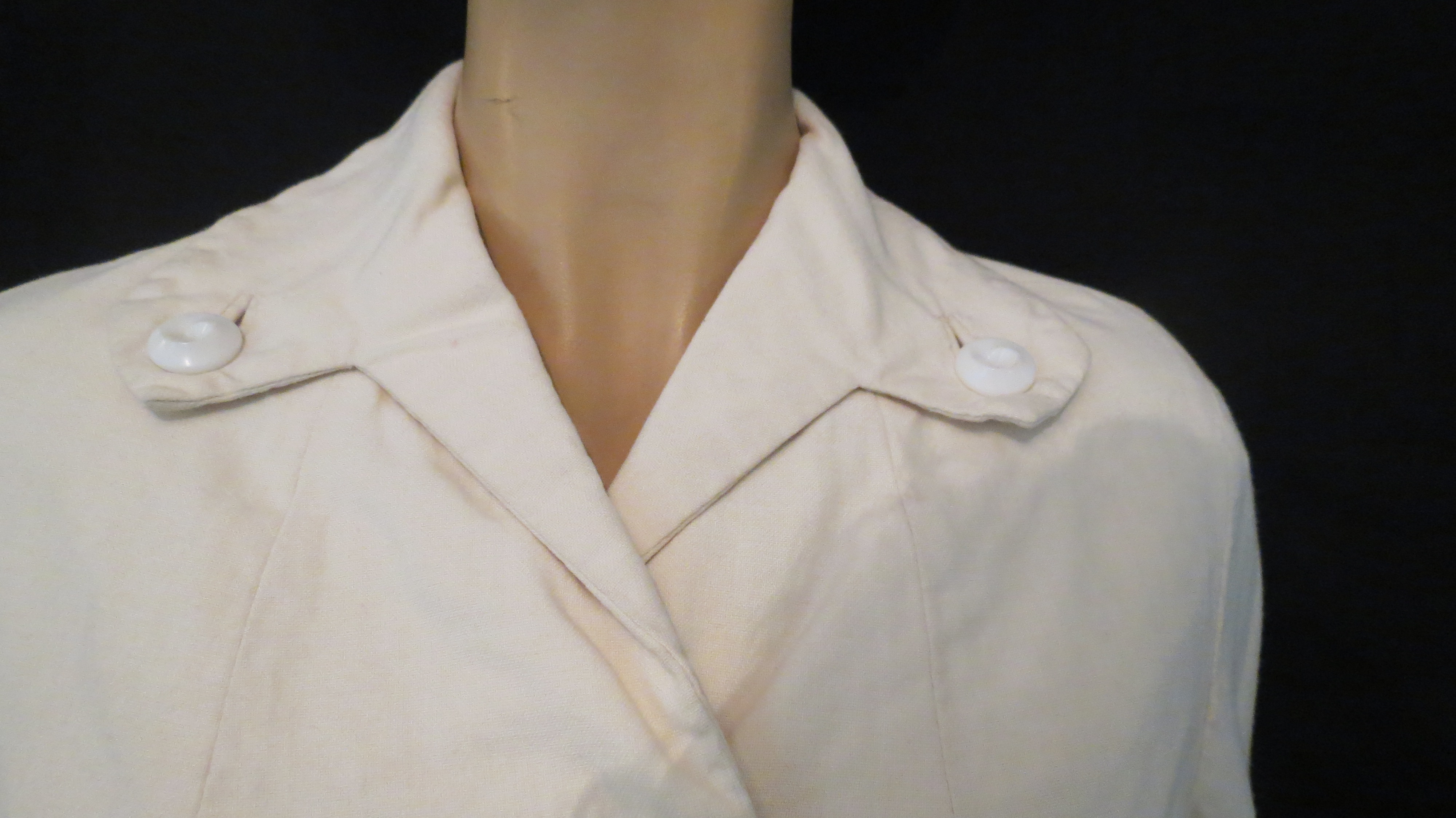
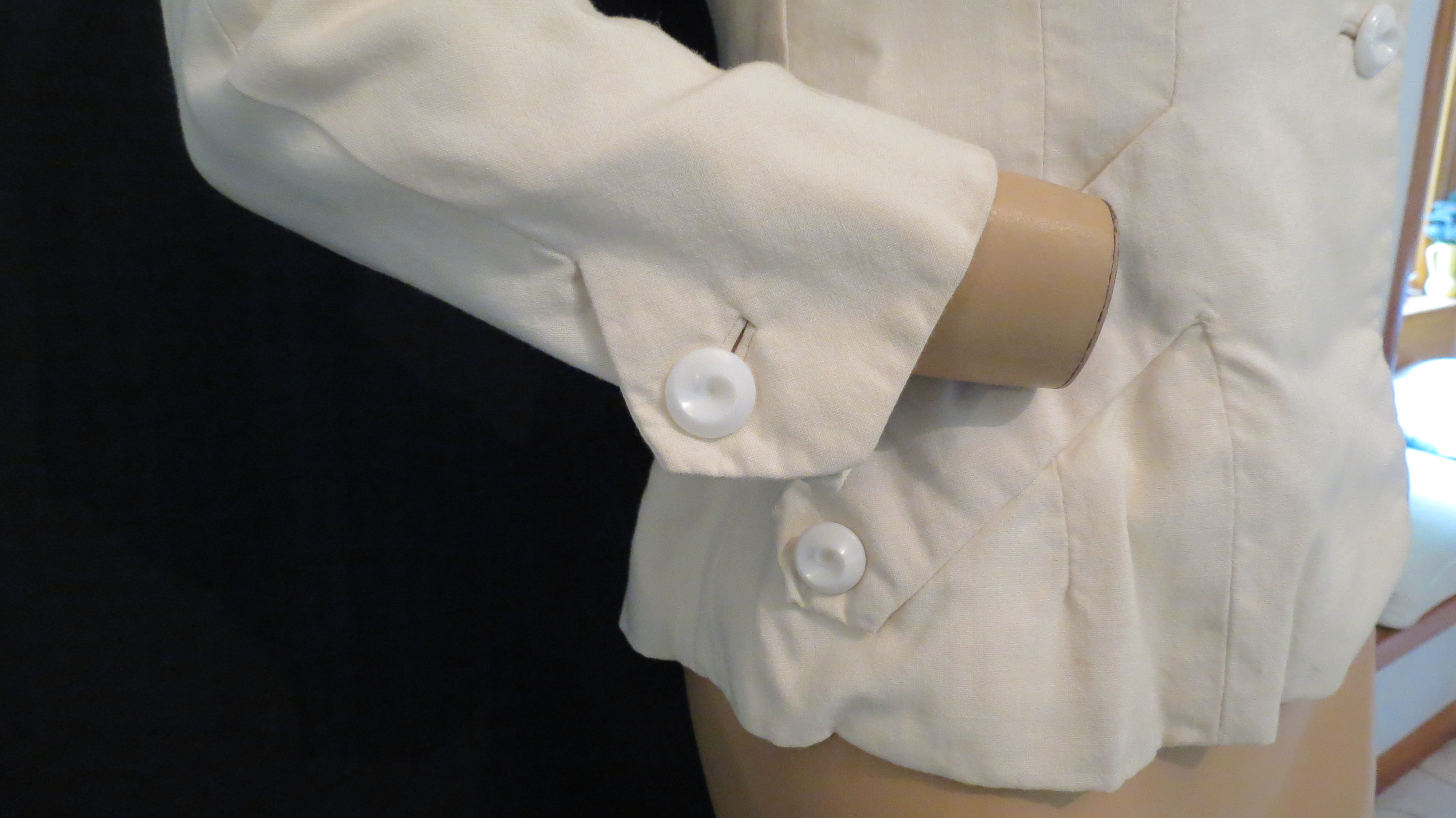
Look at the wonderful tailoring details. A sculpted collar, cuffs and tabs at the hips that are accented with arty buttons (which are all still present!). Full lining in matching rayon(?) fabric. It may even have been custom-made. You just can’t beat the fabulous construction of most garments made during this era. It’s a tiny size that will fit well over a light blouse or even a tank. Easy to dress up or to wear more casually.
My best guess for what the weather is going to be like tomorrow, let alone next week, is up in the air (pun intended). I’ll keep on unpacking what I need, so stay tuned . . . . . . . . . . . . . . . . . . . . . . . . . . . . . . . . .
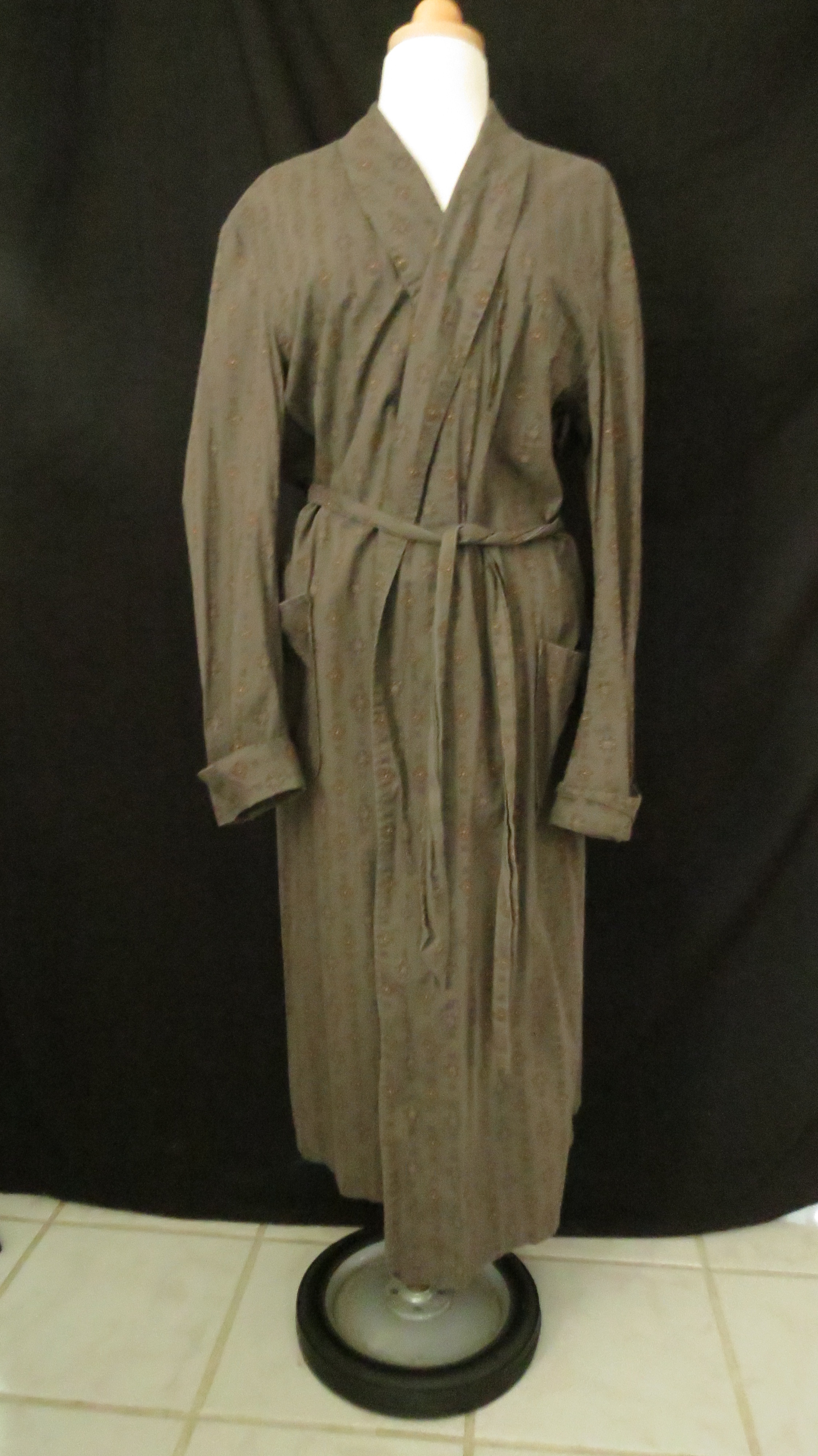
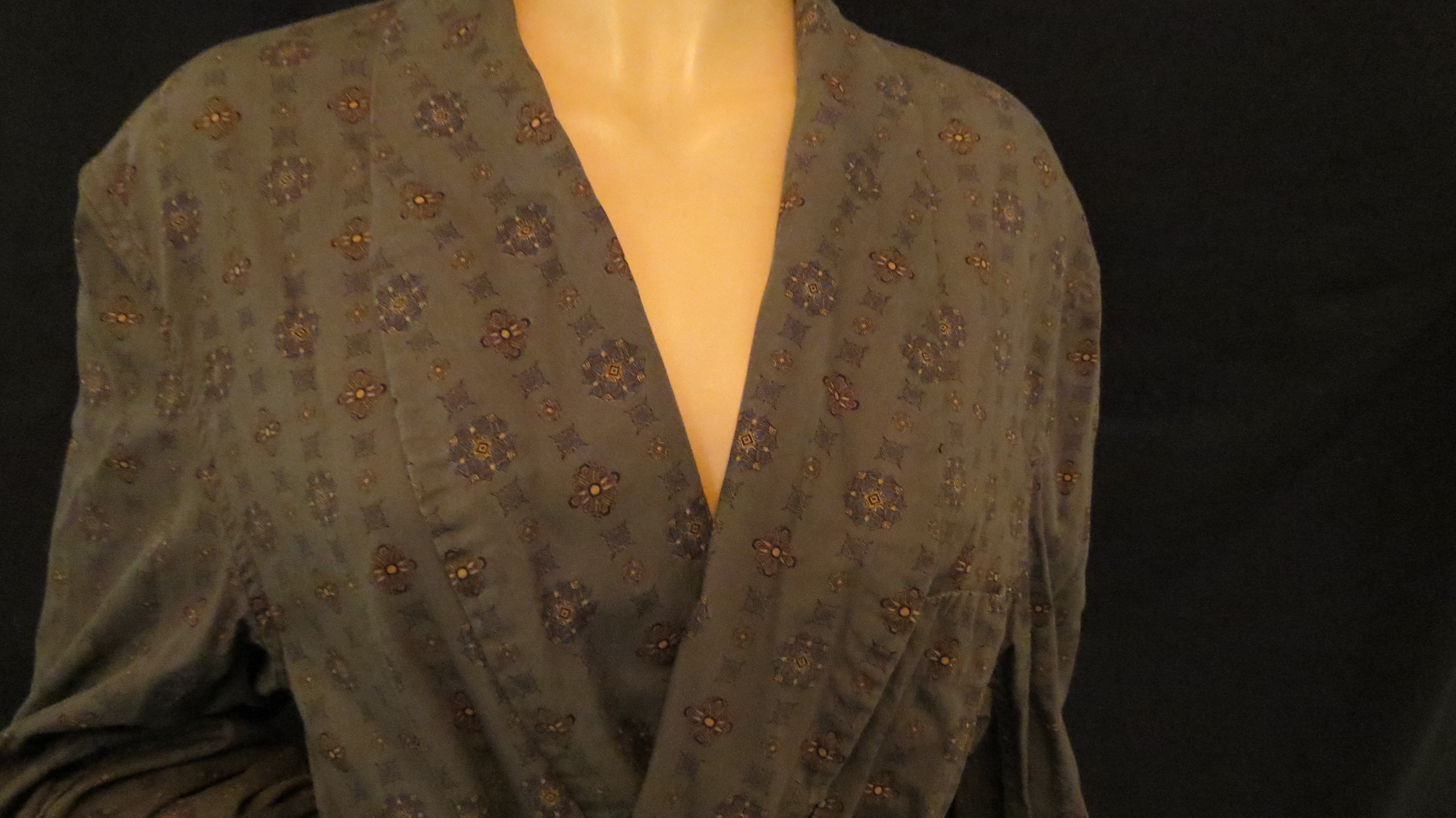
Not fluffy and plush, but a bit warmer with the l-o-n-g sleeves and mid-calf (on me) length. The heavy cotton fabric is good for this in-between weather and I LOVE, LOVE, LOVE the gorgeous medallion prints on true vintage men’s robes and PJs. Also, the cuffed sleeves and big patch pockets. Very useful. I have an even older one with elegant black satin cuffs and collar – very “le smoking”.
So, I’ll be showing more of my warmer true vintage garments as the weather continues to cool and you just never know what else might show up . . . . . . . . . . . . . . . Stay tuned.
I love my cotton skirt and vest set from the late 1970’s. The style had a real moment then and this one is by Mr. Leonard, which was a leading manufacturer of women’s clothing from 1965 until it’s closing in 1999. Cool and casual makes it perfect for September while we’re still having warm days but are in the mood for Autumn colors. It’s pretty easy to dress up or down for daytime, too. Looks just as great with a classic blouse or a t-shirt.
The nicest thing is the quality. Nice fabric, well-constructed. The vest is fully lined with a dark green fabric that keeps it’s shape and minimizes wear. Despite it’s age, it looks almost new. That’s probably my favorite thing about true vintage clothing and accessories, second only to the fabulous style and elegance.
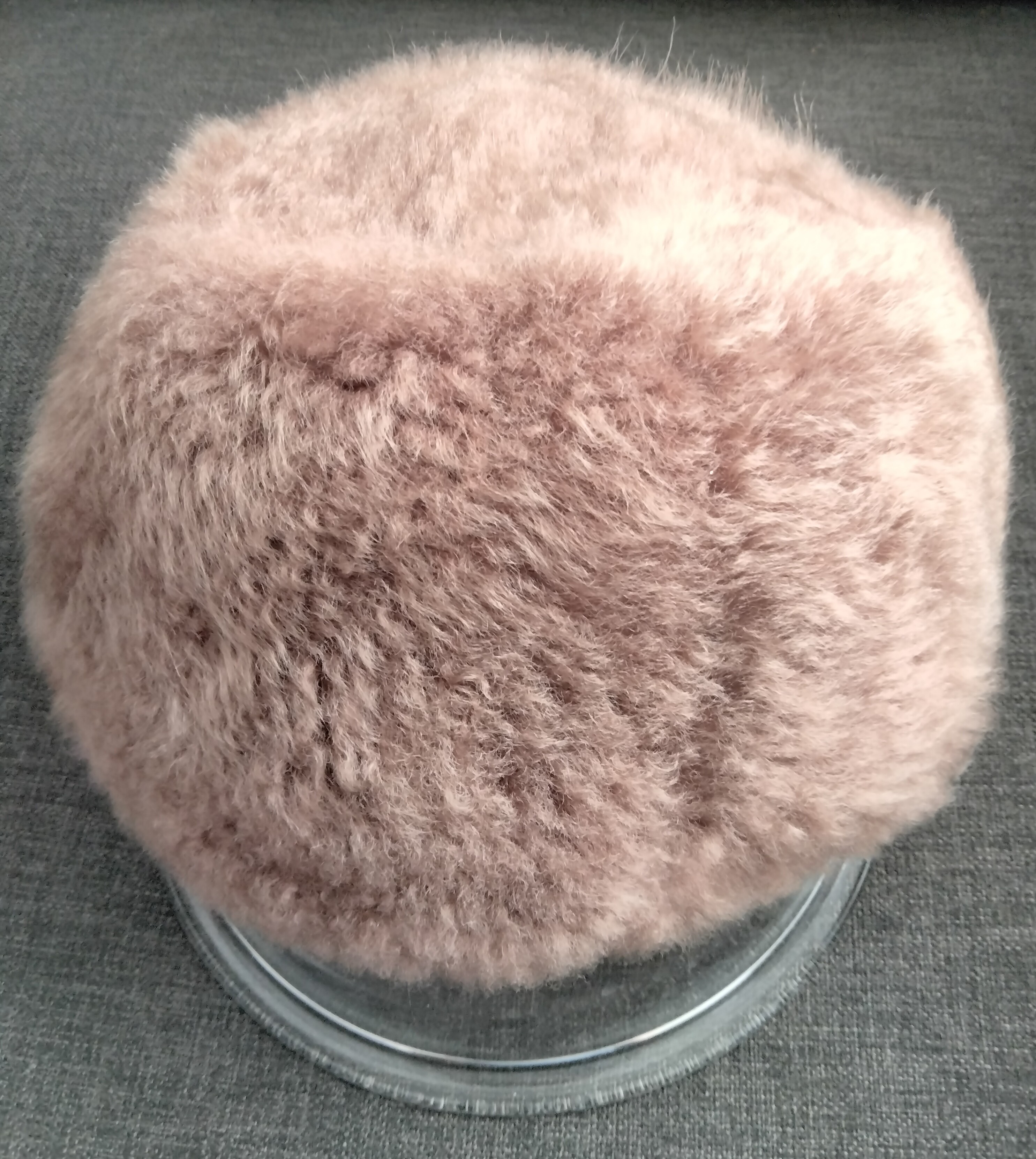
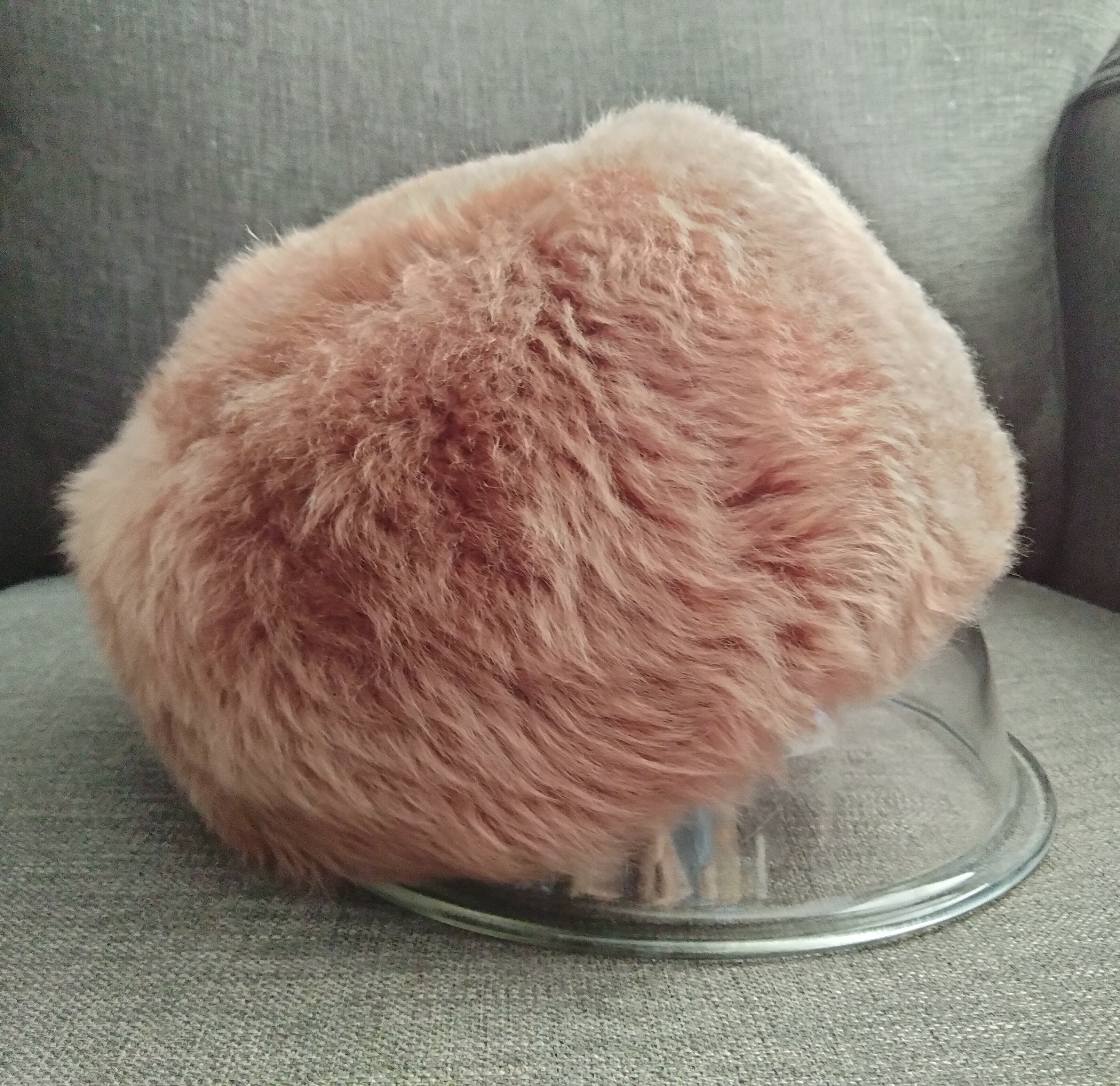
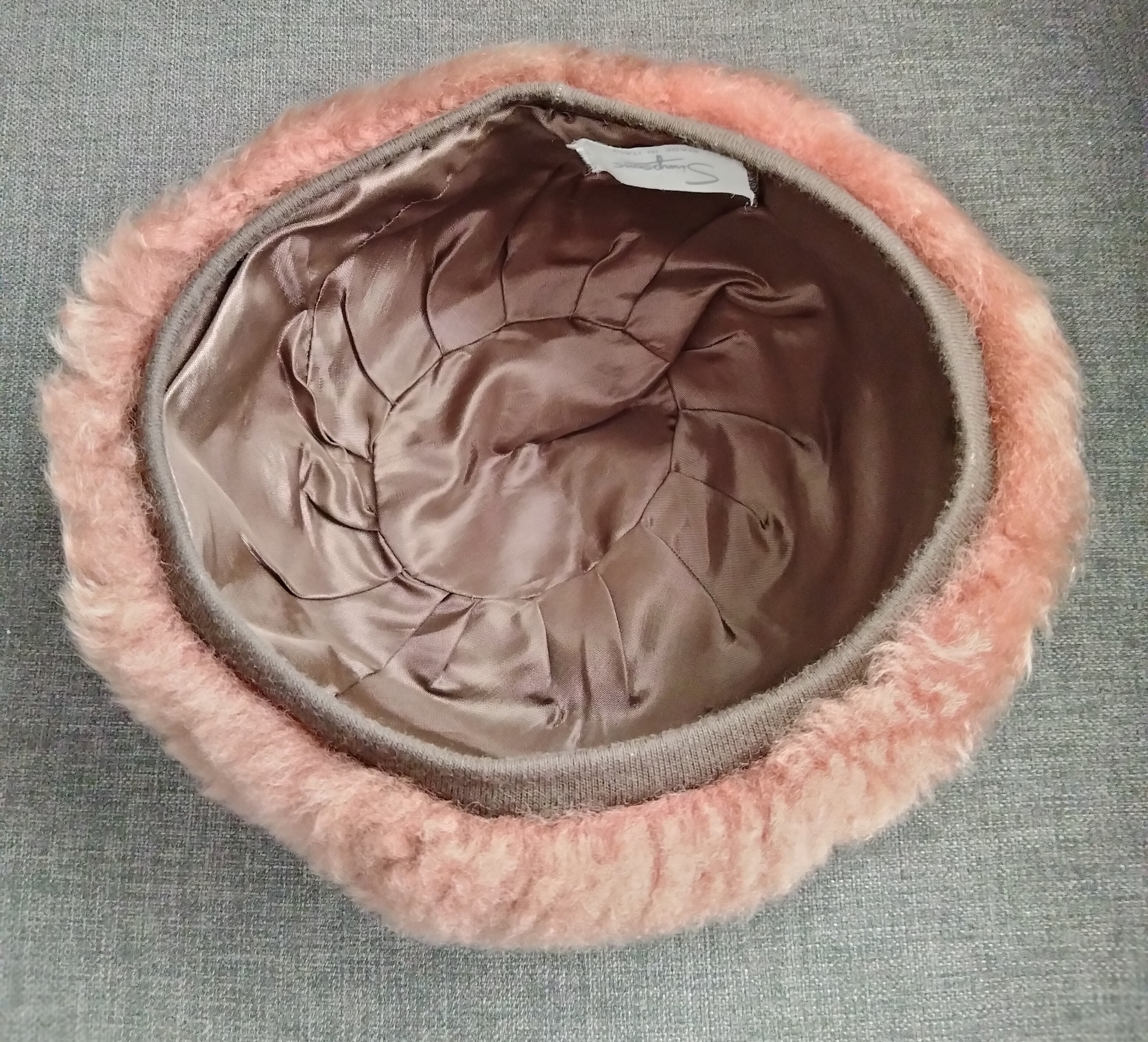
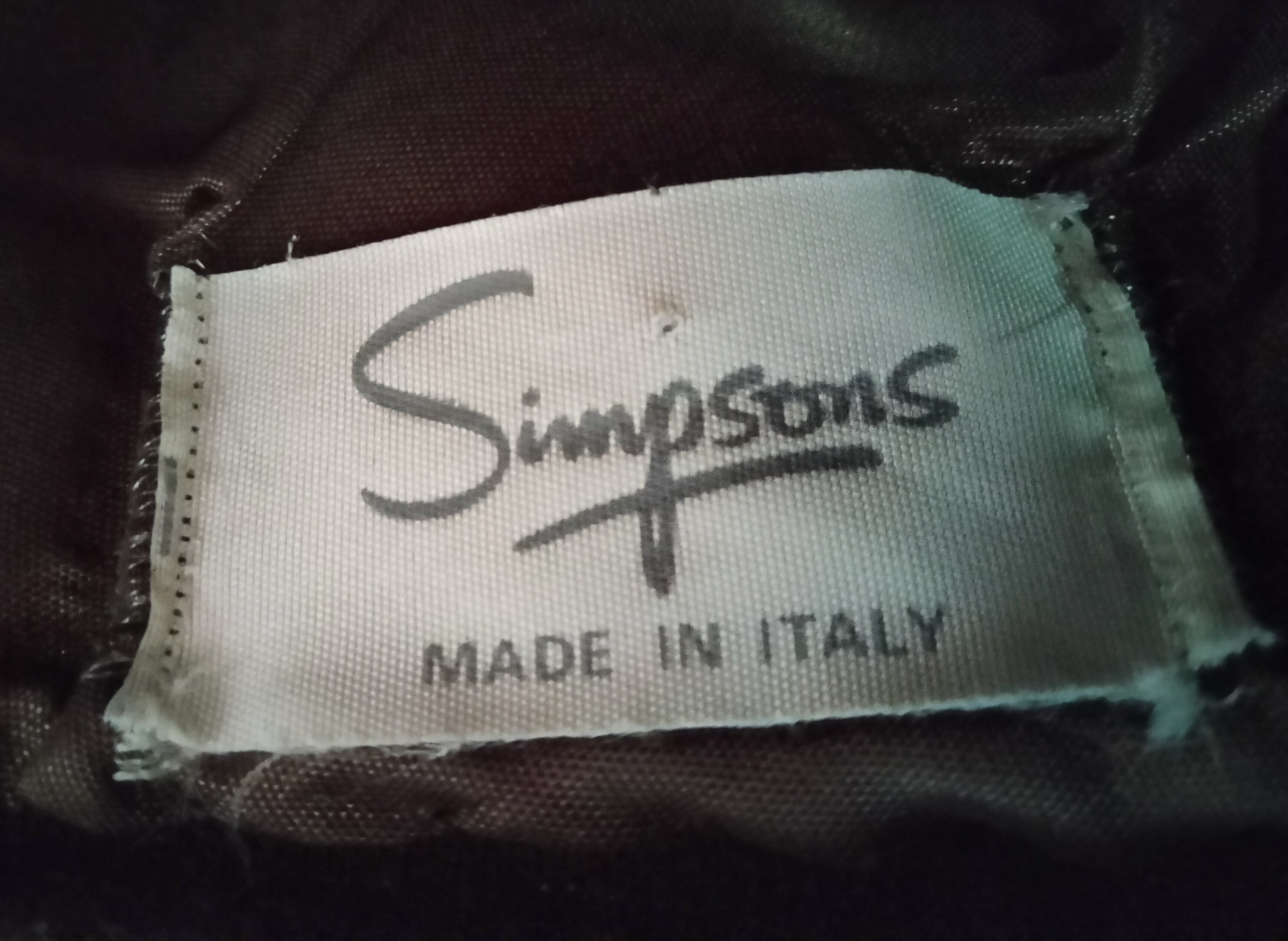
About the last thing I expected to encounter! There I was, looking for some chains for crystal pendants I’ve been buying and a dangle for the end of my 1960’s chain belt (which I found, by the way) and what was propped on a nearby hat-stand?; a quasi-luxe faux beaver fur hat, made in Italy for the iconic Simpson’s department store chain of Canada, which finally phased out in 1991!! More about that a bit later. First, the hat . . . . . . . . . . . . . . .. . . . . . . . . . . . . . .
Boy, do I miss my models who are having time free at Headquarters. They would do a much better job of showing this off, but you can get the essentials from these photos. Looking almost like new, with just a little storage crush. This baby is at least 35 years old and could be more like 60. The rayon-like liner is pristine, with the original label. Classic Russian toque style with a slim fabric hatband for best fit. It’s very flattering and super-practical – will fill an empty niche in my hat collection perfectly!
And, what a pedigree! Made in Italy, to their high standards of that time (some makers still seem to have them). Simpsons Department stores were historic vendors, started in 1872!!! They were in stiff competition with the Eaton’s chain and evidently tried to upscale their merchandise for a winning position. All the Eatons stores finally closed in 1999, so these two were head to head for well over 100 years. The first Simpsons store was in Toronto, Ontario, and could be compared to the iconic Marshall Field of Chicago in terms of the elegance of the store itself and its merchandise. Like Field’s, they also did the elaborate Christmas windows that families would travel far just to see. 80 years later, they teamed up with Sears, Roebuck & Co., becoming Simpson Sears. Like Sears in the U.S., they also offered a catalog service. In another 24 years, the Simpsons element was purchased by the Hudson’s Bay Company and the store name became The Bay in 1991. In the Northeast U.S. and Canada, all three of these names were very well-known and depended upon for high quality and fashionable merchandise. In the States, we could compare Eaton’s, Simpsons and The Bay to Marshall Field’s, Bloomingdales and Saks Fifth Avenue, to name a few. You can see why I’m so thrilled with this true vintage find!
So, as I always say: You just never know . . . . . . . . . . . . . . . . . . Stay tuned. I am . . . . . . . . . . . . . . . . . . . . . .
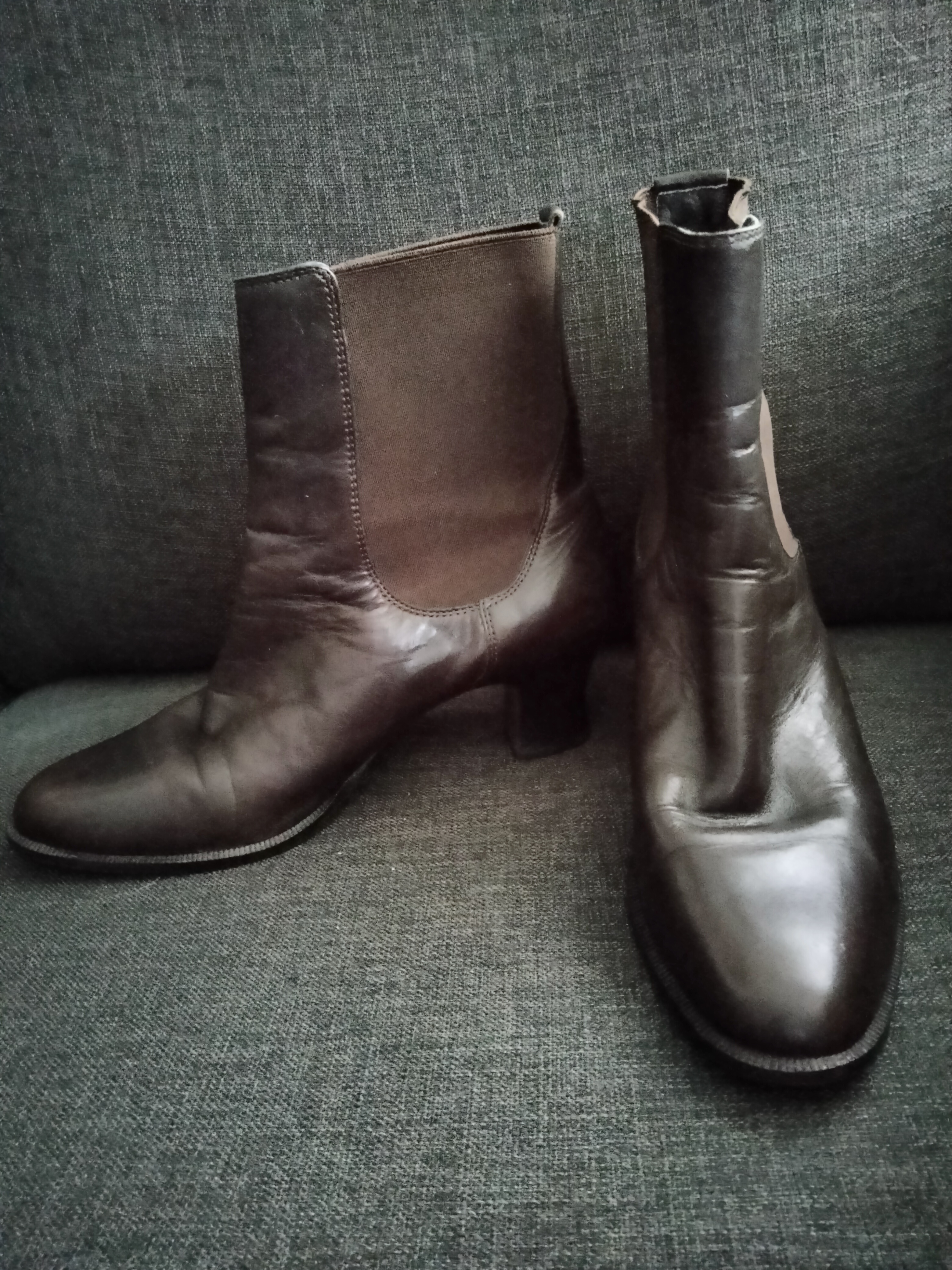
Love, love, love!!!!! Most likely from the 1980’s – maybe the 1990’s. Always one of my favorite finds (they fit!!!!!), and definitely keepers that will serve me well forever. These boots were made in Brazil of lovely, soft leather. The clues abound regarding their excellent pedigree:
1. The craftsmanship is exquisite: even, strong stitching with high quality elastic gussets that have held their shape and stretch. Notice the nice little tab at the back which looks good but also provides a gripping place to pull the boots on comfortably, without stretching that would pull them out of shape.
2. The soles and heels look very much like leather, which is always a plus because it can be repaired by a skilled shoemaker or shoe-repair technician, but instead are made of the wonderful Vibram-type material which came later in the mid-century and is virtually indestructible. The finish eventually wears off the soles but they don’t wear down as quickly as leather. Repair and replacement are hardly ever needed.
3, The heels are so well-crafted that they have the look of stacked leather, though they probably are not(?)
4. The Granny-style of the heels was fashionable at the time these were made but the overall design is perfectly classic and elegant. Despite the heel style these boots are wearable with most clothing types without looking dated and will continue to be in the future.
This investigation proved not only the age, origin and construction details of these boots, but also strong clues as to what class of person owned and wore them as well as the type of vendor which sold them originally. Although modern technology would allow a greater depth of detailed knowledge to be ascertained in a laboratory, I will leave those tasks to the forensic teams. For my purposes, the investigation is perfect and ends here, in my closet.
_ _ _ _ _ _ _
As I’ve said before, I don’t support the markets for any type of animal skins (including fur) by buying newly-made products that involve the raising, hunting and slaughter of the animals who provide them. I also avoid products made from wool, down and other feathers and silk, which also involve animal cruelty. Collecting beautiful true vintage artifacts easily satisfies my curiosity and fulfills my needs.
As the marketplace continues to offer more alternatives, my diet and toiletries are always vegetarian and vegan whenever possible. Excellent alternatives to most products are available and the prices are constantly coming down. Now that cruelty-free hard goods (not food or other things that will spoil) have been in the marketplace for a few years, it’s increasingly possible to find them in places where previously used items are sold or traded. True vintage items may not have been made with an ethical mentality, but they don’t contribute to cruelty and abuse in the present. Secondhand purchases don’t give money to current unethical manufacturing processes or the people who sell them either, as long as you are not buying from the original producer or vendor. And, the older things are, the better the quality in most cases. What could be better?
This is just the beginning of my posts of recent discoveries. More are coming. Stay tuned . . . . . . . . . . . . . . . . . . . . . .. . . . . . . . .
Another chance to love that red. Okay, I give in. I don’t pull out the wool clothing unless it’s necessary and can usually avoid the deep cold because of frequent relocations. But, a little unpacking reminds me how much I love these wiggle dresses from the late 1950’s – early 1960’s. For the jumper on the left (yes, this is what a sleeveless dress worn over a blouse or sweater is called in the United States) I was fortunate to find a turtleneck in the perfect color to coordinate with the tweedy fabric. I love the HUGE pearl buttons down the front – so much a sign of those times, as compared to the thin, easily broken pearl buttons which were popular in the ’90’s.
The wiggle fit is also characteristic of this era; maybe a little warmer, too. Of course, unless there’s a smooth lining, you’d also need a slip underneath which adds another layer of warmth. Attractive tailoring details are always a plus. Although vintage wool garments sometimes feel a little heavy and confining compared to what we’re used to today, the closest similarity I’ve ever come across are the better quality heavy polyester knit dresses and pantsuits of the early 1970’s. Both added warmth, good tailoring and wrinkle-resistance and are welcome when facing true winter weather. Easy storage that doesn’t require protection from moths is great, too, but in the final analysis nothing beats the quality, durability and elegance of well-made true vintage woolens. I thank our furry friends (and the shellfish which create pearl), and am grateful that we now are developing excellent humane and ethical alternatives.
More Xmas red and seasonal true vintage on the way. Stay tuned . . . . . . . . . . . . . . . . . .. . . . . . .
Last night I was out and about to a theater production and couldn’t reasonably drive a two block distance. Walking was the only choice, which I love, but IT WAS SO COLD!!! My warmest outerwear option, which kept me toasty and comfy, was my post-war beaver jacket from Canada. 75 years old and it’s still snuggly and beautiful. I grieve for the precious animals who (yes, WHO) were sacrificed for vanity and retail profit back in the day and will NEVER buy modern fur products. I advocate for animal rights but also celebrate those lives and gifts by preserving and enjoying elegant fashions from the past for as long as they will last.
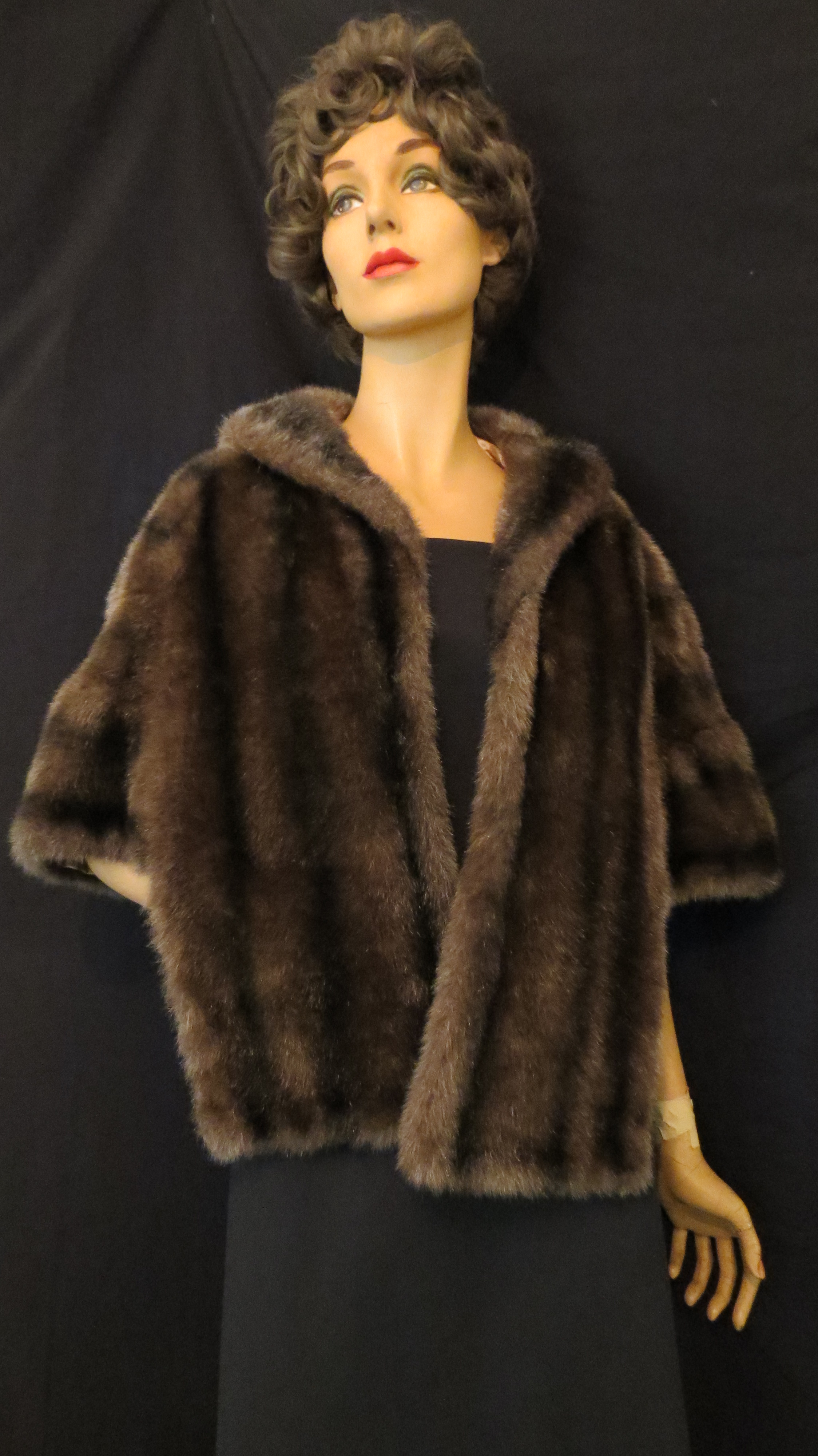
I own many gorgeous fur and faux fur pieces made decades ago, before protective legislation and individual conscience stopped some of the fur trade and promoted humane practices. Above is one example, on the left, of an older fur jacket dyed to mimic mink. I cannot identify the fur – could be muskrat. Before the end of WWII, furs considered to be less fine were often processed this way. Other examples, such as the one on the right, are fakes – popular in the 1950’s and beyond. Some have been very convincing even since the 1950’s. Many of those made today look and even feel very authentic. The look is fun and elegant, in a vintage way, plus, as I proved last night, very practical.
Faux fur and secondhand true vintage furs are the best, the ONLY humane and progressive choice. I prefer those from the 1960’s and before. The remaining fur trade is still a blot on humanity, so we must be vigilant in our boycotting of this active market but I don’t see the enjoyment of historical fashions as being hypocritical. I will continue to show you how much I love them. Stay tuned . . . . . . . . . . . . . . . . . . . . . . . . . . . . . . . . . .
Not your typical “twin-set” – I found this pair of ’50’s cuties together – they probably belonged to the same woman. They’re identical excepting for the color. Very becoming to both Madge and Stella, don’t you think? If you zoom in, you can see the decorative studs on the front of each one.
Of the softest angora blend – rollover neckline, 3/4 sleeves and decorated with button accents on the front – these look great with black cigarette pants or a coordinating skirt. Perfect for a casual Fifties or early Sixties cocktail hour. Belly up to the Tiki bar!
True vintage sweaters in perfect condition are always a rare find! Just another day in the life of the magicvintagespy . . . . . .