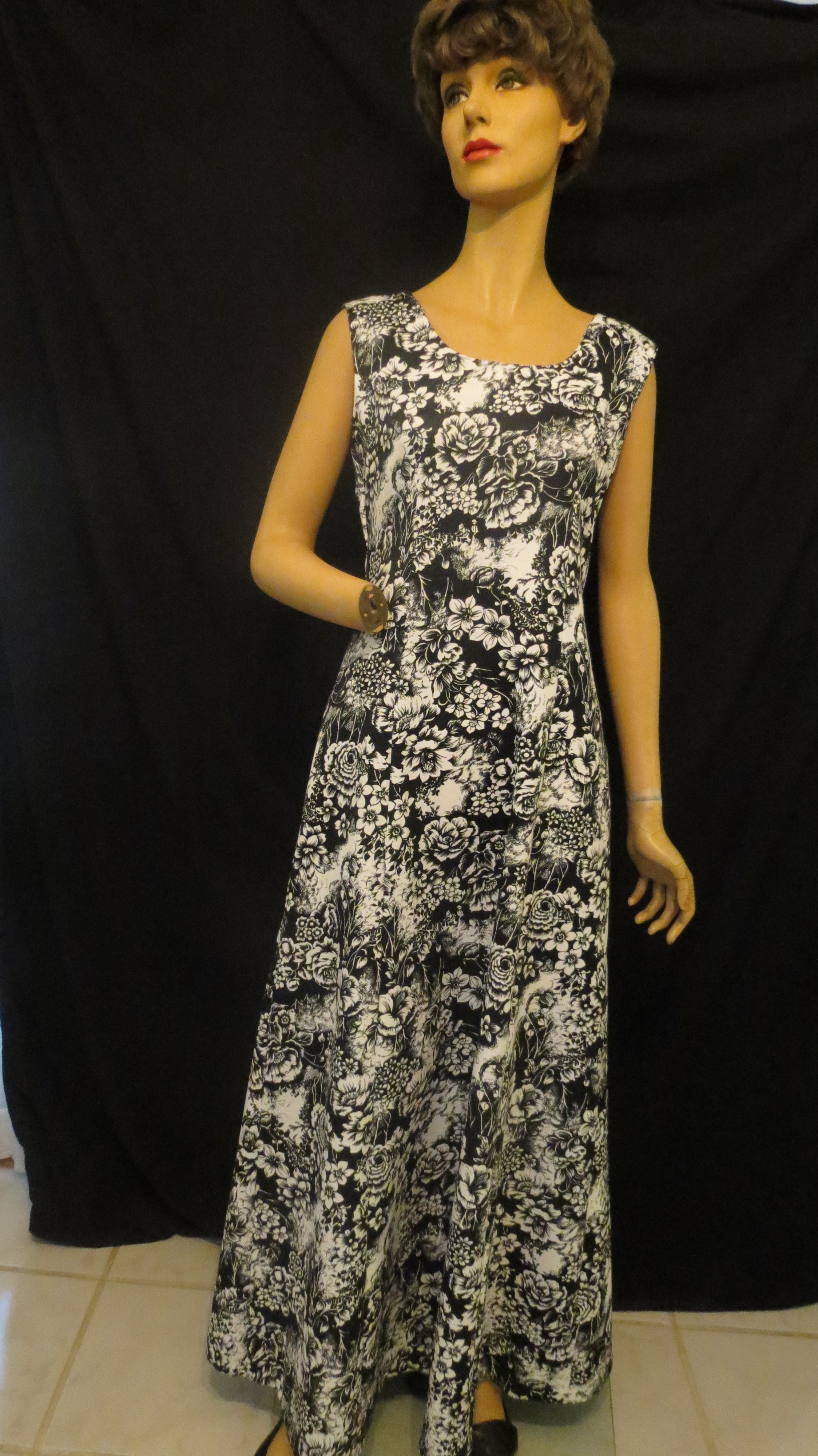
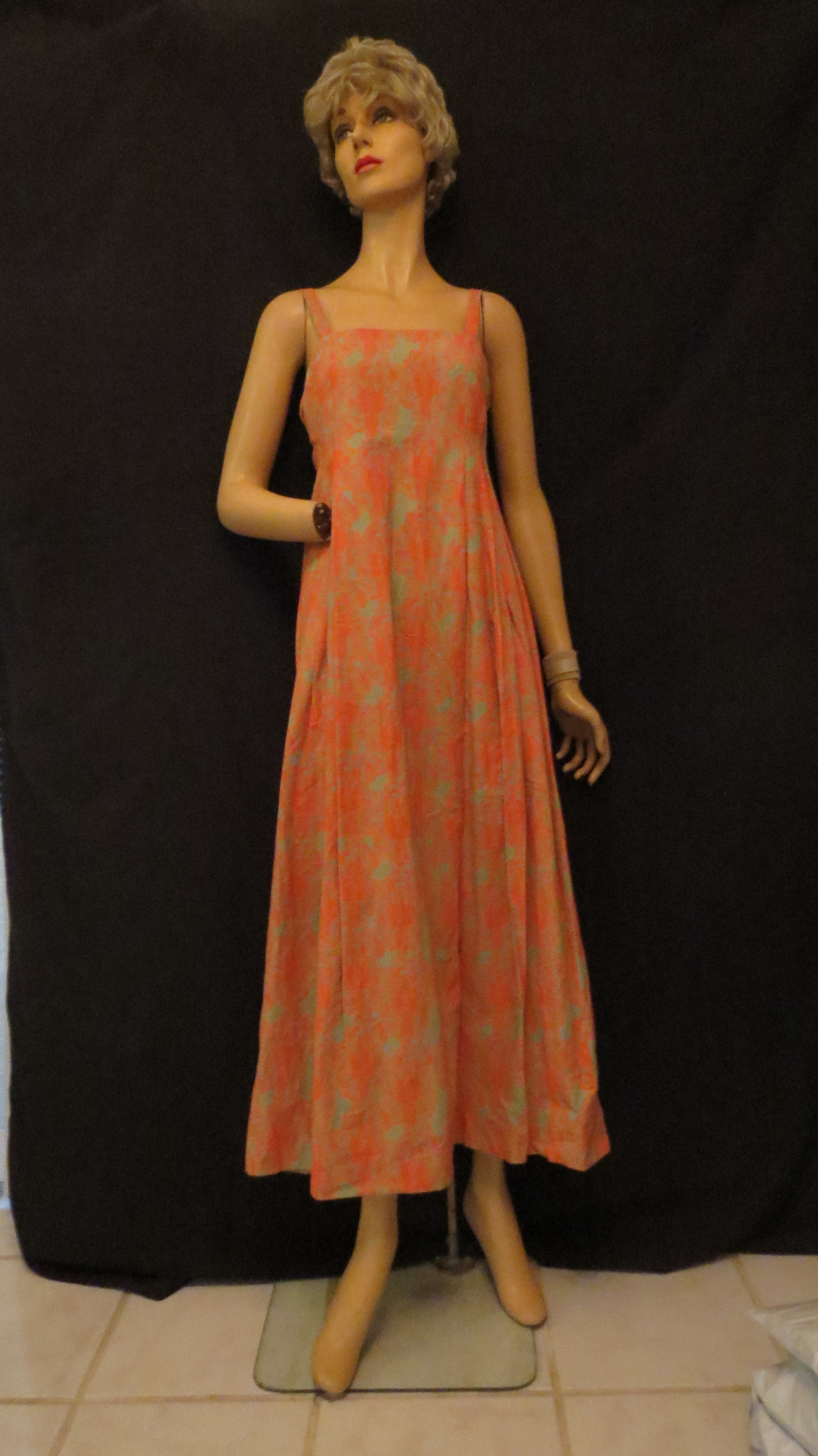
TRUE VINTAGE PATIO LEISURE LONG DRESSES FROM THE 1970’S – 1990’S

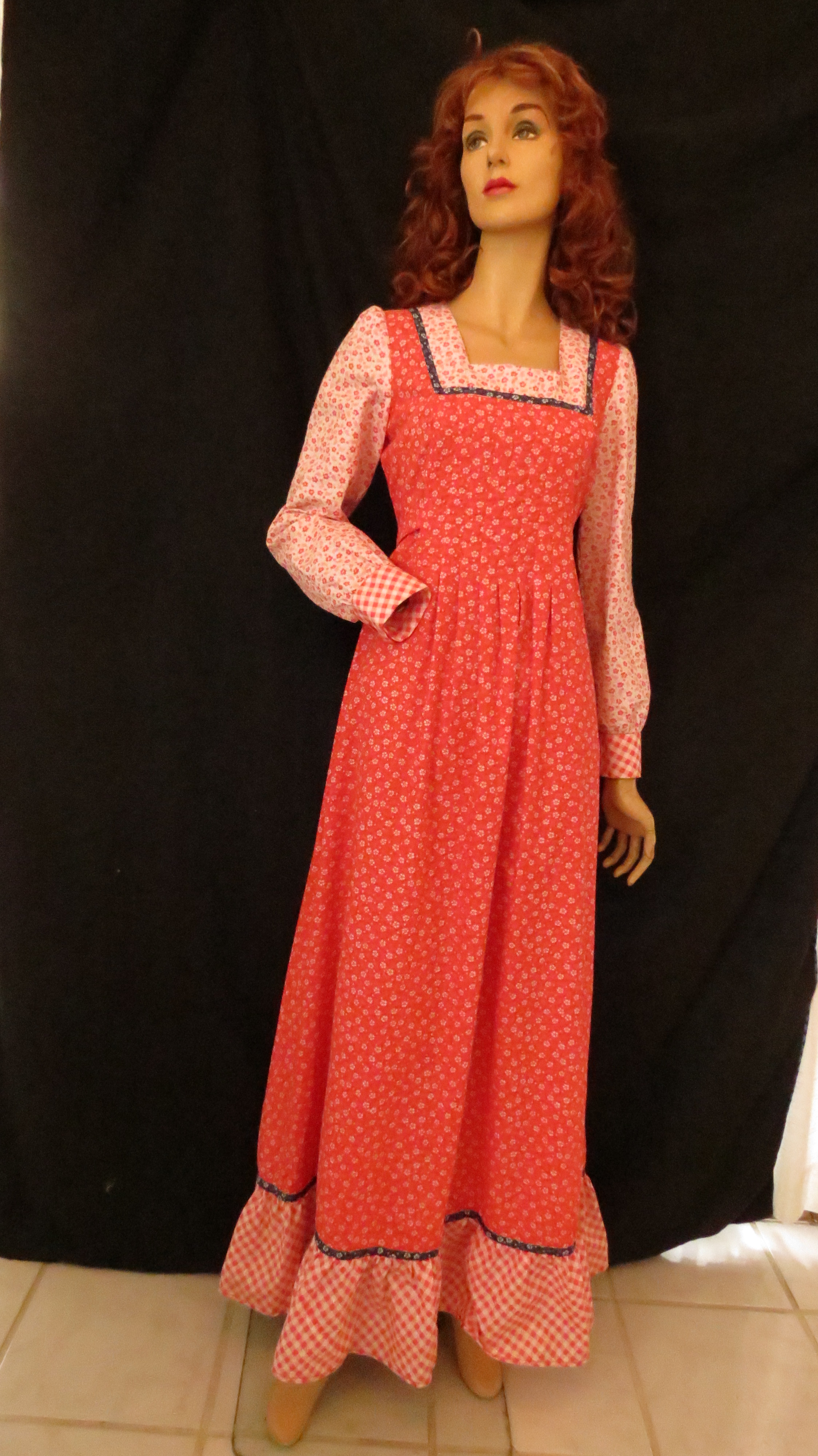
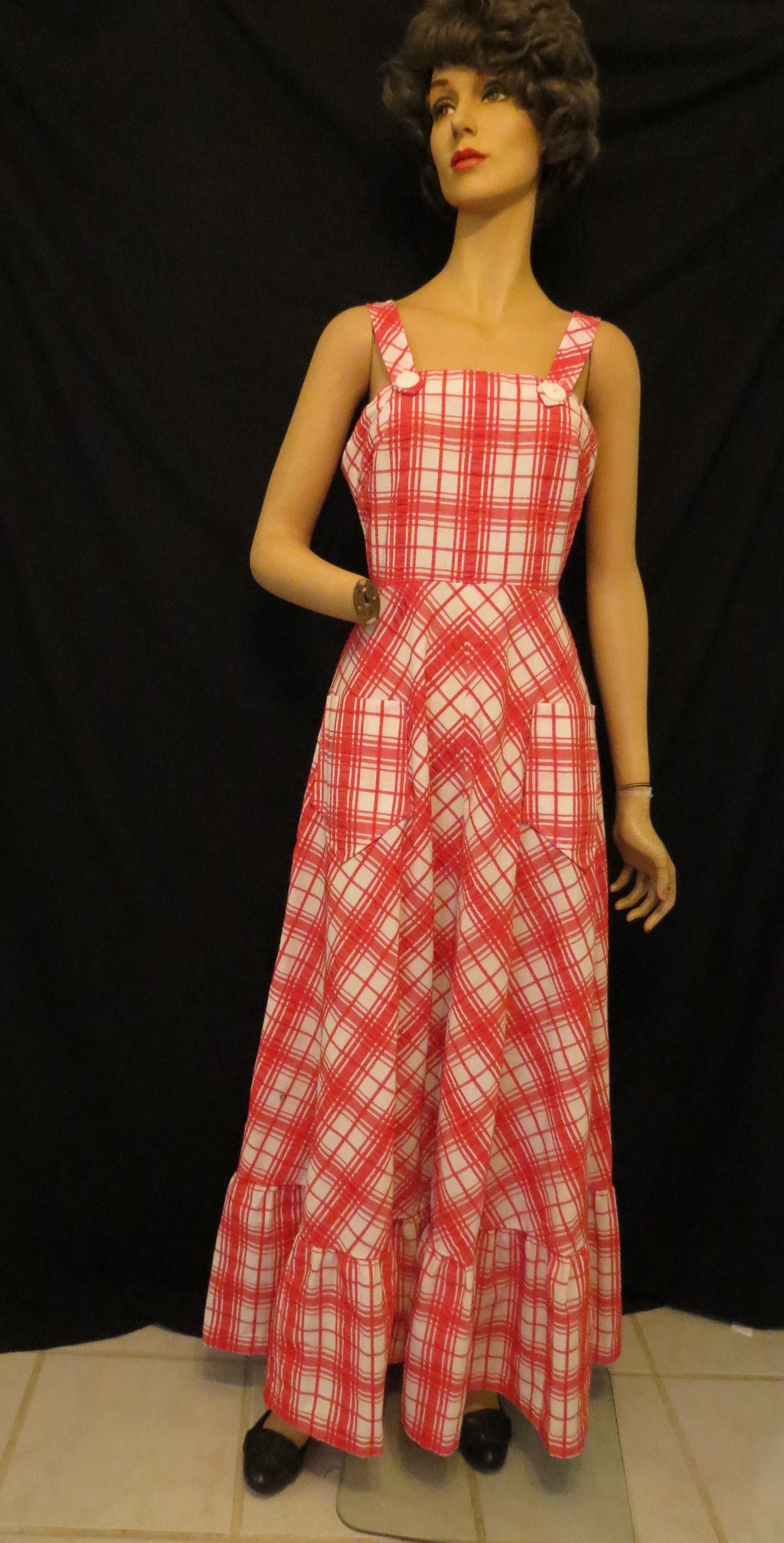
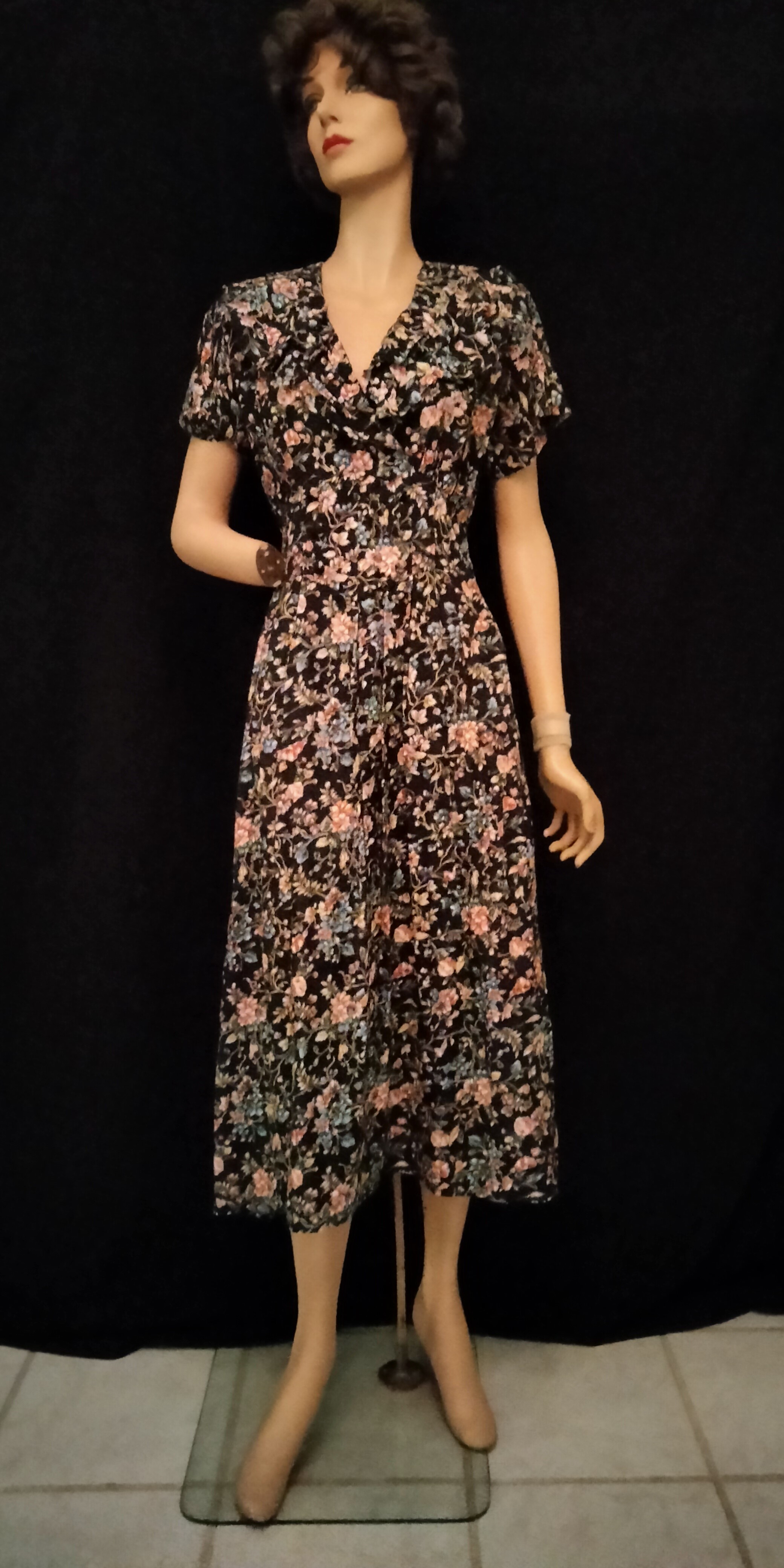
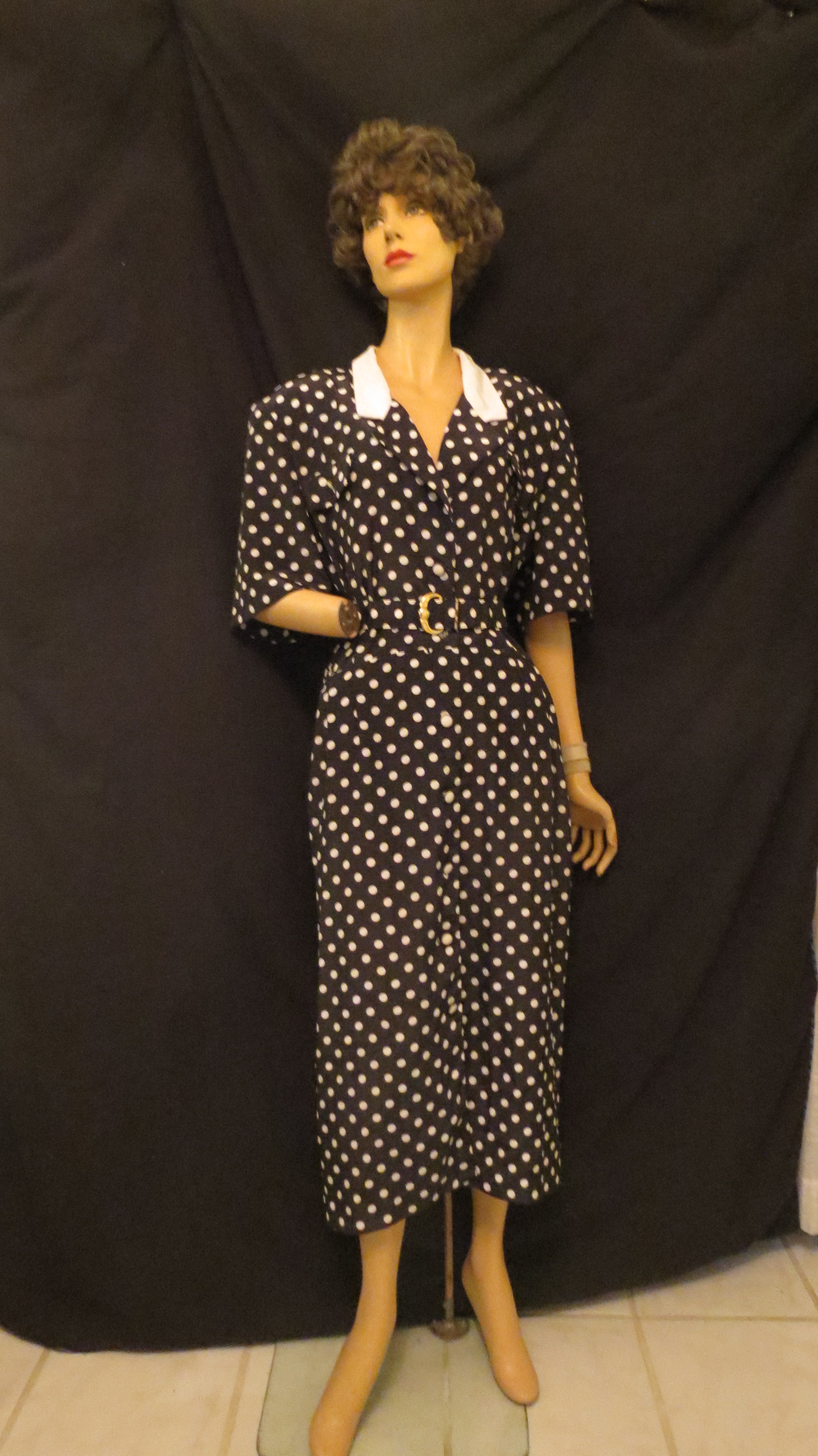
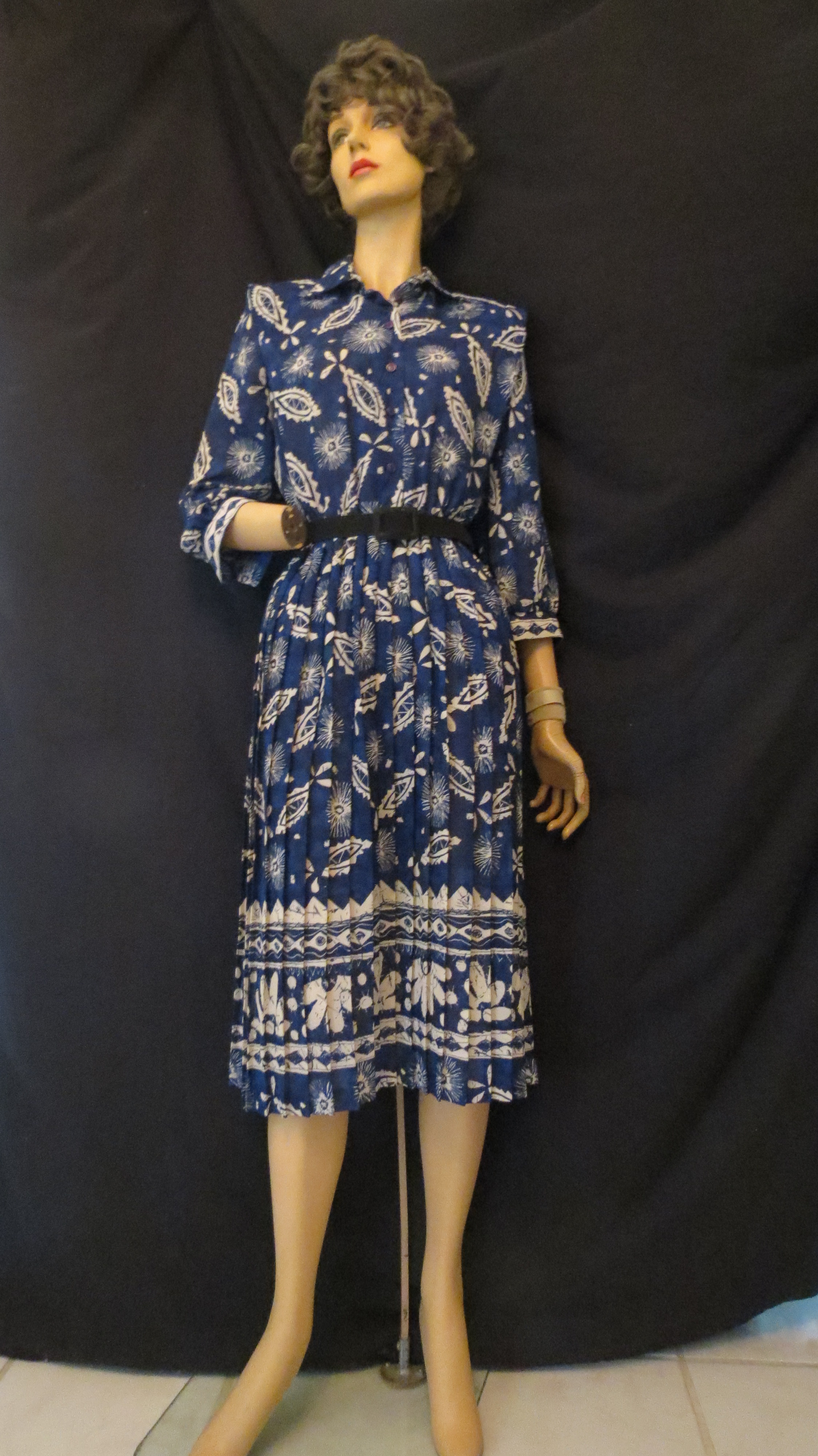
Through the decades the changes in style are often subtle, but they’re noticeable if your sleuthing trade skills are sharp. One thing that all these dresses have in common is excellent quality. I showed several dresses of this genre which were made in the Victorian/Prairie style when covering 1970’s Prom dresses a couple of months ago. Early in that decade, girls sometimes wore them to the Prom but they were usually fussier with lace and more details. Jessica McClintock of Gunne Sax styled them for at least 20 – 30 years. Labels always help, of course, but aren’t always present. The condition of all these examples is near-perfect, which can make the job a easier, though tell-tale signs of wear can sometimes be very helpful clues. Let’s start from left to right:

A Prairie-style gown, pretty and modest in cotton. Looks like it was made for retail because of the precise tailoring detail, but there is no label. I would put it in the 1970’s but it could possibly have been made later by an individual expert or a company that catered to a niche market which preferred very modest styles of dress.

A red and white plaid gown that picks up on the Prairie style, but in a much more casual, carefree design reminiscent of the 1960’s. It’s probably made from cotton but I can’t be sure without the file in front of me and it could be cotton/poly blend. It was made in the 1980’s in West Germany. This is an example of trends jumping the oceans, usually years after they originally appeared in the Western nations. Although they’ve done their own take on the style, it’s exceptionally well-made, as goods from West Germany have always tended to be, in my experience.

A black and white floral print gown made in Hawaii. This one is from the 1980’s, give or take a decade and is the most elegant. Same deal about the fabric as in the previous dress. The style is pure average conservative, which makes it harder to date exactly. A pretty dress, but nothing distinctive about it excepting for excellent tailoring. It might have been a wardrobe item of someone who lived in Hawaii, purchased at a specialty shop stateside which carried Hawaiian garments or by someone who bought it while on vacation. Hawaiian-made gowns have been popular with women worldwide since the 1950’s, but earlier ones were usually made in more traditional Hawaiian style and, often, of Hawaiian fabric with traditional island prints. The more mainstream universal designs like this one came later.

The final dress is from the 1990’s. Always harder for me to think of as true vintage, but it is worthy because of the good tailoring, 100% cotton fabric and the retail designer label sold by a high-end department store in New York City. It’s got pedigree. Again, nothing notable about the style but it is very well-cut, which can make a world of difference in terms of how a dress fits. That’s one feature of even plain, rather boring vintage clothing items that can make them worth collecting and wearing. The style can always be elevated by adding accessories but one thing that always elevates any garment is how well it is made and how well it fits.

Tomorrow I’ll be showing a collection of dressy day-wear accessories from the 1960’s that fit the category of well-made, classic and designer items that can “make” an outfit. Stay tuned . . . . . . . . . . . . . . . . . . . . . . . . . . . . .

MORGANA MARTIN, THE MAGICVINTAGESPY

BLOG: MAGICVINTAGESPY.COM
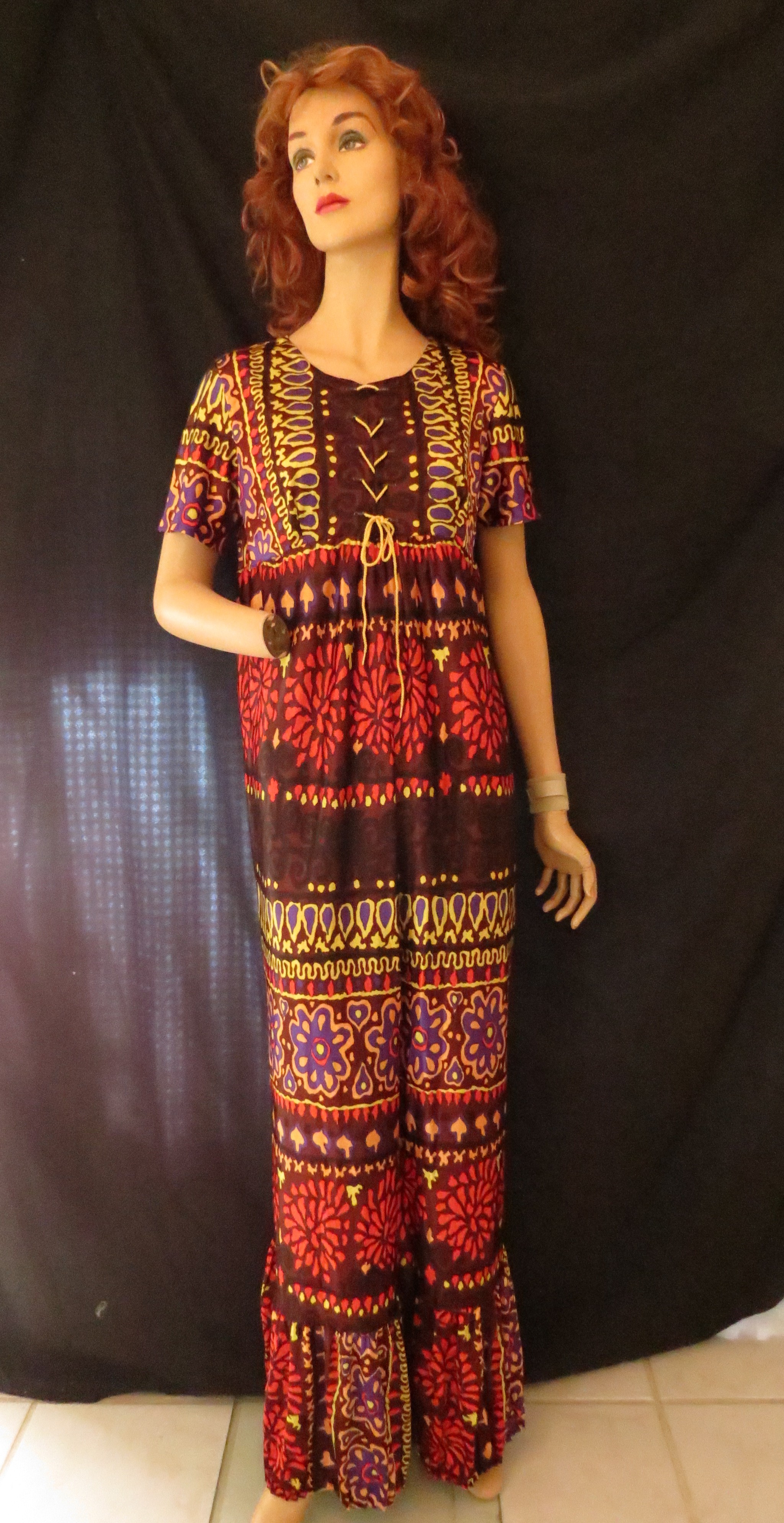
1970’S – 1990’S DOES 1940’S. TRUE VINTAGE RETRO DRESSES AND JUMPSUITS.

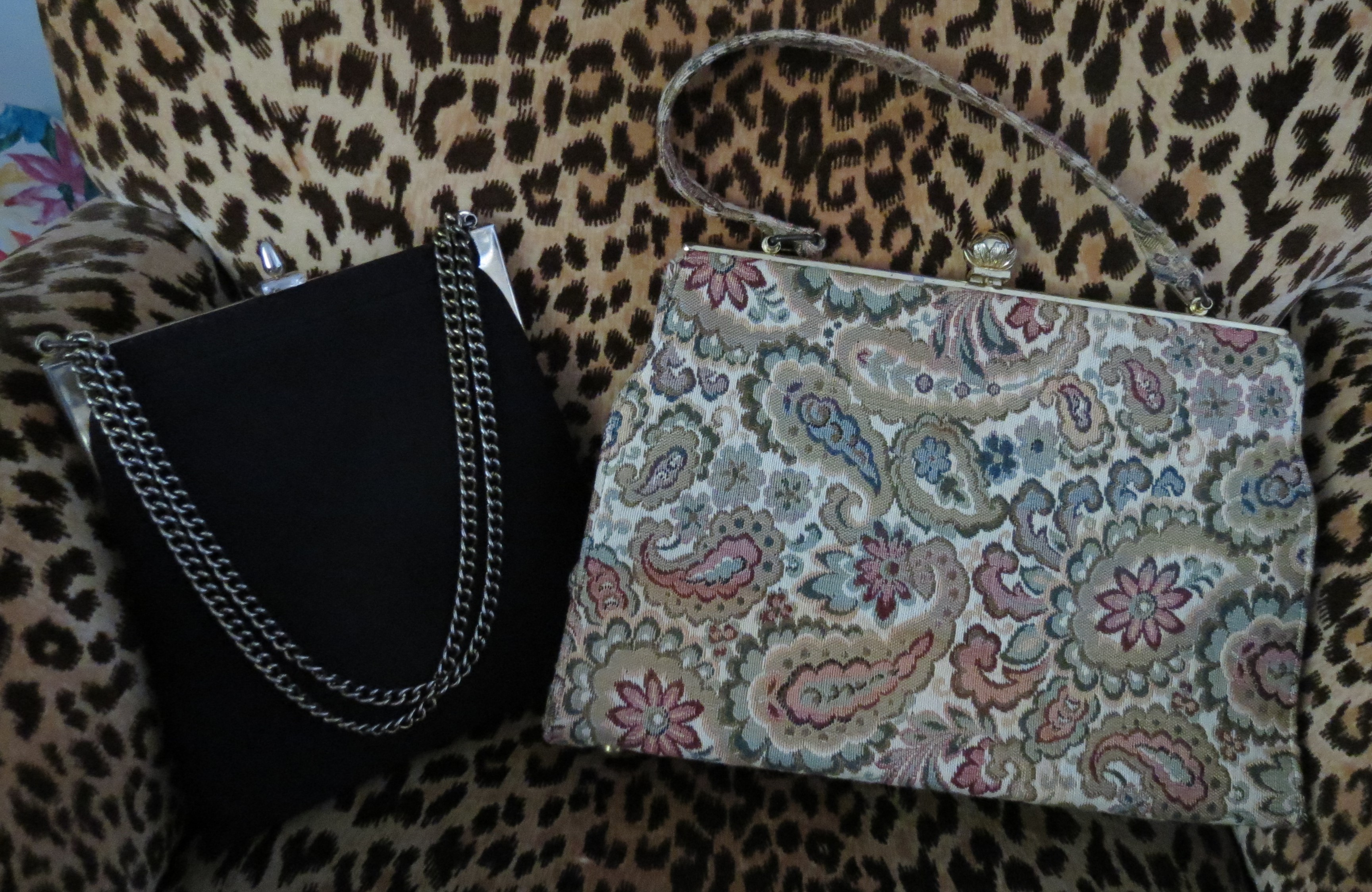
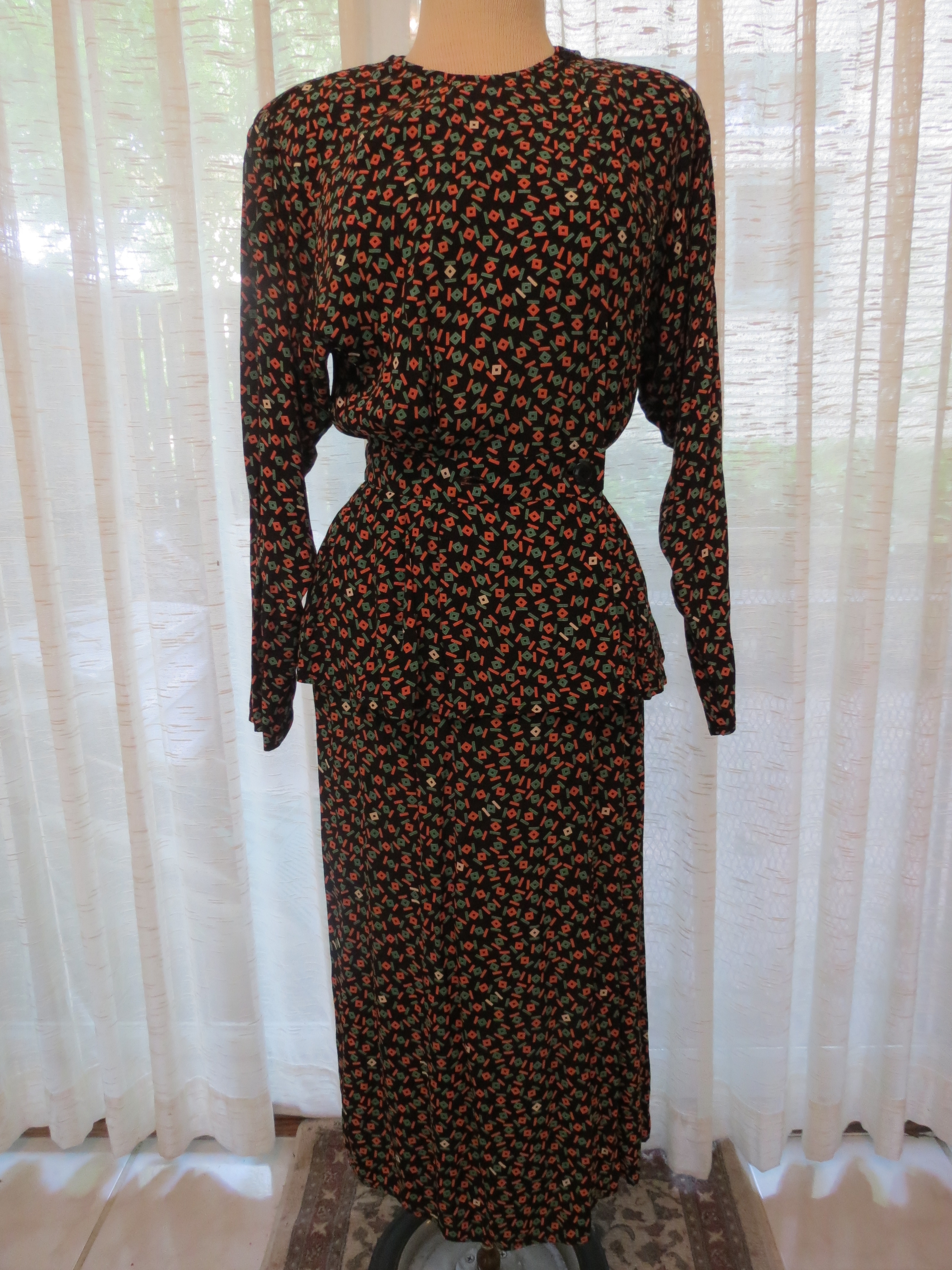
The Seventies, Eighties and Nineties produced a lot of popular retail styles that imitated 1940’s designs. Some were very well done and others not so much, to be charitable. As I’ve said, it’s hard for me to call these decades true vintage but, technically, they are. The two purses echoing shapes and tapestry design popular in the Forties might have shown up in the 1960’s.

All of these could be fun and the reproduction details became best during the mid-1980’s but, unfortunately, modern polyester fabrics and production techniques lowered the quality a lot. No valid comparison, in my opinion, to true vintage from the 1940’s – even the home-sewn versions that were made from older clothing during rationing.

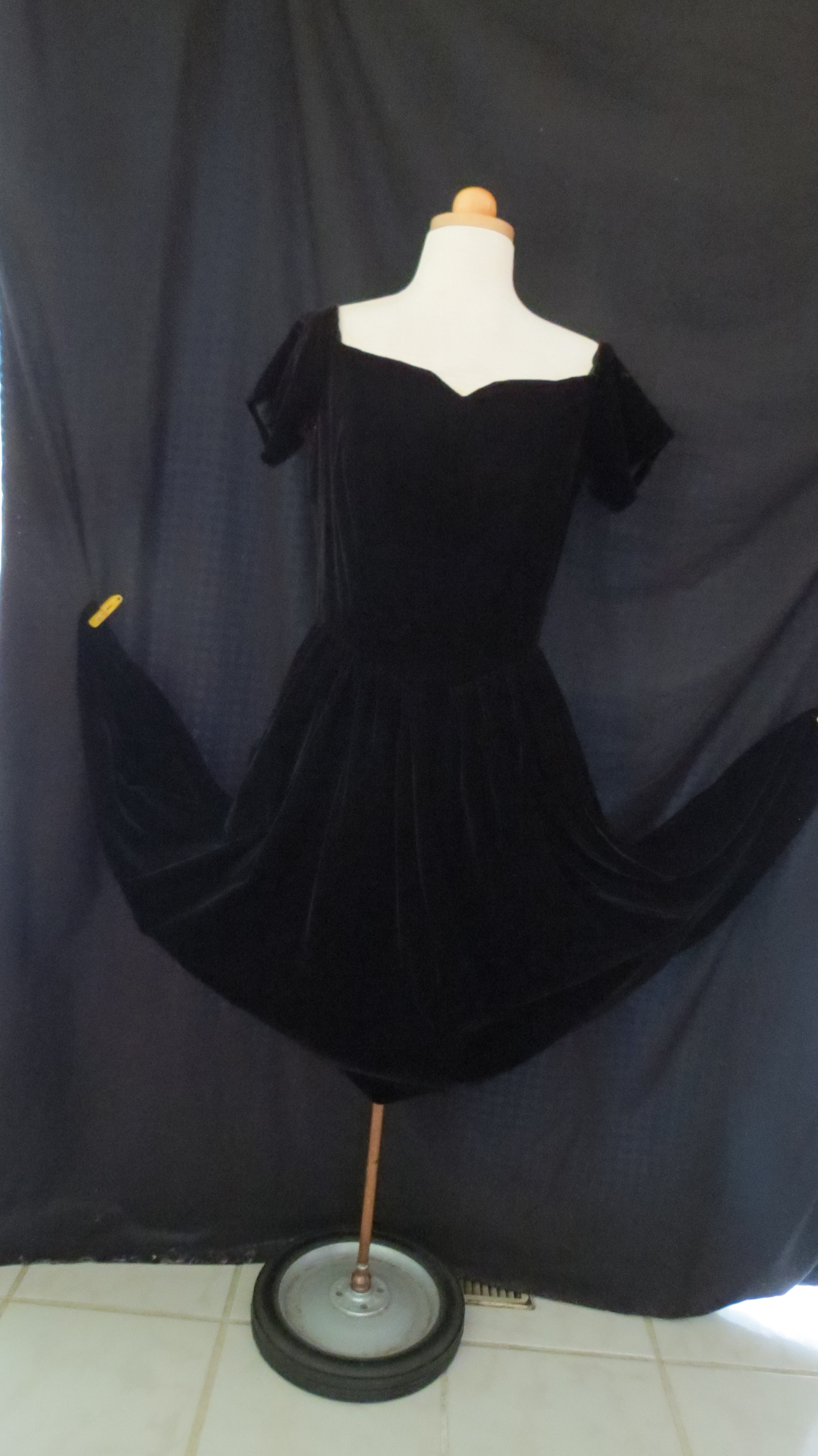
Of this group, the best-made is the black velveteen custom-tailored frock from the 1980’s or 1990’s. It was made by an expert seamstress and is worthy of being called a reproduction in the Post-war New Look style. The retail day-dresses are versatile and the prints are great – pretty faithful to authentic ones that I’ve come across. I always love the padded shoulders and cinched waistlines that are very flattering but were also a nod to the style of military uniforms. Jumpsuits were just for fun in the Seventies, but always are inconvenient. I suspect that the jumpsuits worn by women working in the war effort during the Forties had drop seats, which makes it a little bit better. I do have a pair of high-waisted slacks from the ’40’s that have an ingeniously-designed drop seat that looks quite good.

So, these clues were fun to find and seemed worthy of collection though I always prefer the real deal. Speaking of which, I just came across another archived file of true vintage 1940’s dresses which I will show tomorrow. Stay tuned . . . . . . . . . . . . . . . . . . . . .

MORGANA MARTIN, THE MAGICVINTAGESPY

BLOG: MAGICVINTAGESPY.COM
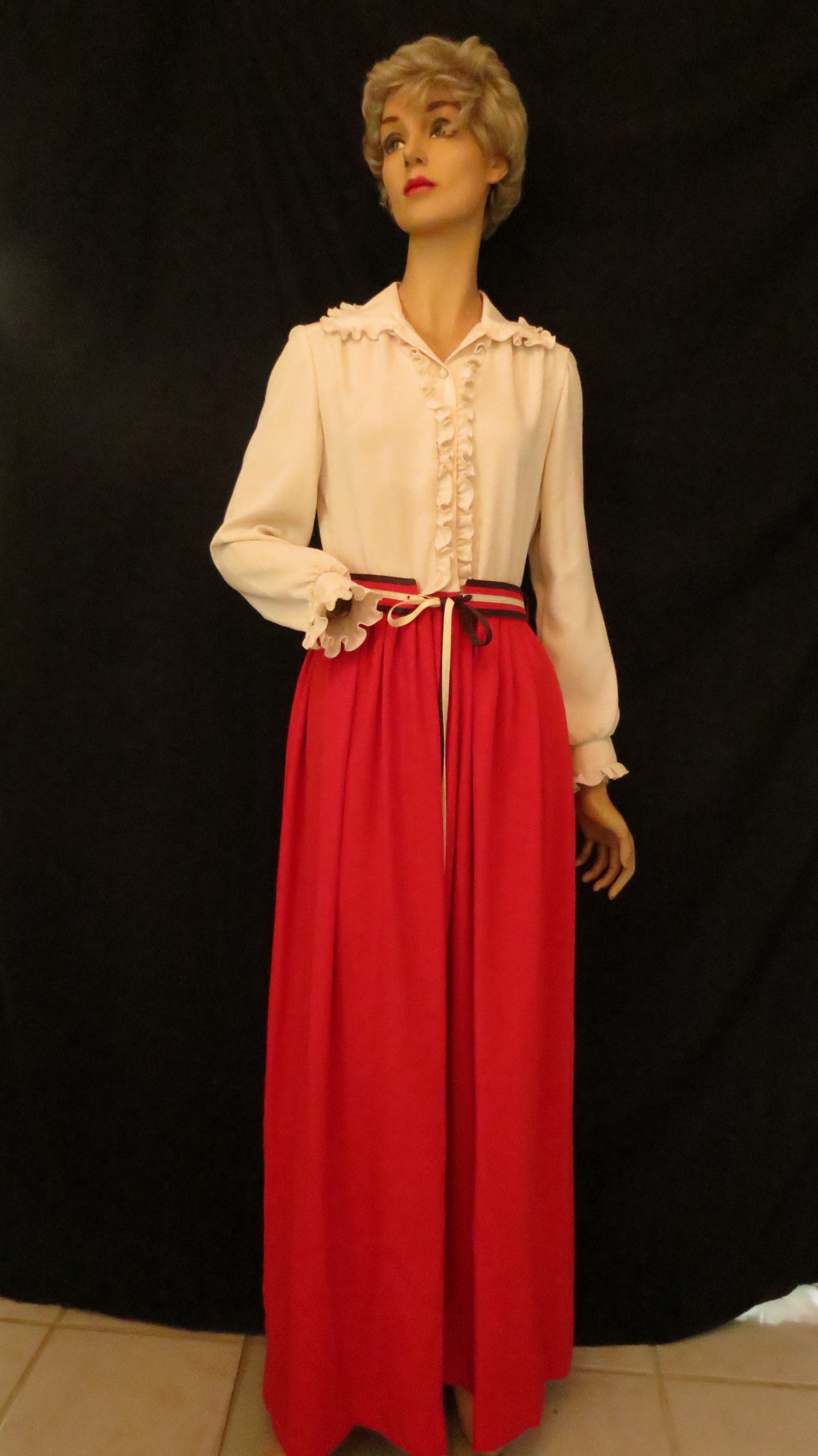
JUST FOUND – VINTAGE LADIES CLASSIC SHIRT WITH EXCEPTIONAL TAILORING

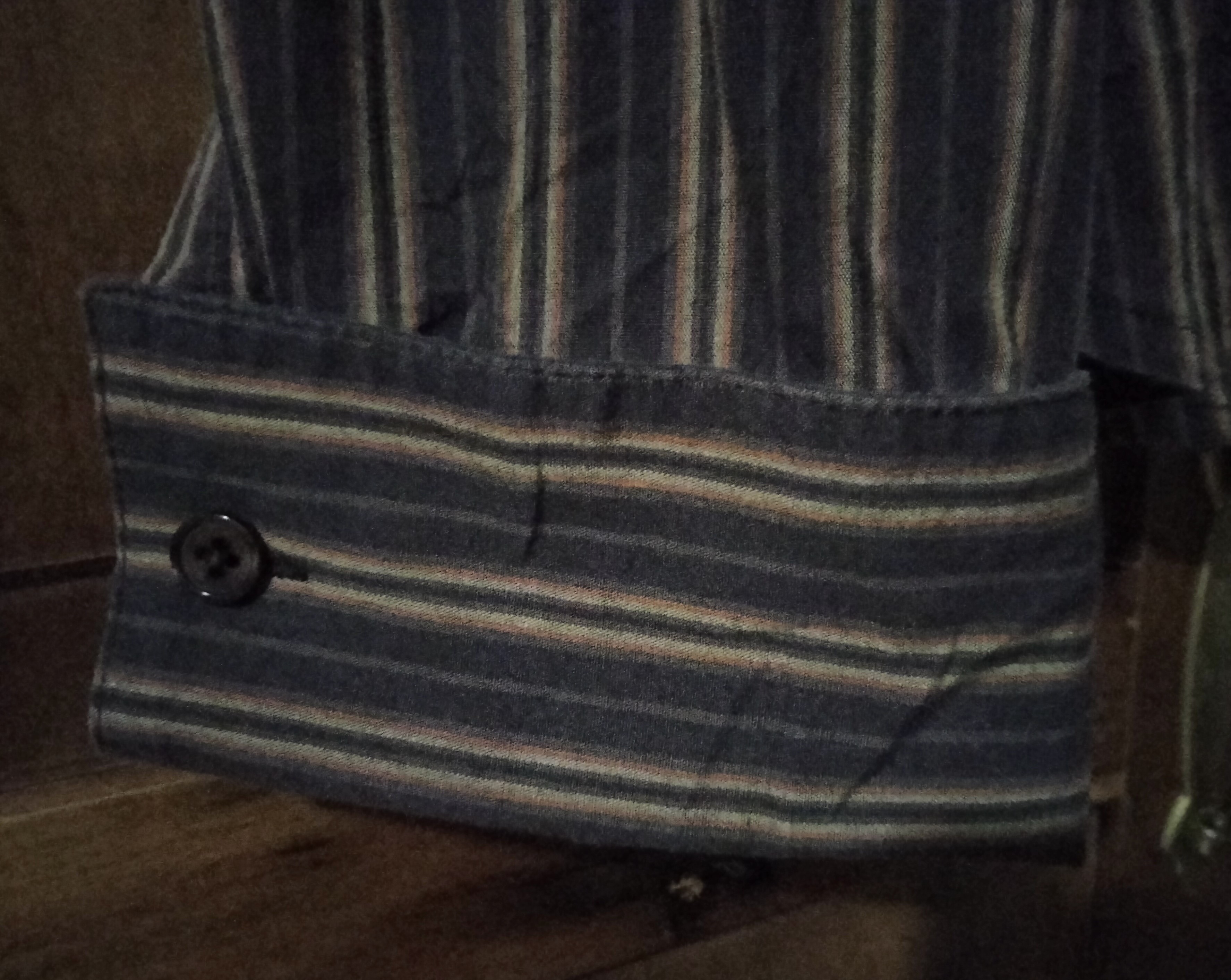
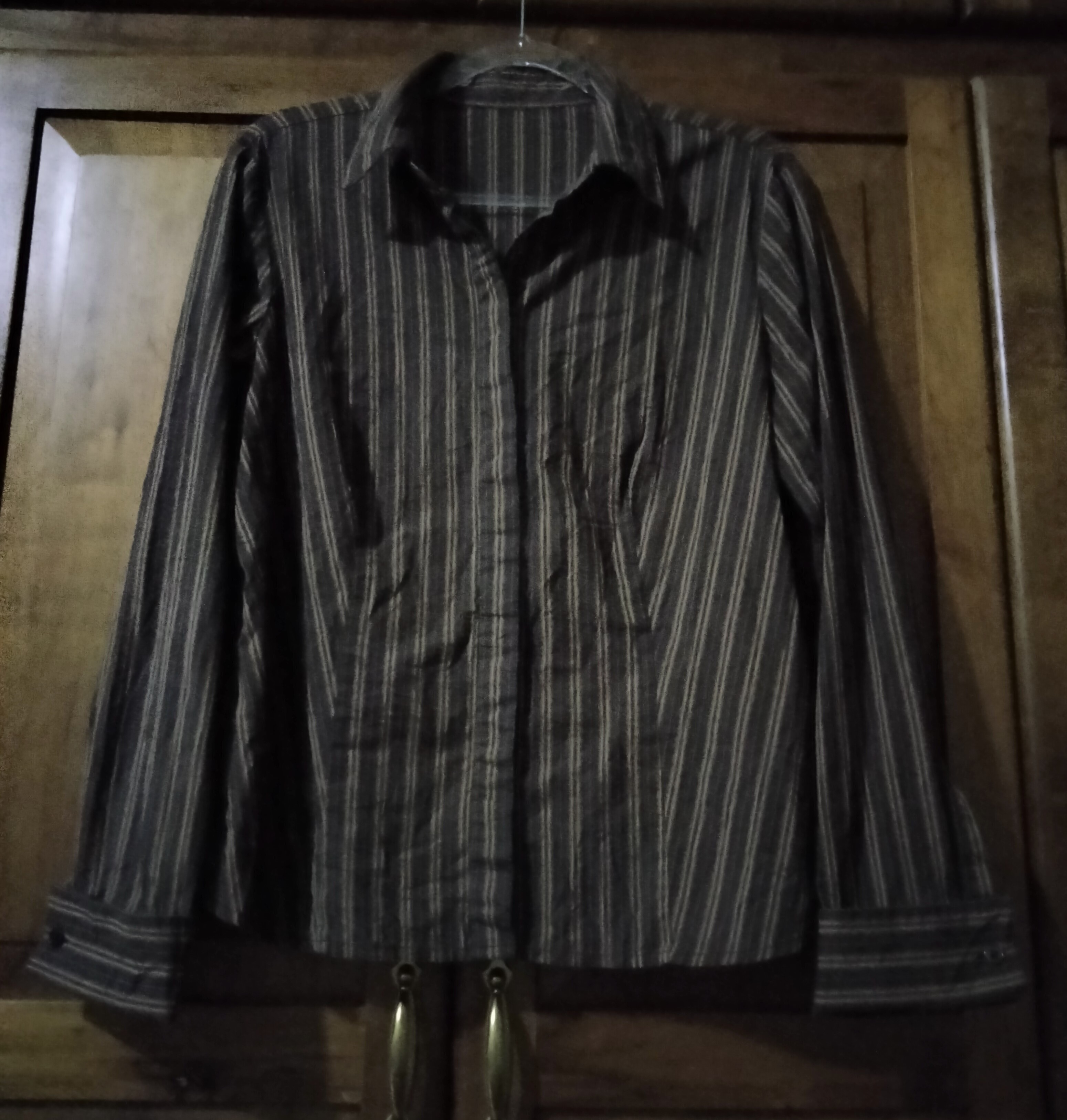
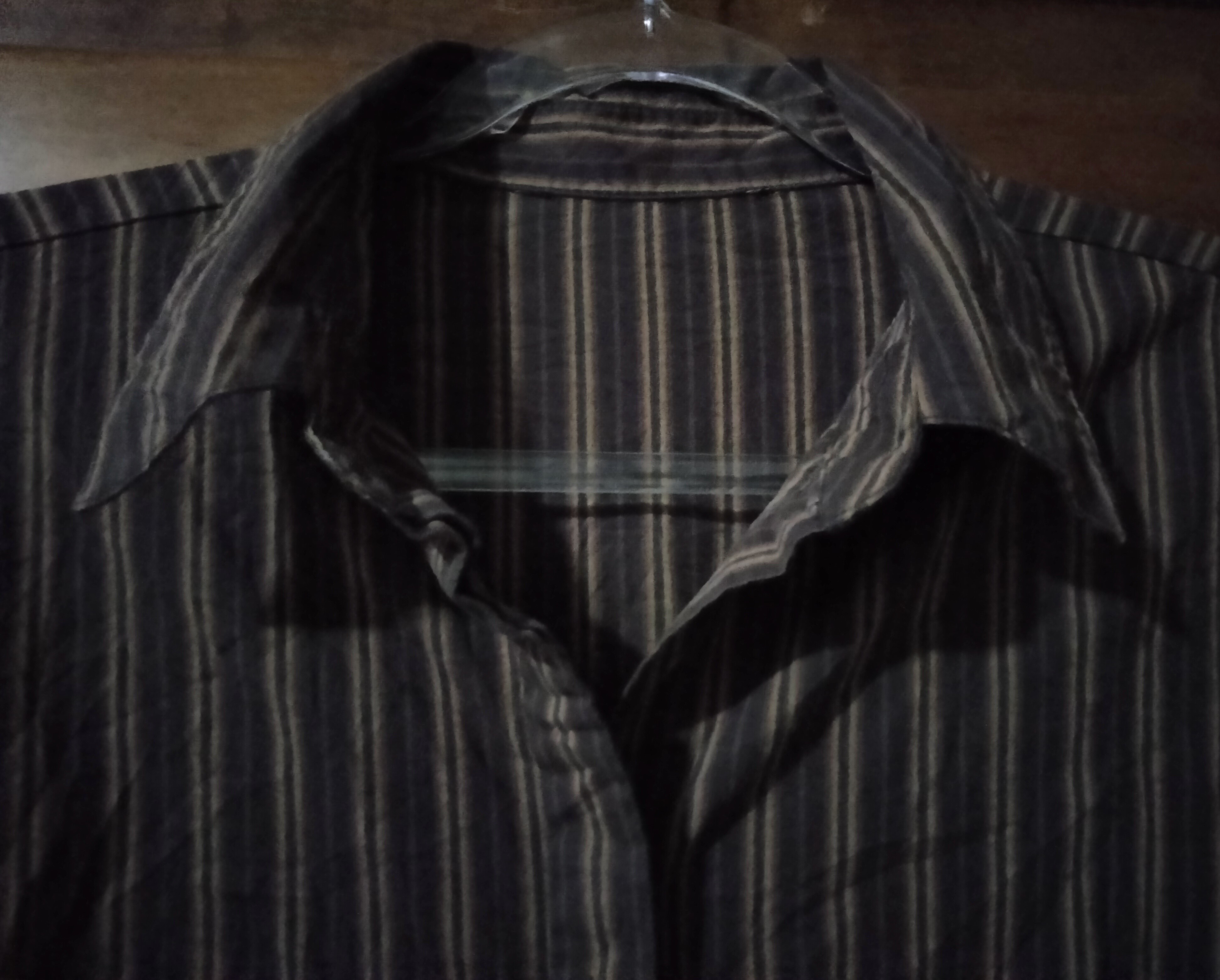
This blouse was worth collecting. I immediately recognized the fine cotton fabric and exceptional tailoring detail, worthy of mid-century ladies shirts though I suspect that this one was made in the 1980’s or ’90’s. The most interesting features are the French cuffs and the distinctively-shaped wing collar. Nicely fitted with front and back darts and a finished, straight hem. The seams are incredibly neat and overcast so carefully that they will stay strong for many years. They have also been reasonably well-matched. Little cufflinks are made from matching buttons but, of course, you could substitute any pair of cufflinks that you own. It’s also nice to see dyed-to-match buttons in a true vintage style as well as a covered-button placket construction, though these are not as unusual.

It’s always a thrill for me to find a garment made to these exacting standards. Finding one in any retail establishment, even lots of expensive ones, is rare. Just had to show you these recent finds but tomorrow we’ll return to the 1940’s and Post-WWII era. Stay tuned . . . . . . . . . . . . . . . . . . . .

MORGANA MARTIN, THE MAGICVINTAGESPY

BLOG: MAGICVINTAGESPY.COM
TRUE VINTAGE 1980’S DOES 1940’S DRESSES

As you probably noticed in my last post looking at the 1970’s, I am not very focused on the “modern” styles from that decade because they were not interesting, in my opinion, and generally not of high quality. The same goes for lots of the 1980’s clothing, but I do enjoy some of the New Wave styles and the revival (again!) of 1940’s designs. I don’t have a large archive of New Wave examples because it was a short movement and so trendy that lots of the garments were cheaply-made and didn’t last. However, the Forties revival was a bit more mainstream and produced some dresses, etc., of better quality. The examples above cover this whole spectrum.

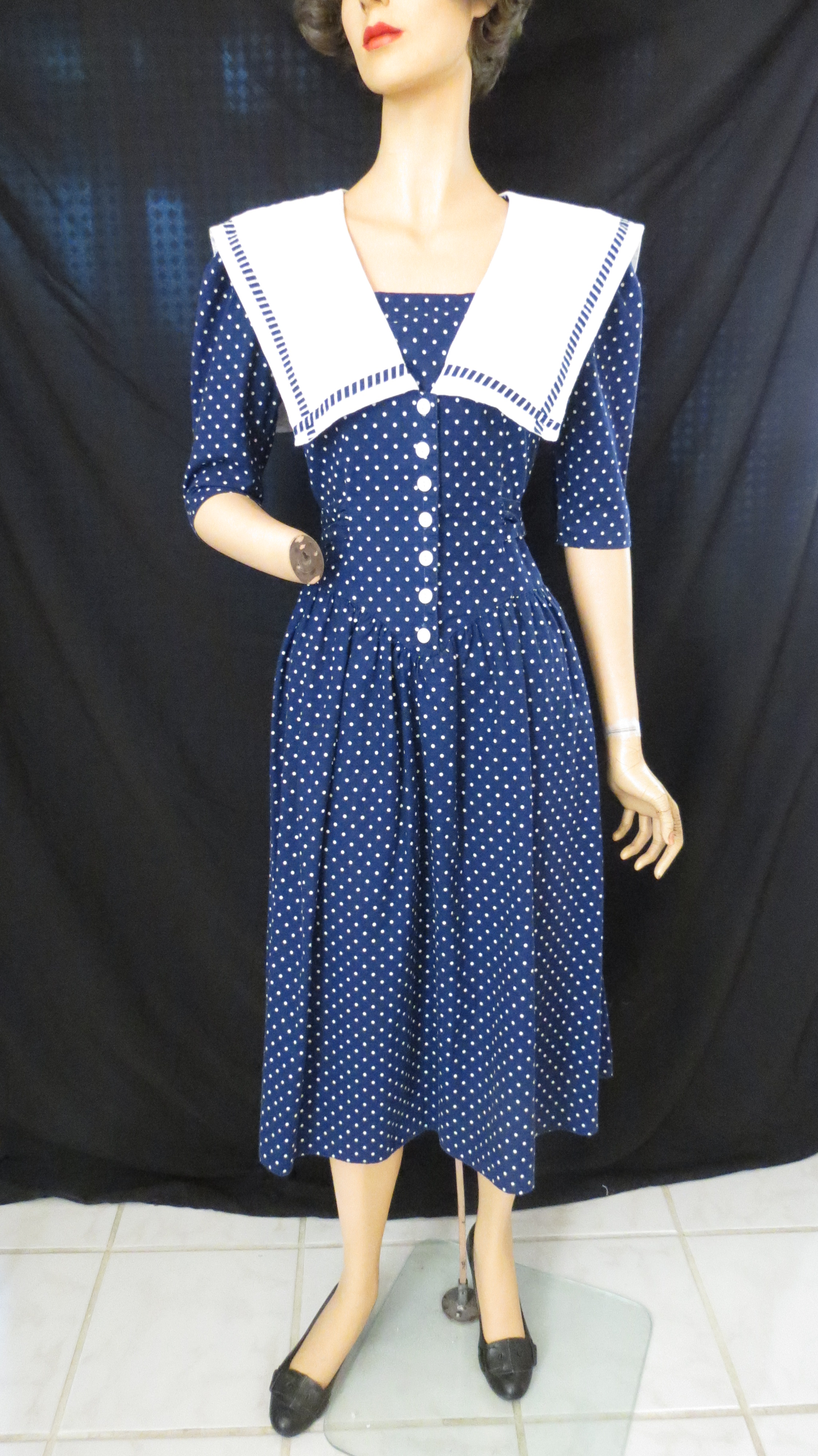
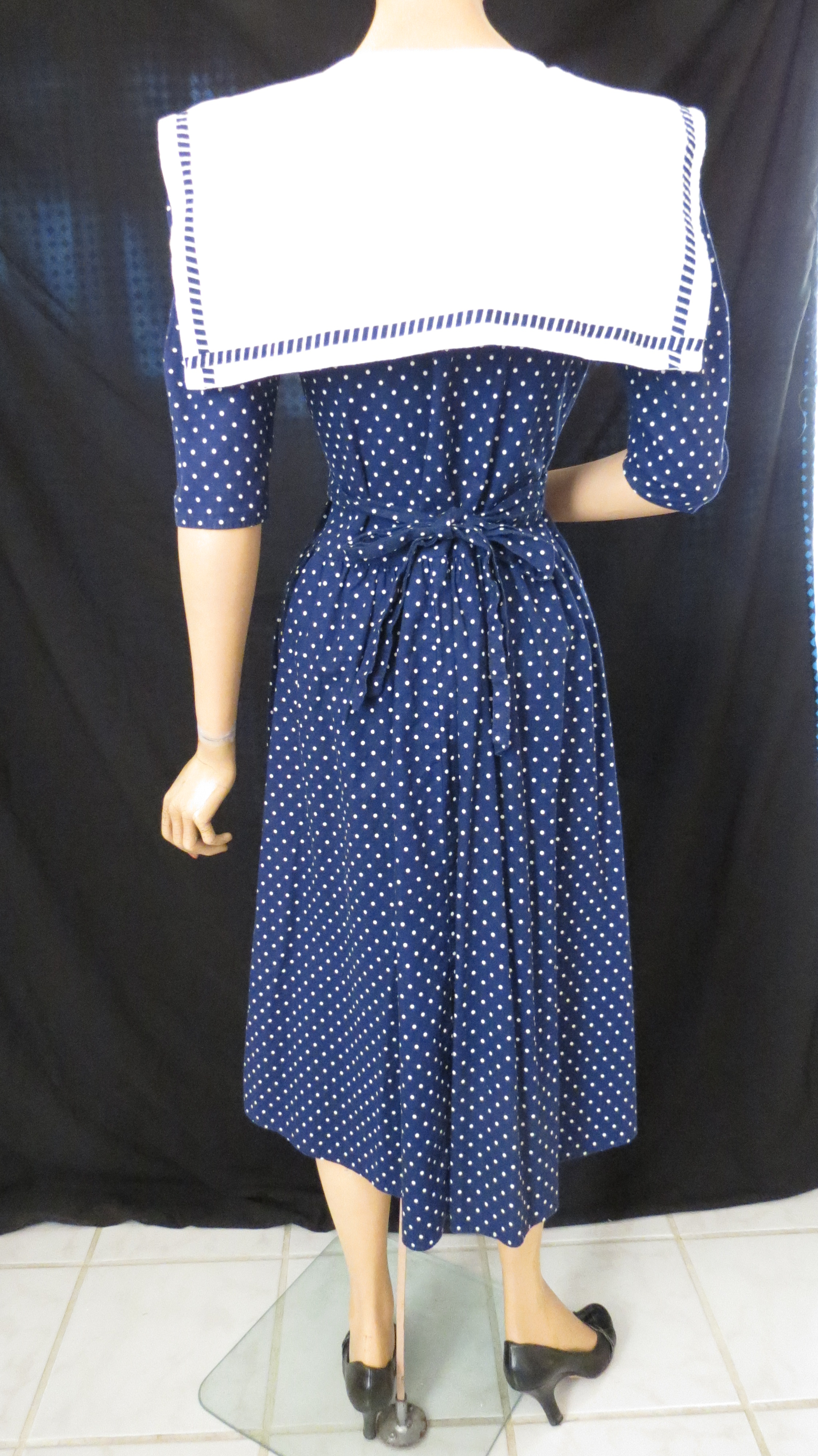
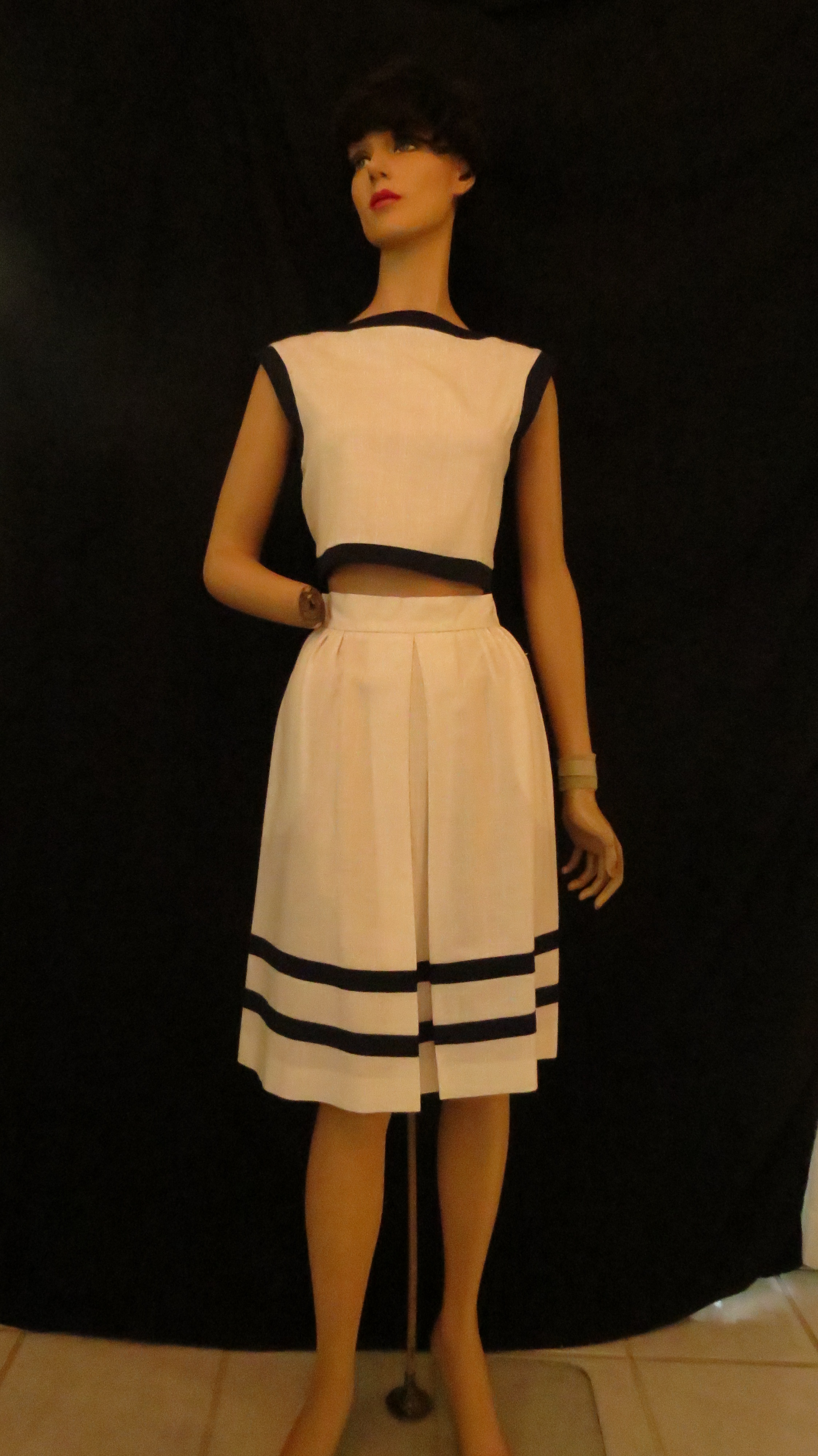
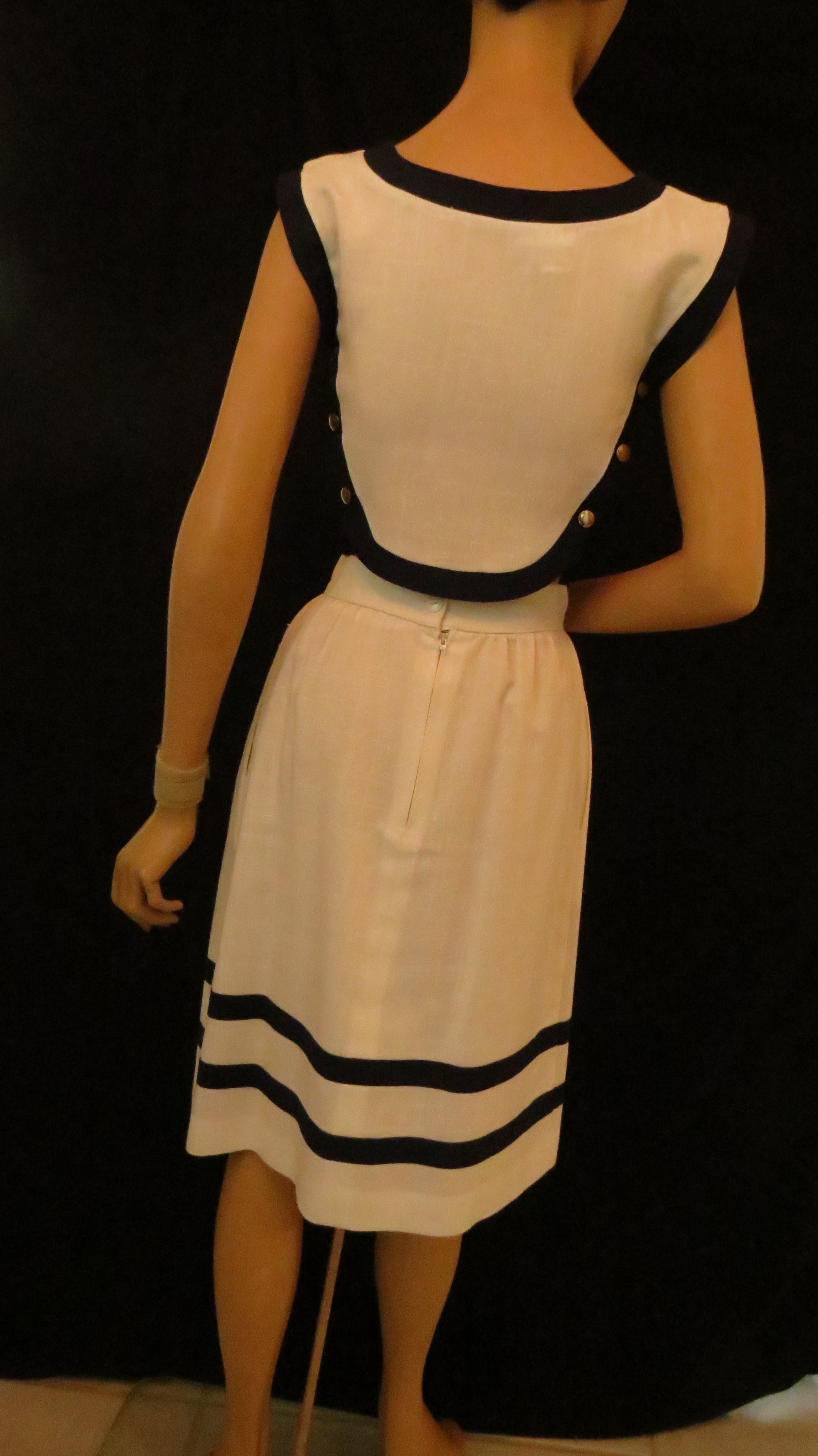
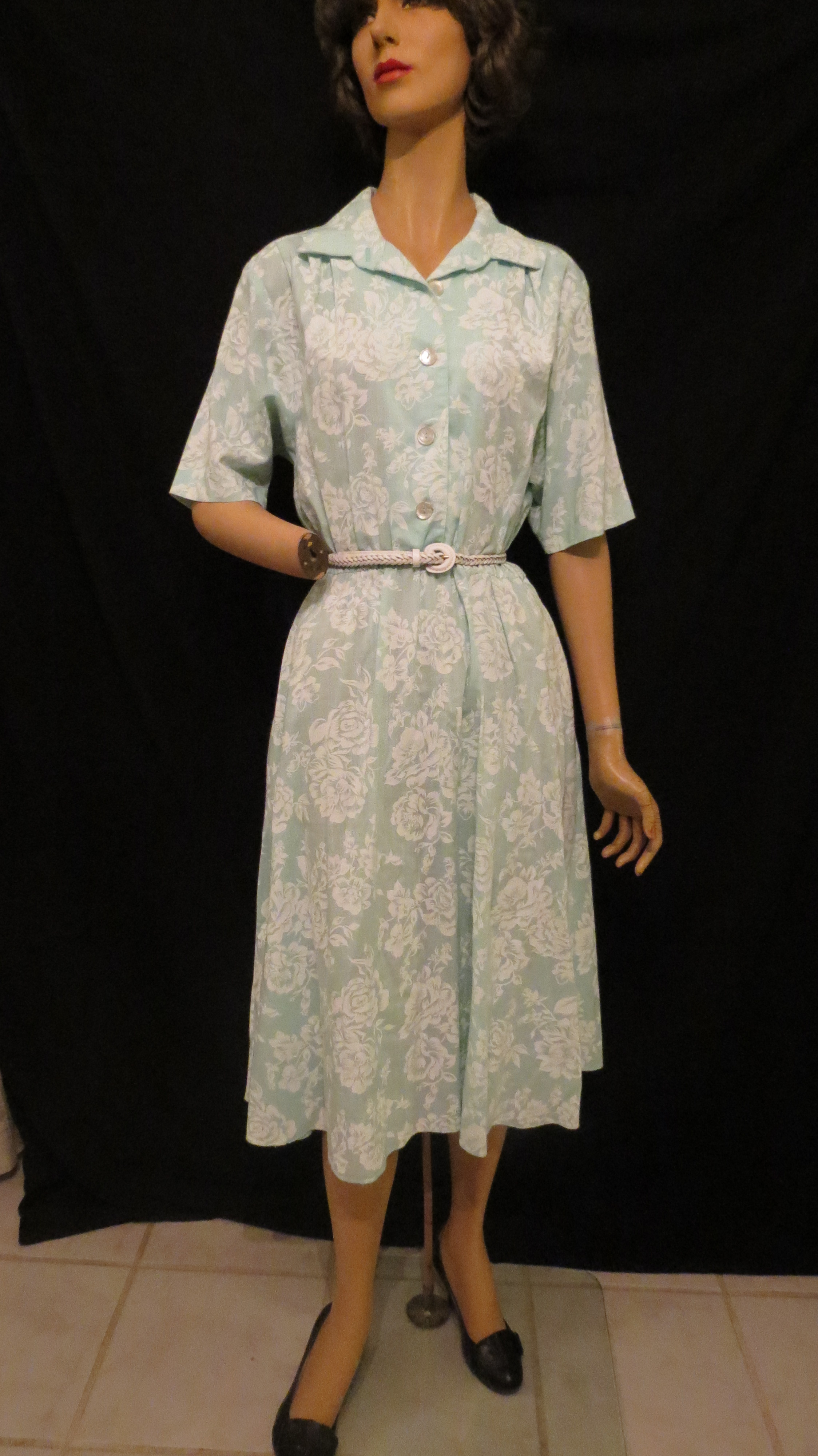
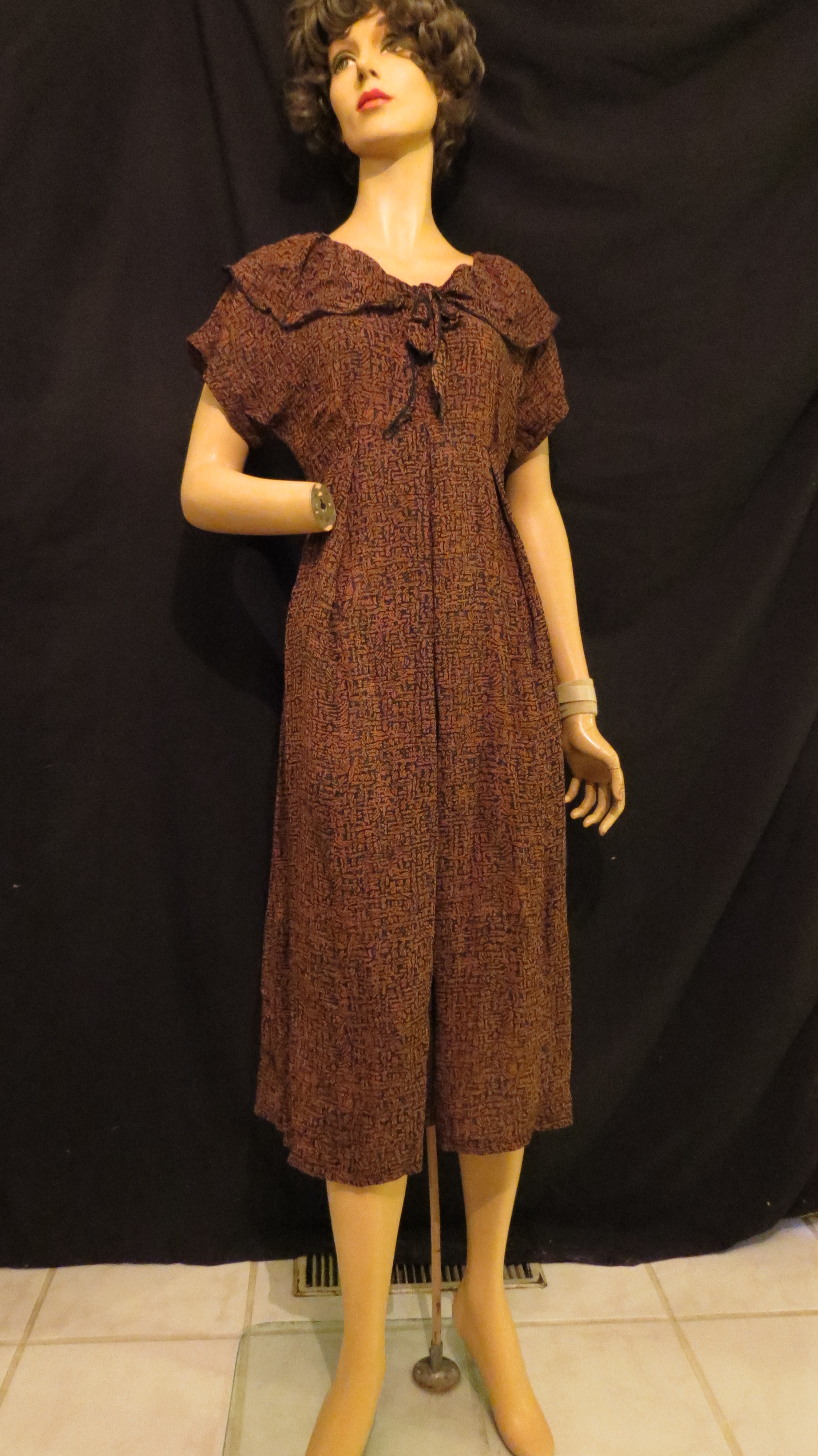
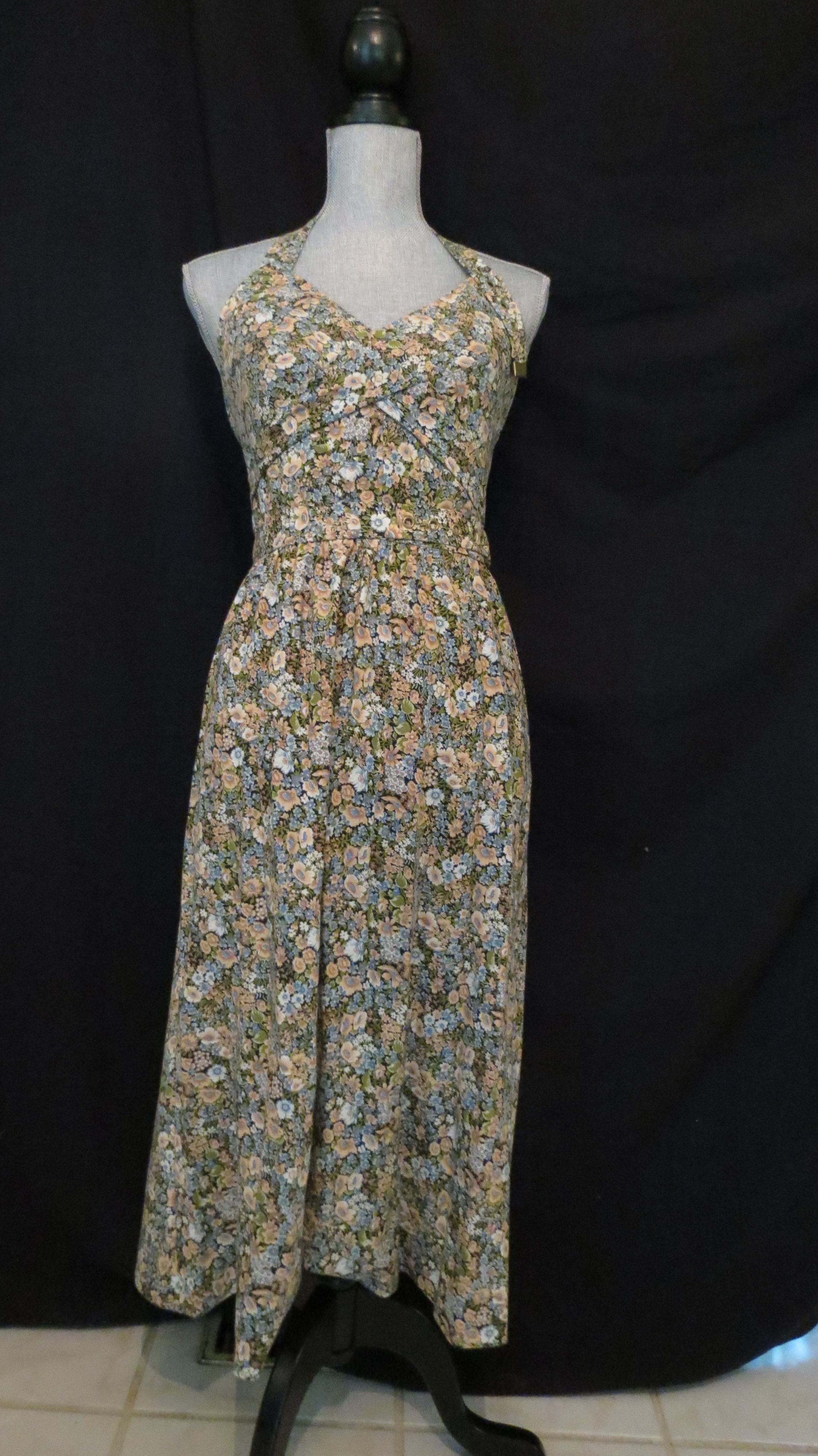
The first two frocks are a revival of designs giving a nod to nautical or “sailor” styles. Sailor collars, especially, have shown up on women’s dresses and children’s clothing since the 1800’s and maybe before. Blue and white have been classic color combinations in Spring fashions, too. The first example above with the outsized collar also has 1940’s-style cut, waistline, 3/4 sleeves and midi hemline. It’s a less expensive dress, very trendy and not true navy blue in color. By contrast, the second dress is true to military style with it’s embossed metal buttons, true navy blue and white colors and prominent stripes. The rest of it’s style is more New Wave, with a midriff top and geometric cut. It’s much more elegant and well-made. We saw a LOT of mid-priced floral print midi skirts and shirtwaist dresses, which were very good flashbacks to 1940’s everyday styles. Finally, I do love this brown print rayon dress by a trendy mid-priced designer (forgot her name). It’s a late ’30’s – early ’40’s design with great fabric drape. I also love this halter style floral midi – Very mid – ’40’s!

I rarely cover anything from the high fashion or couture world since my investigations don’t typically take place where those clues are likely to be found, though exceptions to the rule always exist. Tomorrow I’m going back to my primary focus on dresses and accessories actually made before 1970. Stay tuned . . . . . . . . . . . . . . . . . . . . . . . . . . . . . . . .

MORGANA MARTIN, THE MAGICVINTAGESPY

BLOG: MAGICVINTAGESPY.COM
True Vintage Late 1970’s – 1980’s Prom Dress and Heels

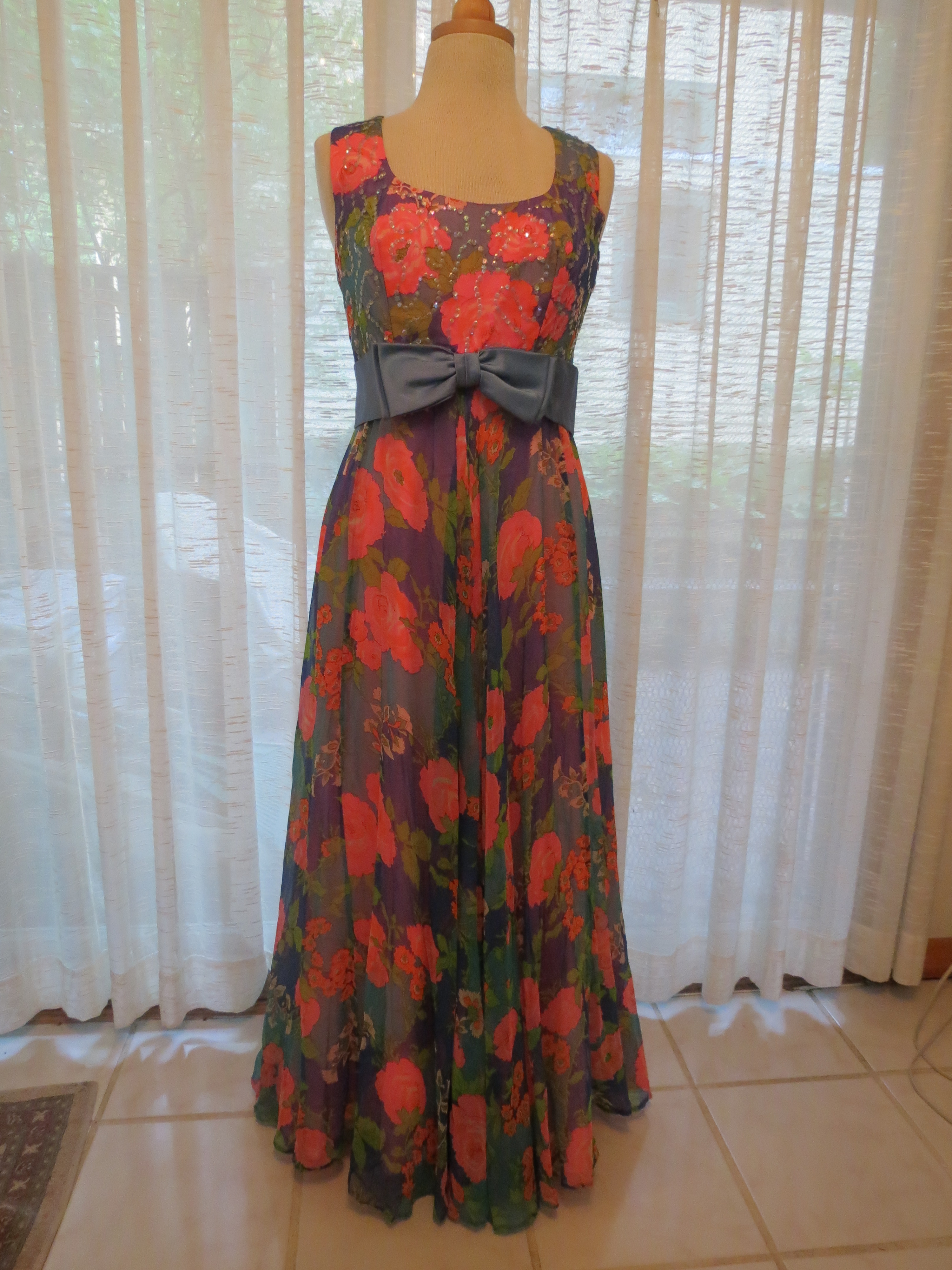
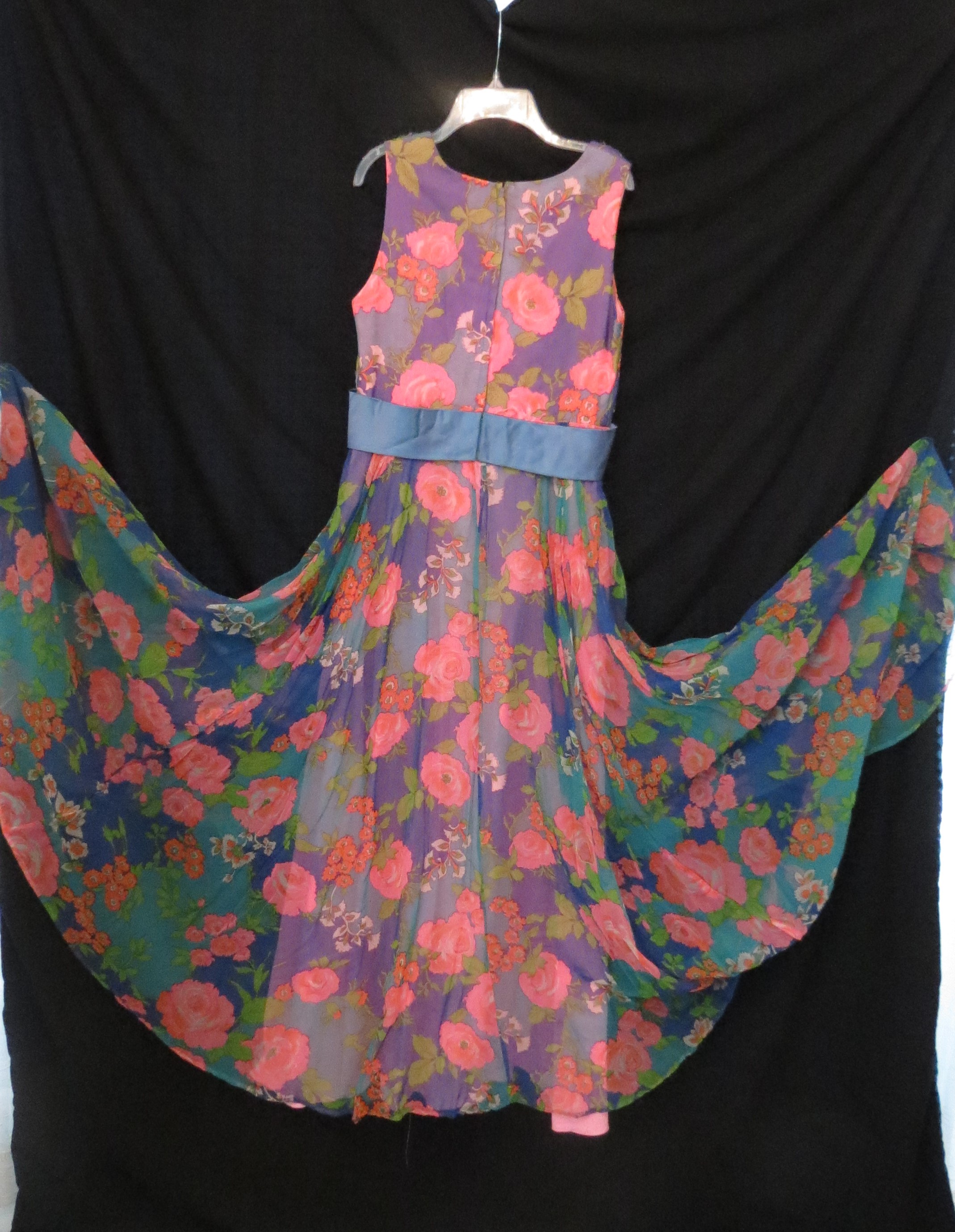
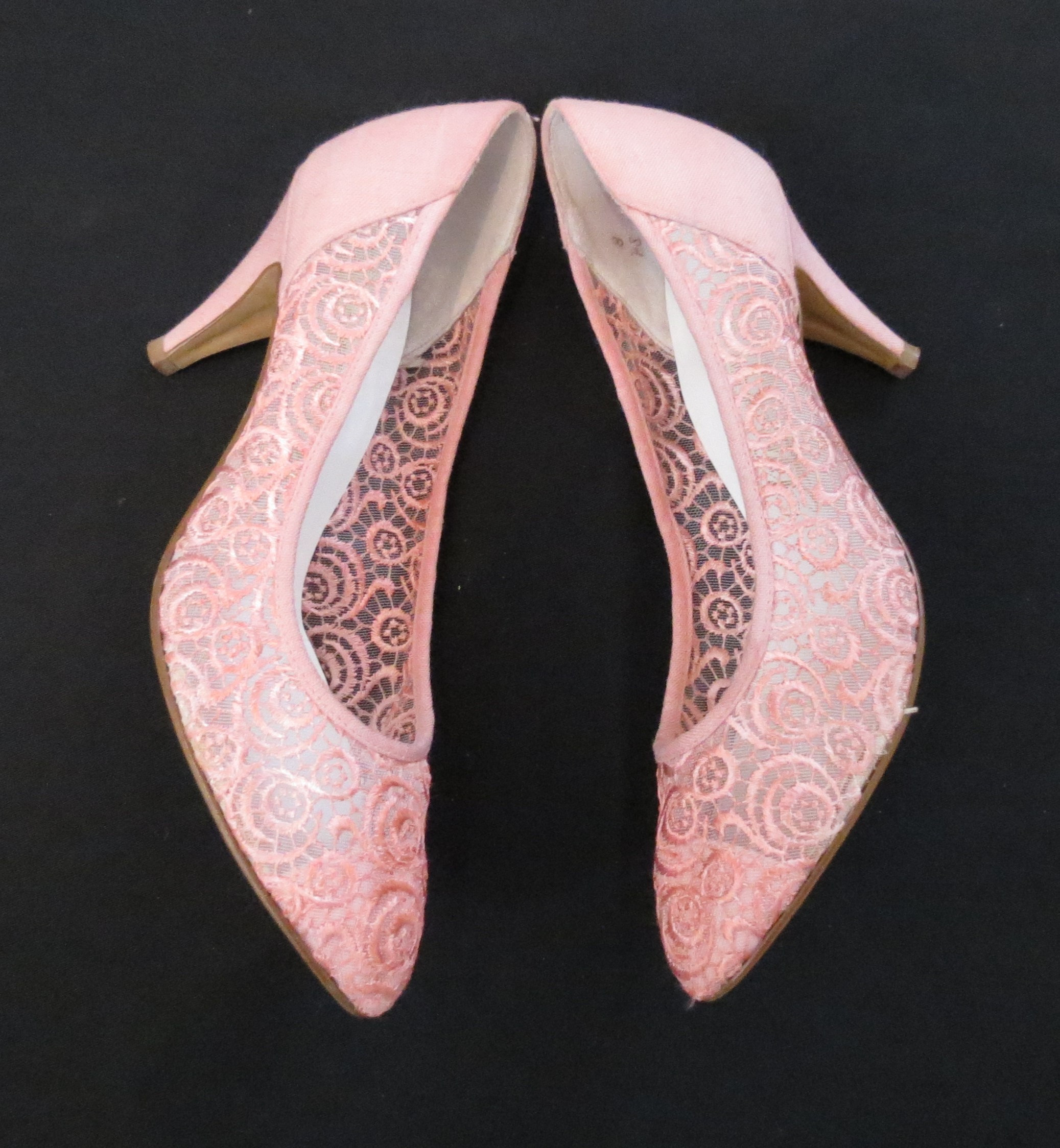
Again, a bow at the waistline and sheer fabric over opaque. But, the flavor has changed – big, bold Eighties does Forties floral print and in-your-face colors. Also, the sequins and beads sprinkled on the bodice looks like Eighties and Nineties, rather than the mid-century style. The pumps are a Sixties throwback. This gown is much more showy than the tailored, sophisticated styles of the Fifties and early Sixties and we’re still about 10 years away from the glitzy power frocks of the Dynasty decade.

Still pretty and girly, though not quite as “sweet”, in spite of all the pink underneath. It’s so interesting to see how clues and evidence overlap from year to year. Stay tuned for the file containing mid-century day-wear suits, dresses and accessories as Winter moves toward Spring . . . . . . . . . . . . . . . . . . . . . . . . . . .

MORGANA MARTIN, THE MAGICVINTAGESPY

BLOG: MAGICVINTAGESPY.COM
Cute LBD with Iconic Mid-century Tailoring Detail

I admit, this dress is no star with regard to overall quality. Very middle-of-the-road in that department, but I couldn’t help being struck by the embroidered sheer mesh bodice. This is a detail that I have seen in 1940’s and early 1950’s frocks; usually not since then. The gold thread gives it a holiday feel which makes styles like this appropriate for Christmas events. The fabric leads me to decide that this garment was made in the 1960’s at the earliest – possibly as late as the 1990’s.

I have to give the designer congrats for using this tailoring again. It’s so attractive and feminine, allowing for an interesting neckline without gapping, buckling or too much de’collete’ to allow it to be truly elegant. This frock drapes well and fits beautifully in the bodice. The only improvements I would point out might be a full lining, which would support the lines better without fullness. That would make it a very sophisticated cocktail dress. .

Of course, this one might have been a late 1970’s disco design in which case you wouldn’t want to add any bulk to the skirt or a potentially sweaty lining, for that matter. In any case, it’s cute and can stand proud exactly as it is. Stay tuned for more cocktail frocks, each with it’s own personal character . . . . . . .

MORGANA MARTIN, THE MAGICVINTAGESPY

BLOG: MAGICVINTAGESPY.COM

A Gallery of True Vintage Lingerie Slips

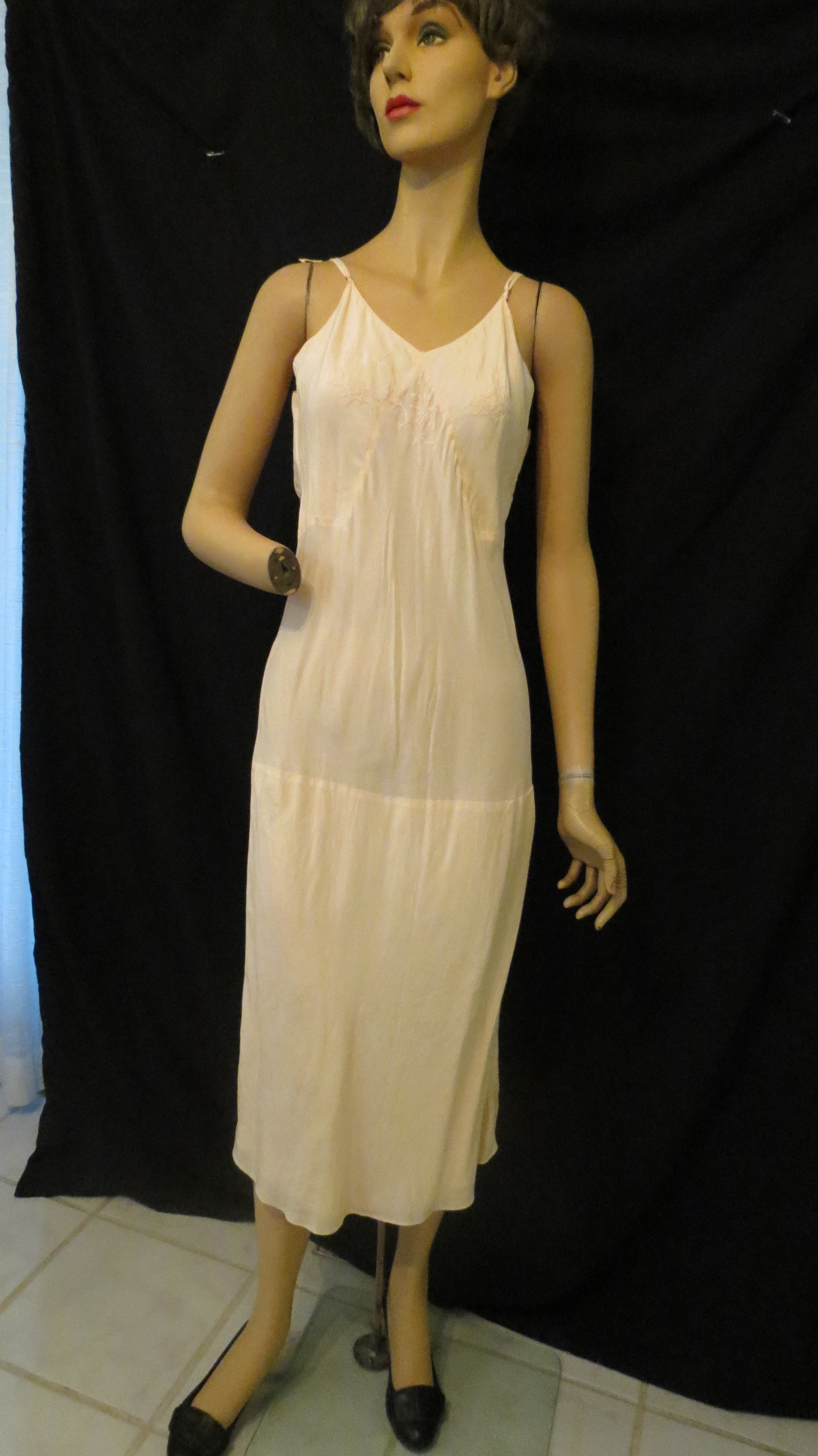
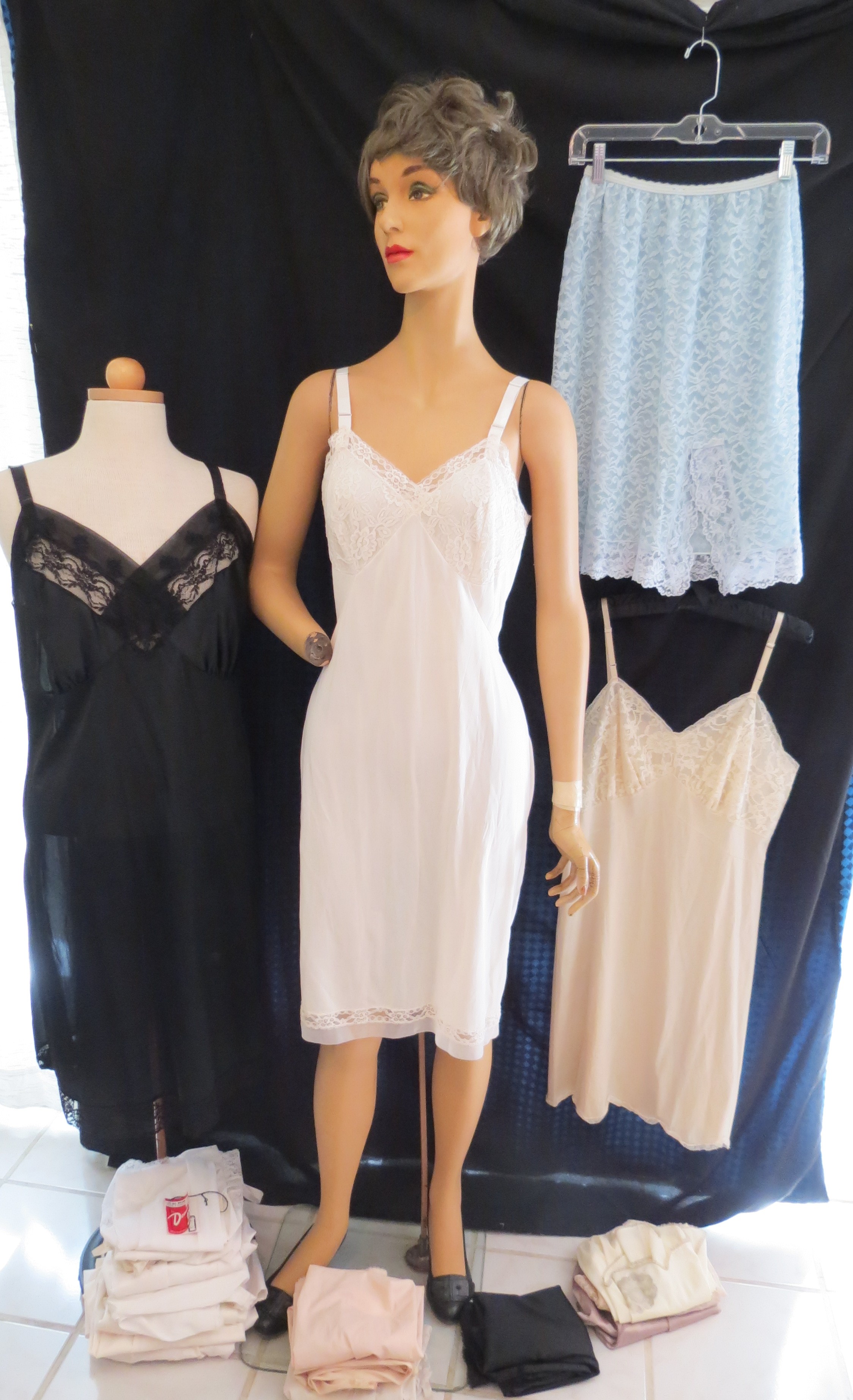
Here’s a sampling of my dozens of beautiful lingerie slips from several eras. True vintage lingerie is essential to wearing your dresses, blouses and skirts with their best fit and comfort. Slips can be fine cotton, rayon, silk, acetate or nylon. Designs can be highly decorated or very sleek and plain. It pays to have every type you can find in different lengths and colors. Some are so gorgeous they can be worn alone as “slip dresses”.

Matching your undergarments to your dresses in a way that minimizes binding, getting too hot or having some unsightly see-through makes all the difference in the final presentation of your outfits and your enjoyment of wearing them. Usually, you’re the only one who knows how truly beautiful your full or half-slip really is. Sometimes it’s fun to allow just a corner of lace trim to show beneath a hemline or at a neckline. In other words, have fun. Have a beautiful Thanksgiving holiday and stay tuned . . . . . . . . . . ..

MORGANA MARTIN, THE MAGICVINTAGESPY

BLOG: MAGICVINTAGESPY.COM

TRUE VINTAGE OUTERWEAR? FUR REAL OR FAUX? WE HAVE TO THINK ABOUT IT . . . . . . . . .

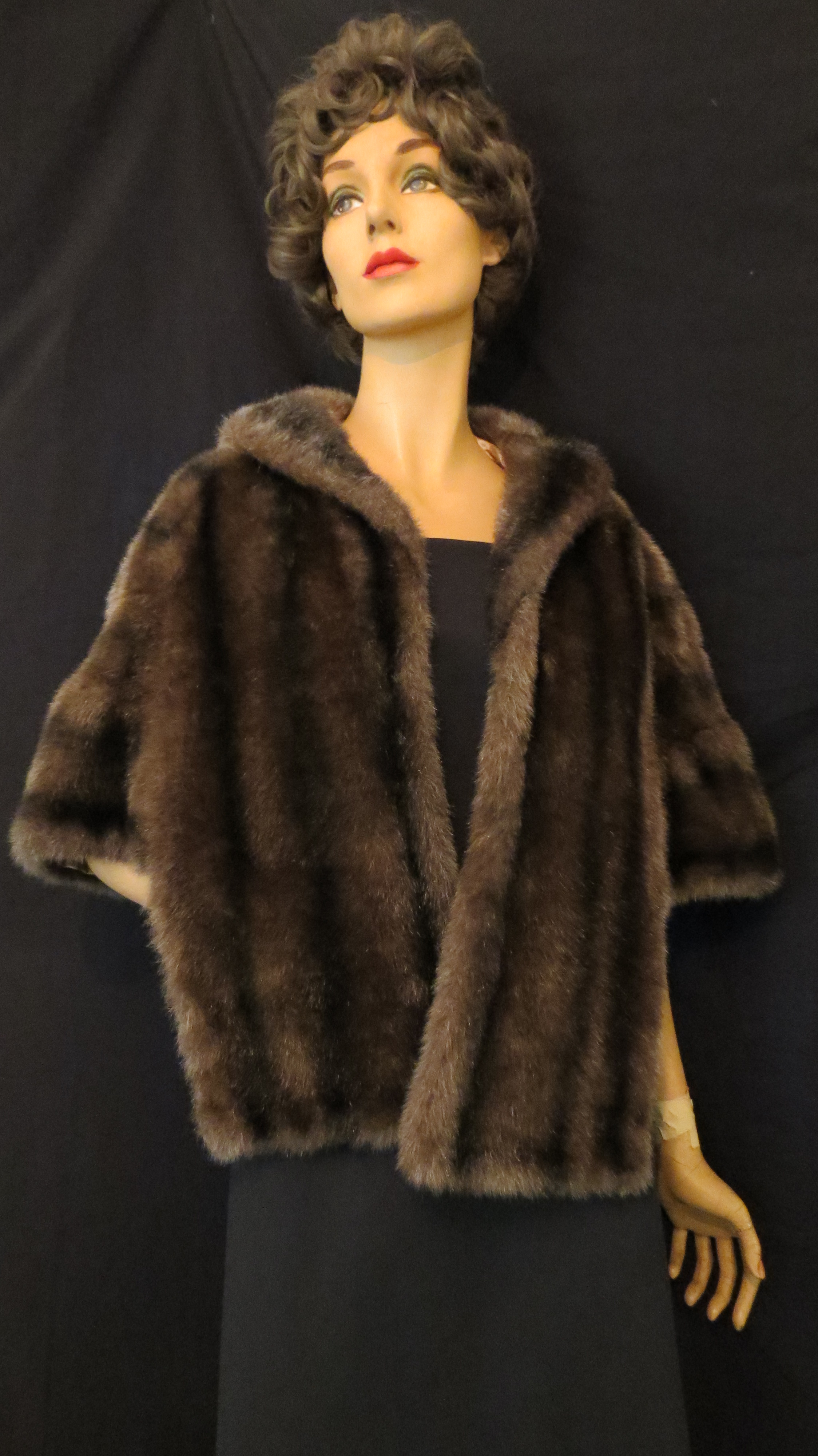
Last night I was out and about to a theater production and couldn’t reasonably drive a two block distance. Walking was the only choice, which I love, but IT WAS SO COLD!!! My warmest outerwear option, which kept me toasty and comfy, was my post-war beaver jacket from Canada. 75 years old and it’s still snuggly and beautiful. I grieve for the precious animals who (yes, WHO) were sacrificed for vanity and retail profit back in the day and will NEVER buy modern fur products. I advocate for animal rights but also celebrate those lives and gifts by preserving and enjoying elegant fashions from the past for as long as they will last.

I own many gorgeous fur and faux fur pieces made decades ago, before protective legislation and individual conscience stopped some of the fur trade and promoted humane practices. Above is one example, on the left, of an older fur jacket dyed to mimic mink. I cannot identify the fur – could be muskrat. Before the end of WWII, furs considered to be less fine were often processed this way. Other examples, such as the one on the right, are fakes – popular in the 1950’s and beyond. Some have been very convincing even since the 1950’s. Many of those made today look and even feel very authentic. The look is fun and elegant, in a vintage way, plus, as I proved last night, very practical.

Faux fur and secondhand true vintage furs are the best, the ONLY humane and progressive choice. I prefer those from the 1960’s and before. The remaining fur trade is still a blot on humanity, so we must be vigilant in our boycotting of this active market but I don’t see the enjoyment of historical fashions as being hypocritical. I will continue to show you how much I love them. Stay tuned . . . . . . . . . . . . . . . . . . . . . . . . . . . . . . . . . .

MORGANA MARTIN, THE MAGICVINTAGESPY

BLOG: MAGICVINTAGESPY.COM
Undercover Magic, Essential True Vintage Lingerie

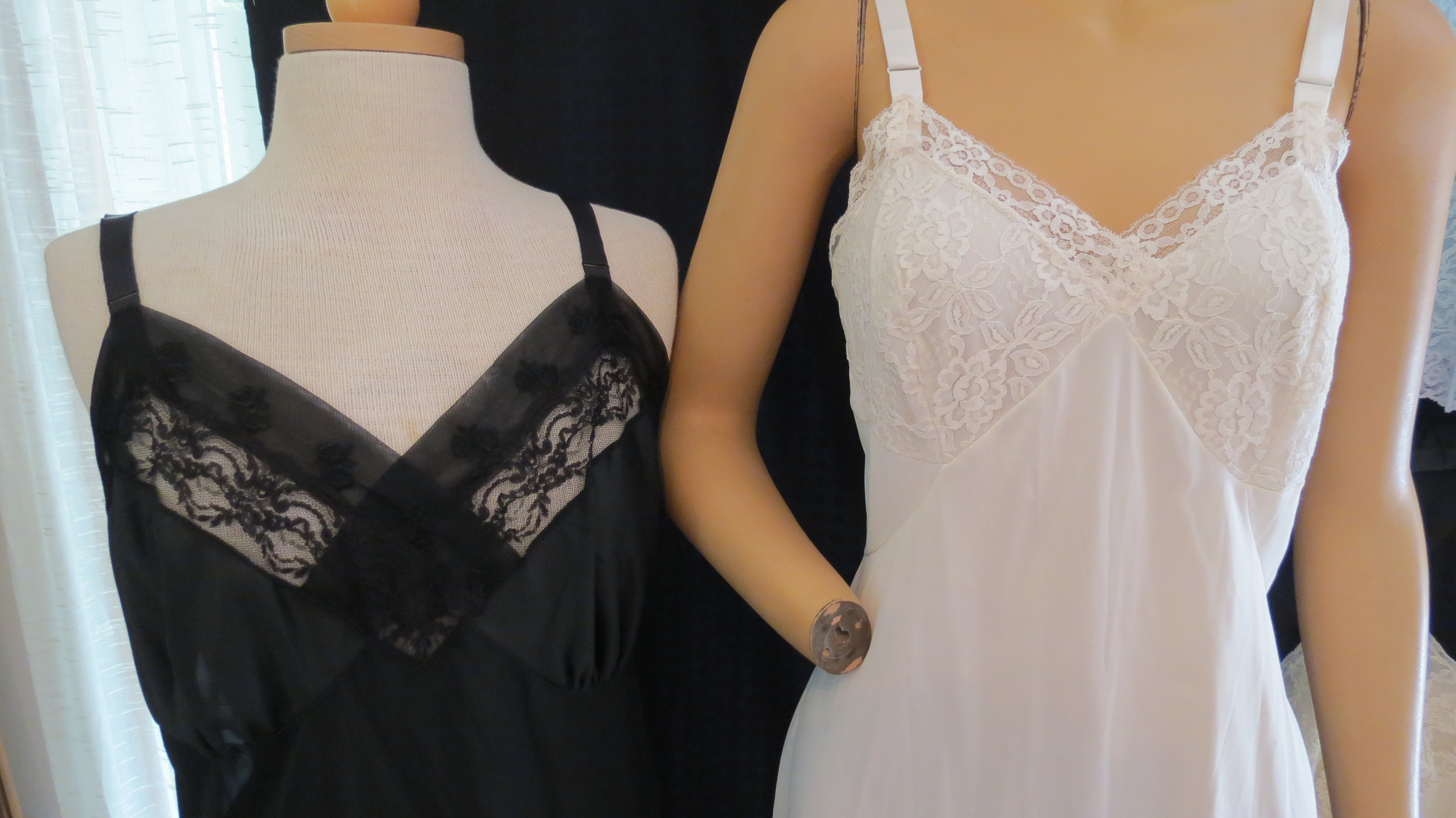
No matter what you’re wearing, lingerie pieces are key to making the outfit look right. Preventing lumps, bumps and see-through are only the simplest issues. The proper undergarment also ensures that the fabric lays correctly on your body and allows it to drape without clinging. Above are a very few examples of beautiful slips and only a tiny fraction of my complete collection.

You can see here how lovely the details are. Typically, even the plainest design will have nice little details and excellent tailoring. More elaborate styles are full of lace, embroidery, ribbons, sheer panels, satin straps and, often, some work done by hand. Though most slips are done in neutral, pastel colors, some (especially from the 1950’s to early 1960’s) were made in fabulous vibrant colors. True vintage nylon has a feel like no modern fabric and is absolutely luxurious. So gorgeous they could often be worn as a lightweight dress or skirt on their own.

Look for vintage lingerie that suits your wardrobe. Notice the details. Slips, of course, are the basis if you wear dresses and skirts. Search for cotton slips as well as the more-common nylon ones. In the summer, you will appreciate the difference! It’s also important to match your undergarments to the clothing worn with it – if anything might show or peek out, whether by accident or on purpose, will the color be OK? How will your outer garment move over the fabric of the slip? How will the fabric of the slip react with your skin in hot weather? Lots of things to consider in order to get the best result.

Also, look for other undergarments – in the 1960’s some split slips were made to be worn under culottes and split skirts. “Slips” to be worn under slacks can even be found from the 1960’s and 1970’s. A 1950’s/1960’s girdle was ALWAYS a base foundation for most women at that time (thank goodness, not now!). If you’re wearing a wiggle dress, you may not have a choice in order to make it look right. Silk tap pants from the Twenties are so comfy and perfect under a lightweight dress in the summer. A camisole under a blouse or top can improve the fit, add some warmth on a cold day and sometimes provide a little neckline interest depending on the style. A “bullet bra” is perfect if you want to be a “sweater girl”. Garter belts and girdles are necessary for wearing stockings. A crinoline is important for most mid-century dress styles with circle skirts, especially from the late 1940’s through the early 1960’s. Some dresses have their own, but others require you to add one.

I’ve probably forgotten to mention something but you get the drift. Lingerie is SO important that I probably should always start any series of posts with it. . . . . . . . . . . . . . . . . . .

MORGANA MARTIN, THE MAGICVINTAGESPY

BLOG: MAGICVINTAGESPY.COM
More Accessories ESSENTIAL for a True Vintage Wardrobe: Scarves and Ties

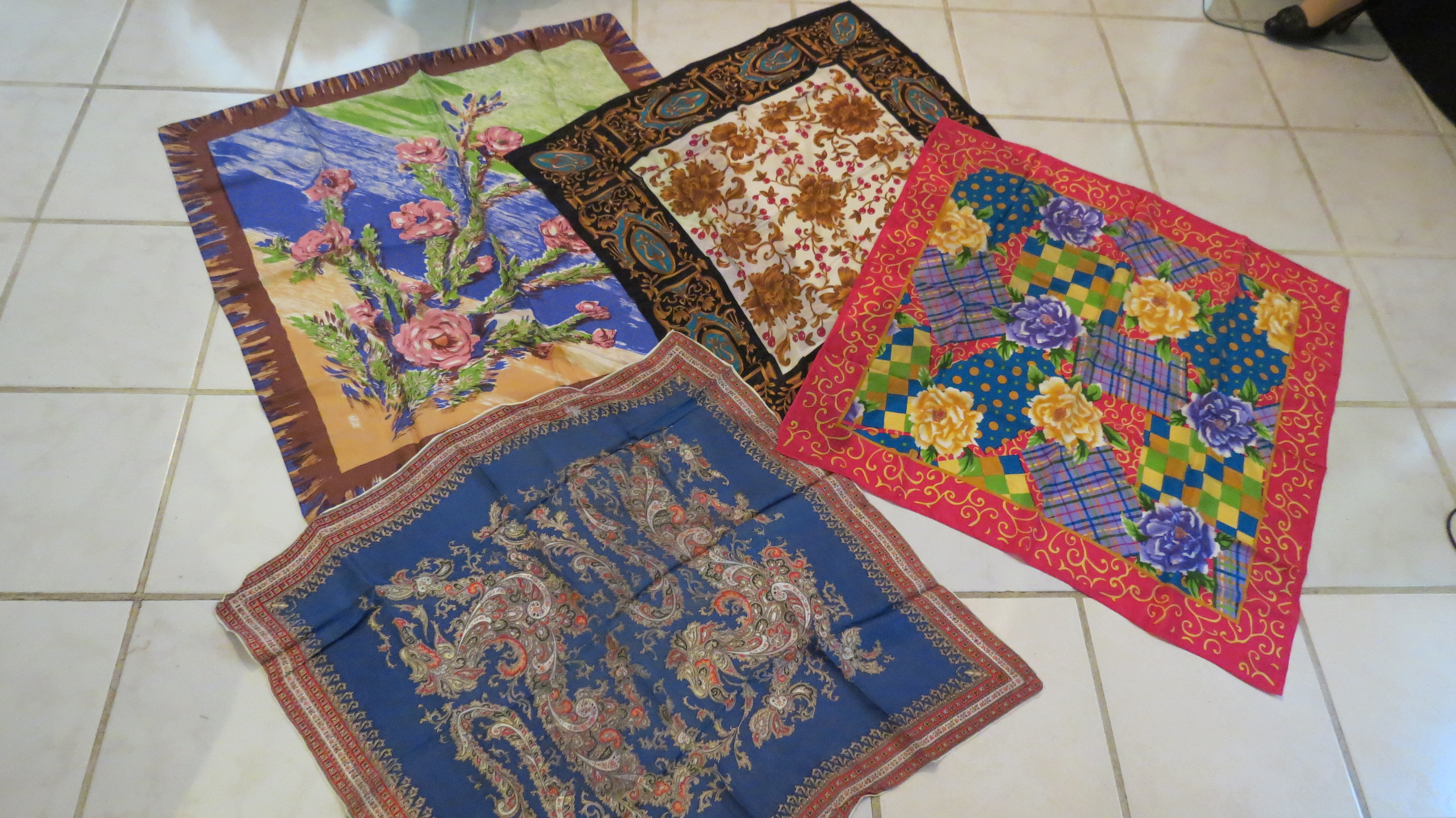
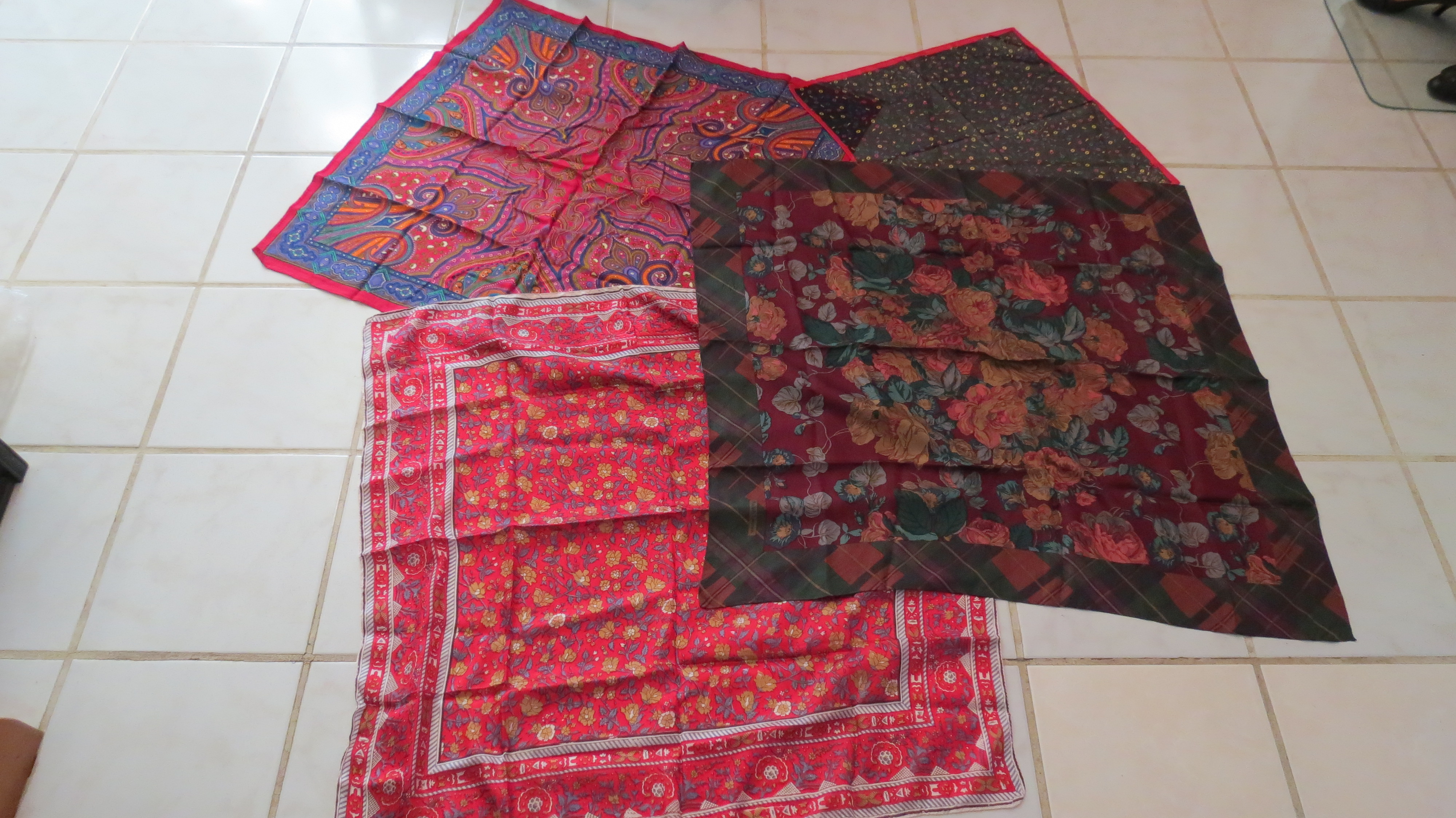
True vintage scarves are a must-have. They are generally very well-made with hand-rolled and stitched edges. Often, they are made of silk; if not, the fabric is of very good quality. Mostly, it’s the artwork on printed vintage scarves that is so wonderful. The only essential example I’m not showing here is the souvenir scarf, depicting scenes from a specific place or theme. Mid-century women collected these. Large scarves are great as capes or folded into turbans. Small scarves make cute little collars or accents on handbags or pockets. Every size in between can be worn in a gazillion variations. Lots of books and online tutorials teach you how to do this.

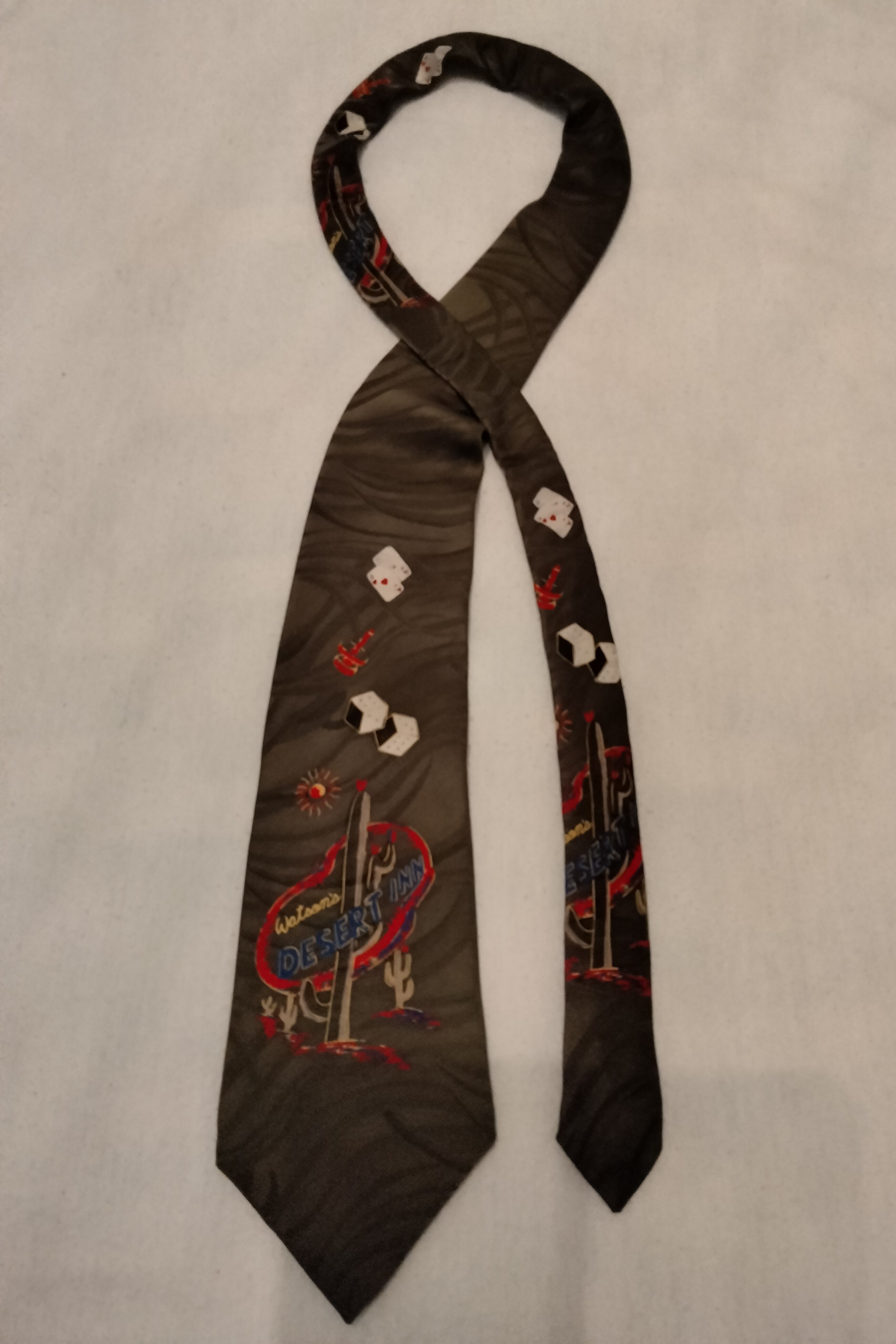
For a menswear outfit, a true vintage necktie is key. I especially love the mid-century graphics. Some 1940’s ties are truly spectacular and the only example I have of this style is a 1970’s/’80’s souvenir tie from Watson’s Desert Inn in the Canary Islands.

Scarves and ties alone can make up a vintage collector’s obsession but I prefer to use them as accessories only. As a very useful clue added to a modern or otherwise banal outfit, they can open unexpected doors. Stay tuned . . . . . . . . . . . . . . . . . . . . . . . . . . . . . . . . . . . . . .

MORGANA MARTIN, THE MAGICVINTAGESPY

BLOG: MAGICVINTAGESPY.COM