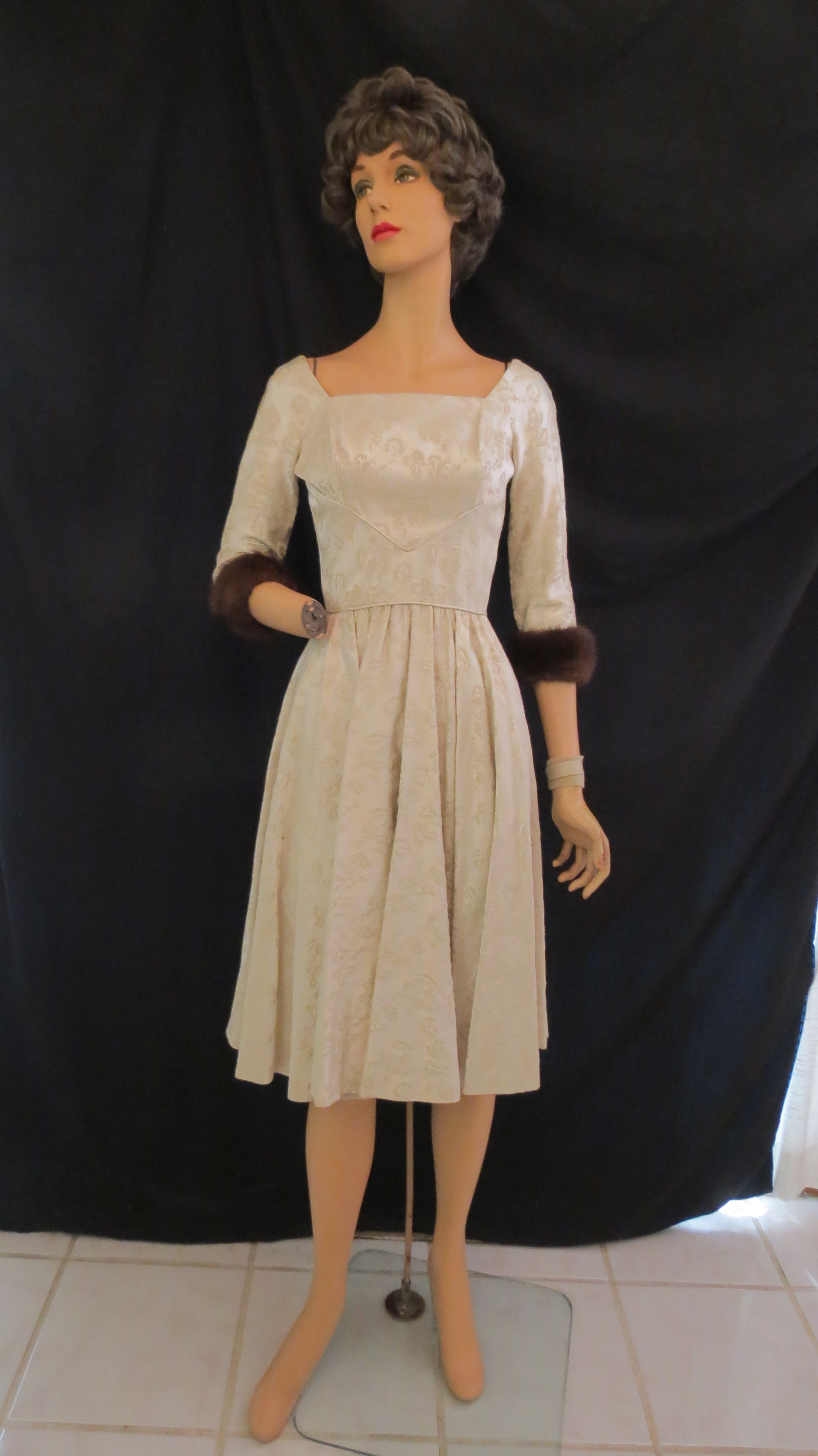
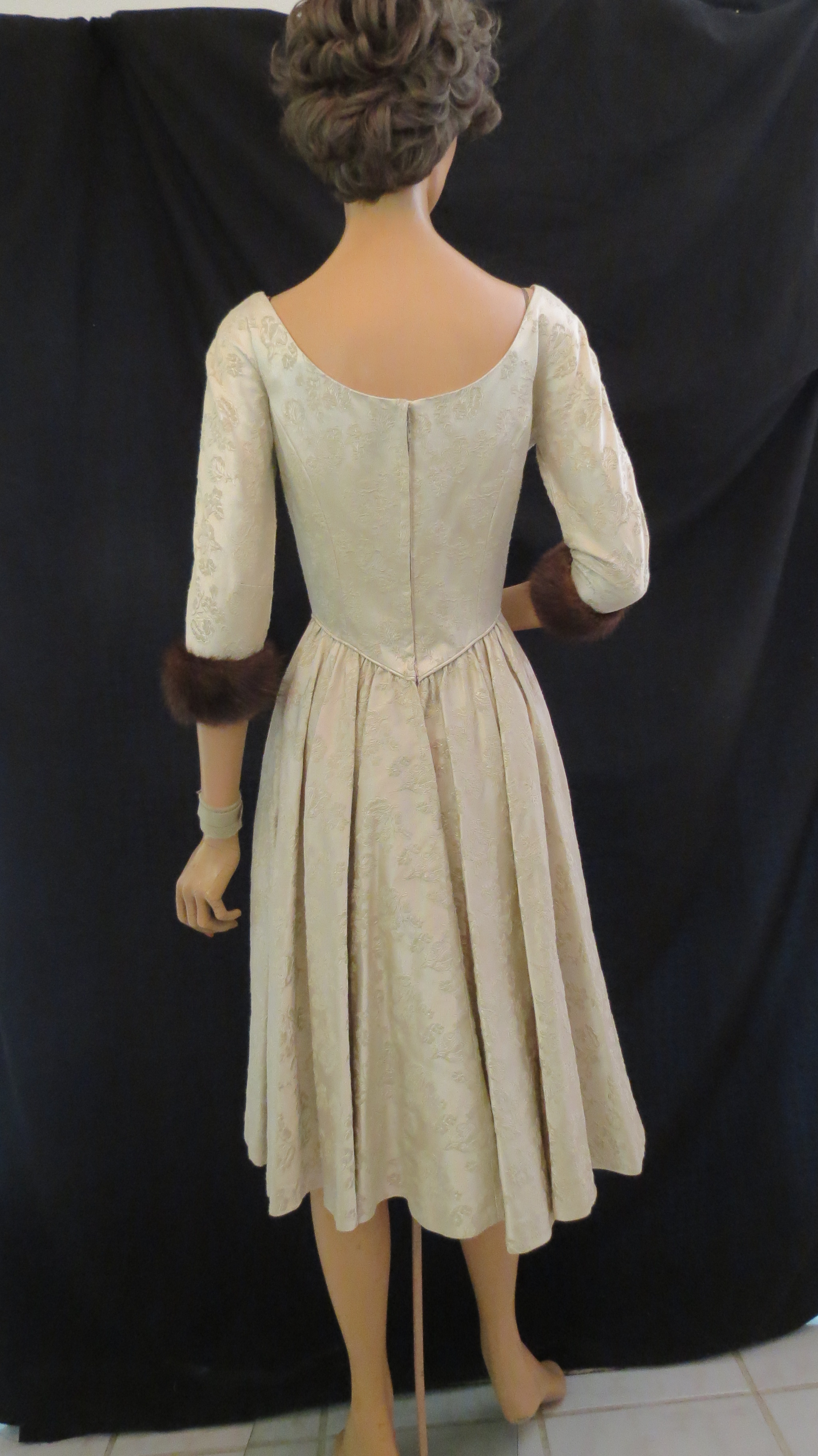
New Look style without the crinoline. Nipped waist and full skirt. Instead of in the front, as was possible in the 1940’s, there’s a V-shaped seam at the back waist. In this case, we also see the increasingly-popular fur-trimmed sleeves. The fabric is a medium-heavy jacquard with a glossy brocade look. Again, simple elegance though the fur trim does put it alittle over the top, to my eye.
There’s no label, so this gown could have been custom-tailored but it’s quite possible that the owner removed the tag, as so often happened. It’s a lovely semi-formal dress with a neckline which could show off a statement necklace. Doesn’t need that in any way as far as I’m concerned, but you know how some women are. . . . . . . . . . . . . . . . .
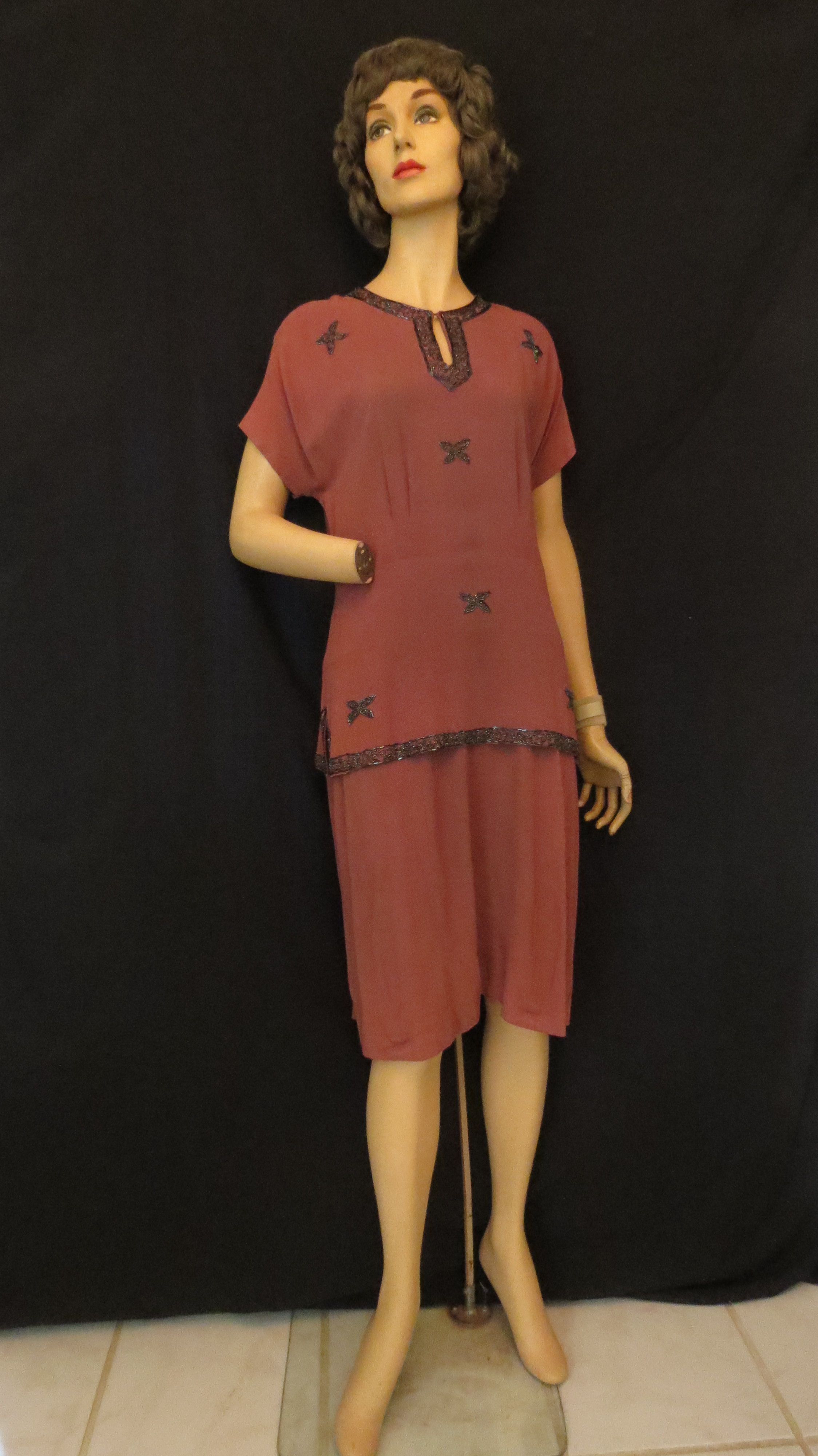
Several elements here from the decade between the two World Wars. Drapey rayon fabric, geometric beading decoration a la’ art deco and a dropped waist/peplum effect, a la; the 1920’s and the early 1940’s. The length also doesn’t know exactly where and when it is – looks pretty short on a tall gal like Stella but would be midi-length on a woman of short stature, or even medium height at that time when average height was shorter than it is today.
As “upscale” as this looks, it was apparently a massed-produced design. That makes it a little easier to understand why the styling was as confused as the times. Marketing always follows social trends. Think about it; we were still recovering from WW1, Prohibition was effecting the economy and the culture, The Depression was strangling almost everybody, war was fomenting in Europe and it was looking like WW2 might happen any day.
Yes, it’s a pretty and fun dress but the historical and cultural overtones are even more fascinating. Just another day in the life of a true vintage sleuth. We ARE going to cross the Post-war border between the 1940’s and the 1950’s by early next week. Stay tuned . . . . . . . . . . . . . .
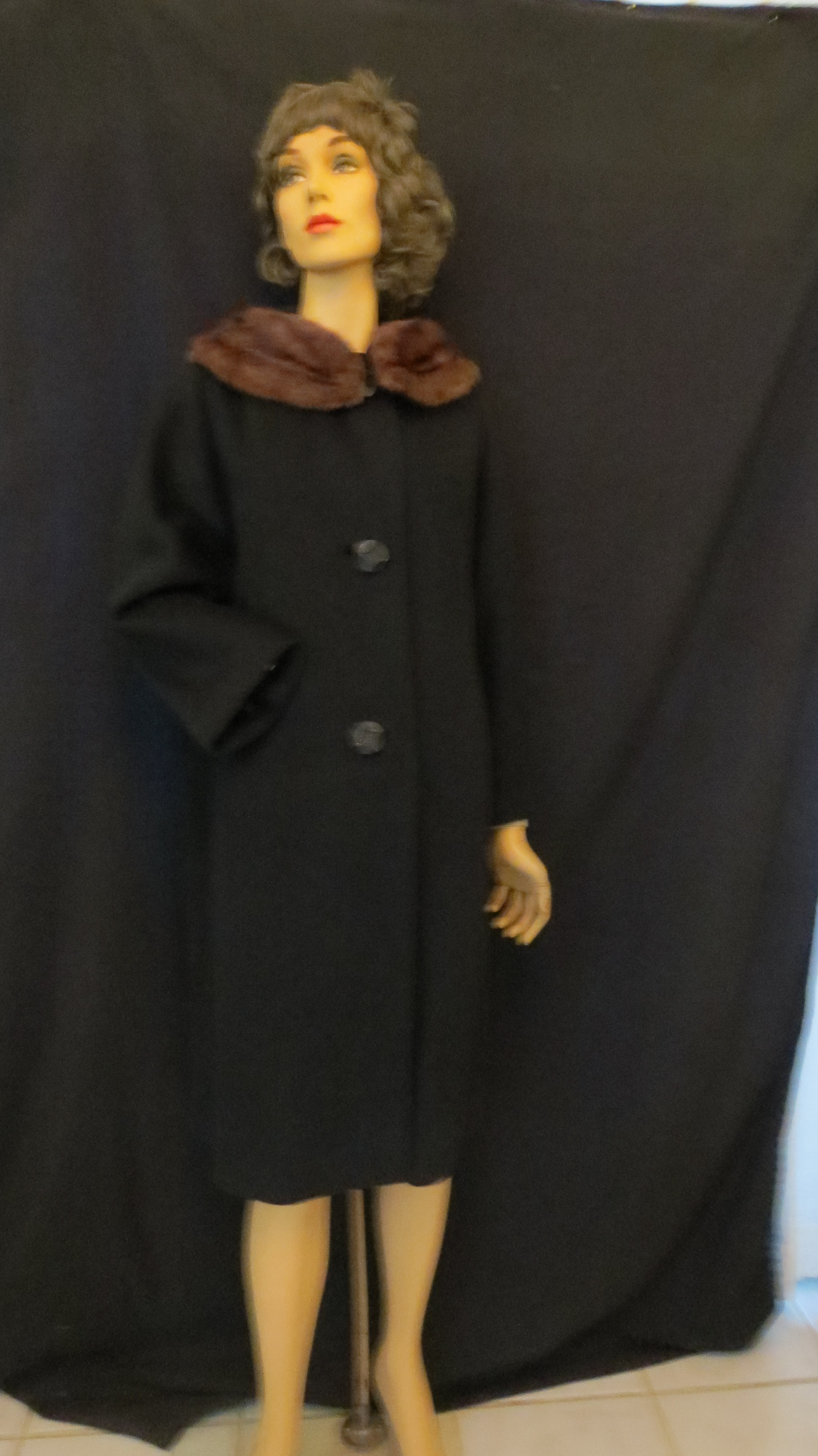
The standard and traditional mid-century classic: a wool coat with fur collar and oversize buttons. Perfect and elegant in black. Wartime in Europe hadn’t yet impacted women’s fashion with rationing, but the economic Depression was being felt by almost everyone. Though the fur collar is not fine, the owner of this coat was a lucky lady.
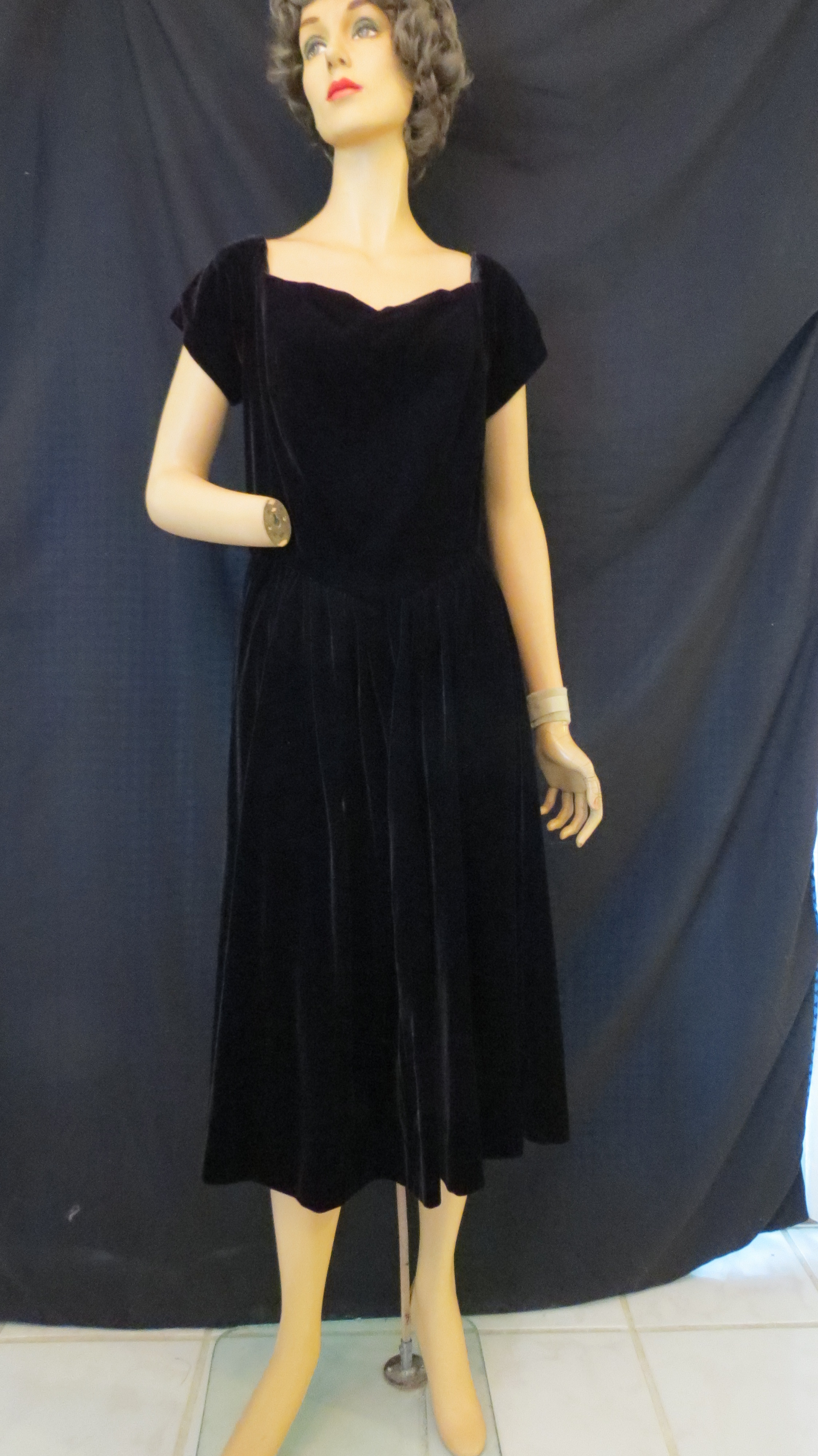
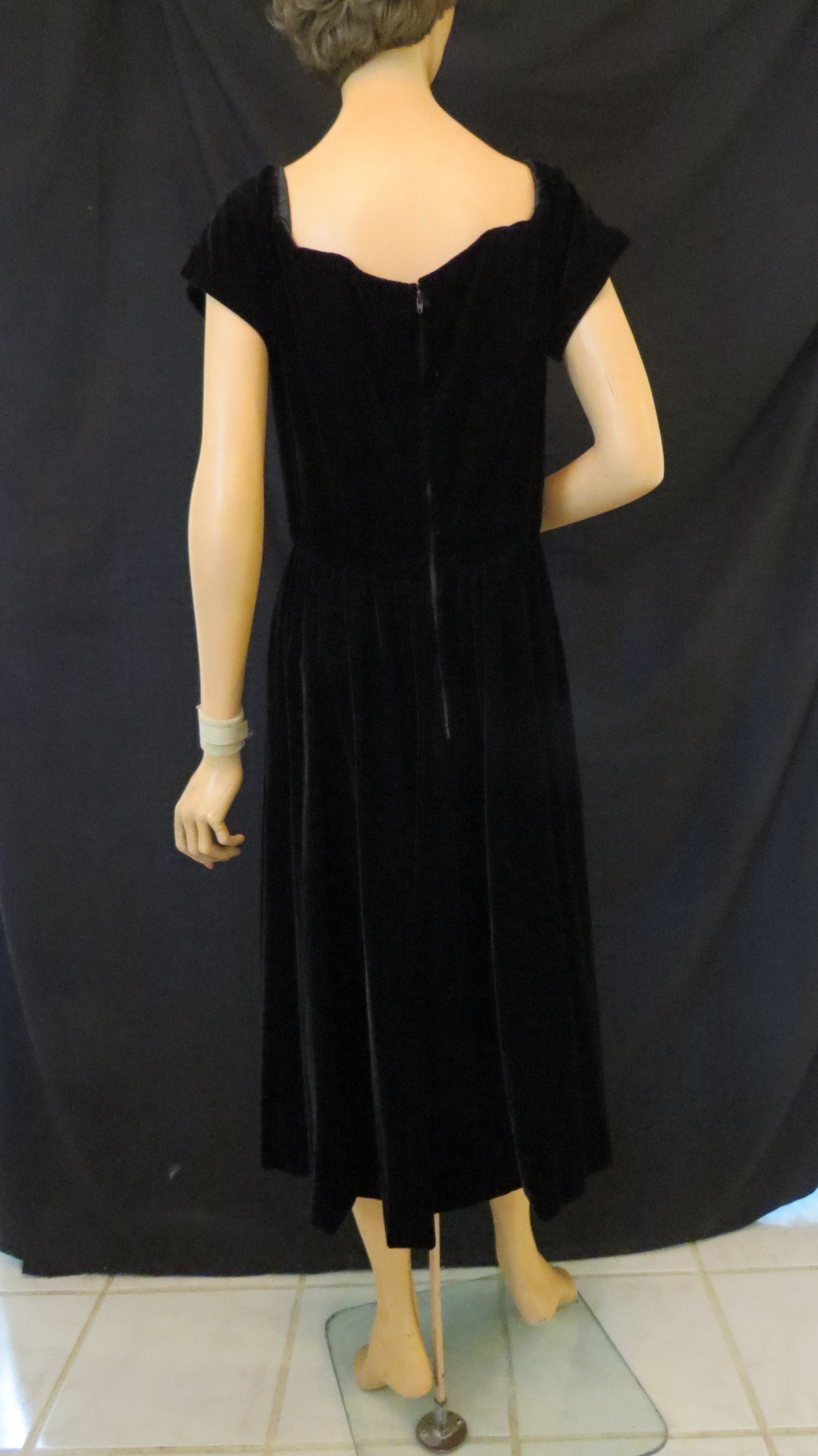
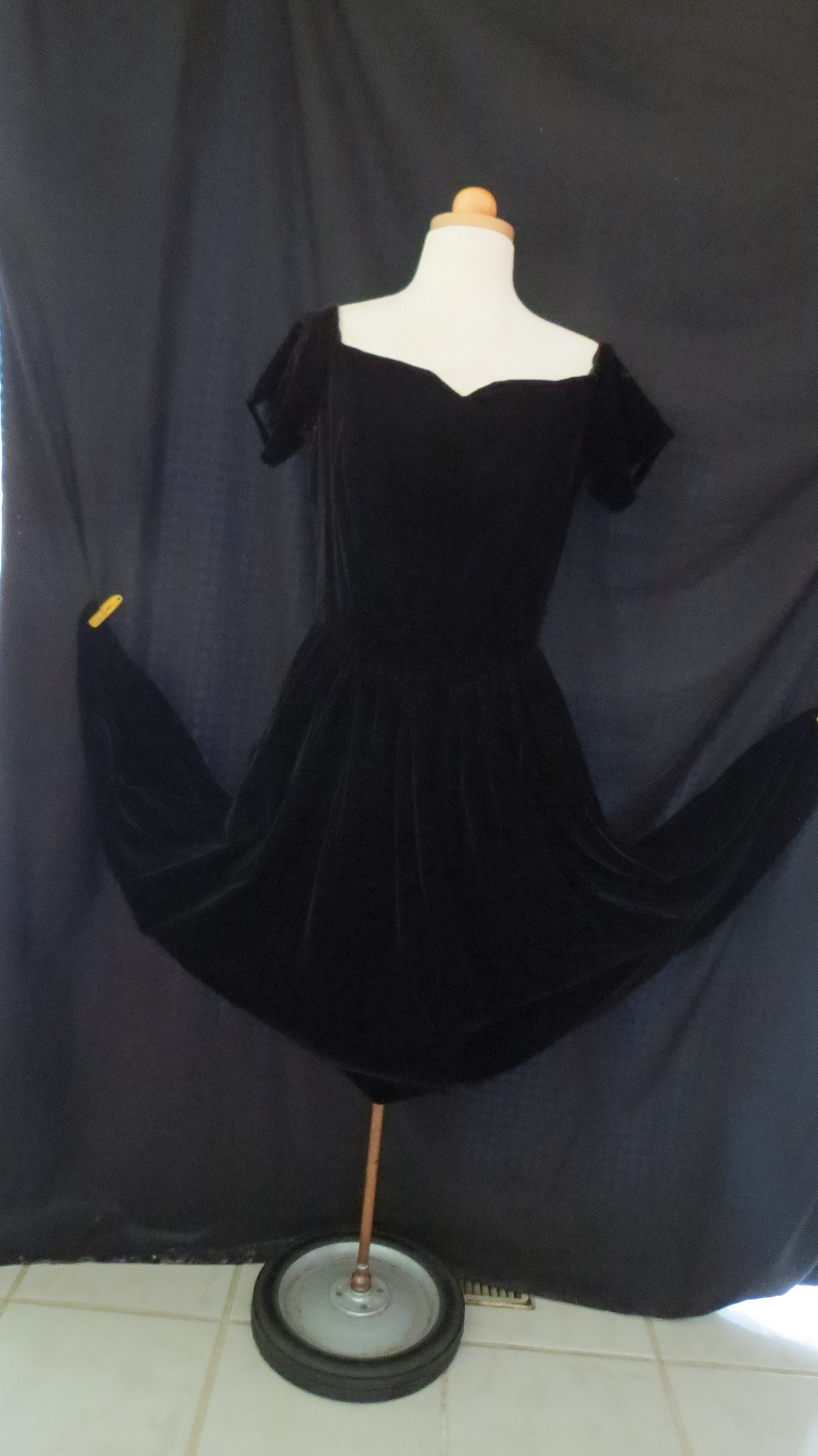
Here’s a lovely frock made by an amateur (?) tailor with her own name label sewn in. The photos don’t do it justice – the tailoring is exceptional. No decoration – classic and elegant. Neckline is the focus, but the features of a post-war 1940’s New Look dressy frock are faithfully recreated – nipped waistline and the point at waist front, sweetheart neckline, very short sleeves and circle skirt. The fabric is a lush velvet.
So, I had to collect it when it showed up. More coming before we round out this decade. Stay tuned . . . . . . . . . . . . . . . . . . . . . . .
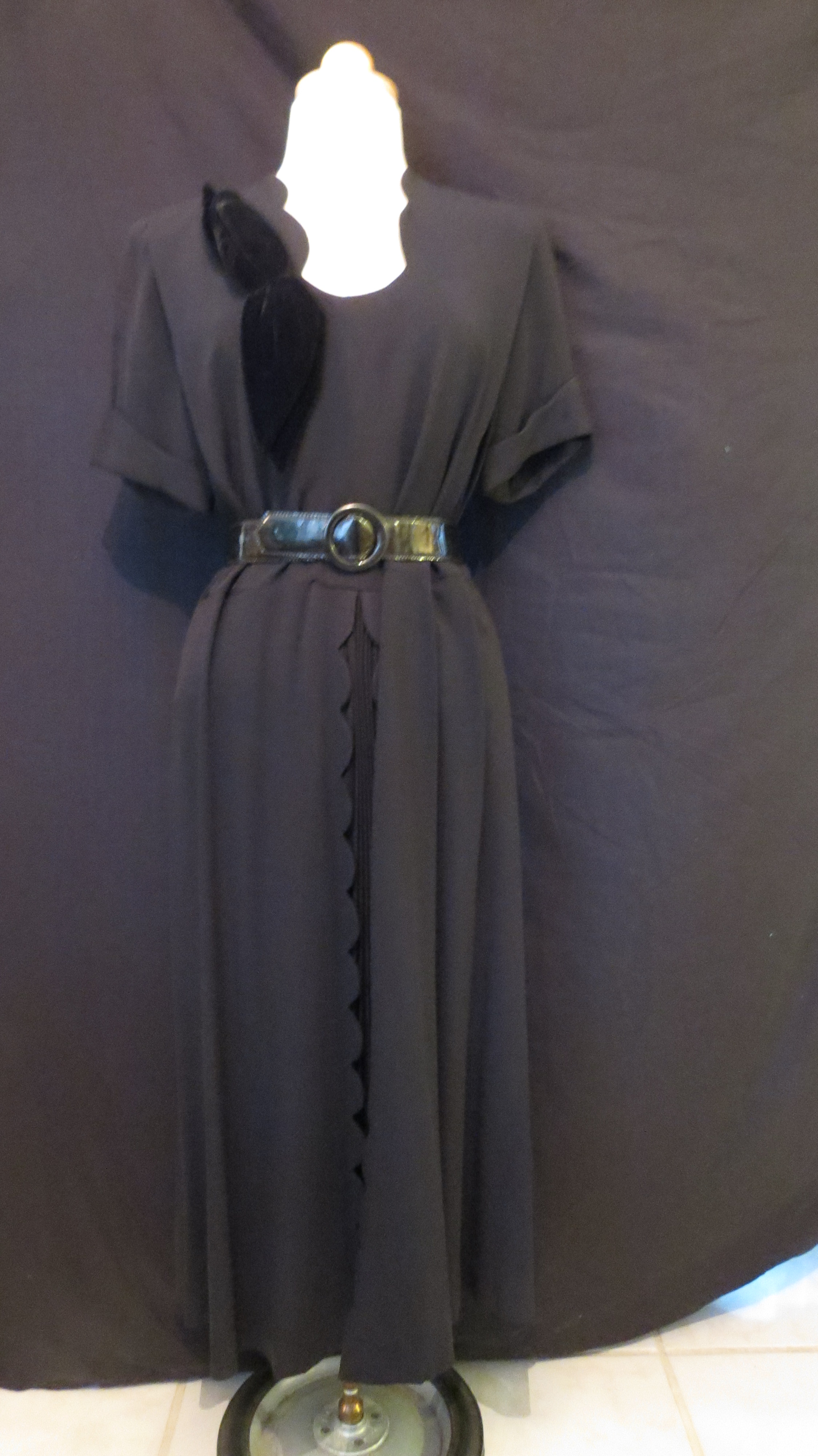
This pretty dress is made of rayon material with a BIG velvet bow and inverted front pleat for added interest. I love the scalloped overlay and the shaping on the cuffs of the short sleeves, which is SO Forties! This dress is labeled as having been made by a company or maker that was nationalized during the years surrounding and following WW2 when many, if not most, fabrics and notions available to garment-makers before the war and the Depression were unavailable to manufacturers and home-tailors because of rationing. Women still wanted pretty fashions and our government helped to make that possible and affordable.
Despite having no lining or buttons, there are very nice tailoring details. It is, unusually for that time, quite a large size but is so well-cut that belting it on my size 6 mannequin (thank you, Madge!) still looks amazing. That is an advantage of any well-made garment and especially in the case of most true vintage clothing. Stay tuned for more . . . . . . . . . . . . . . . . . . . . . .
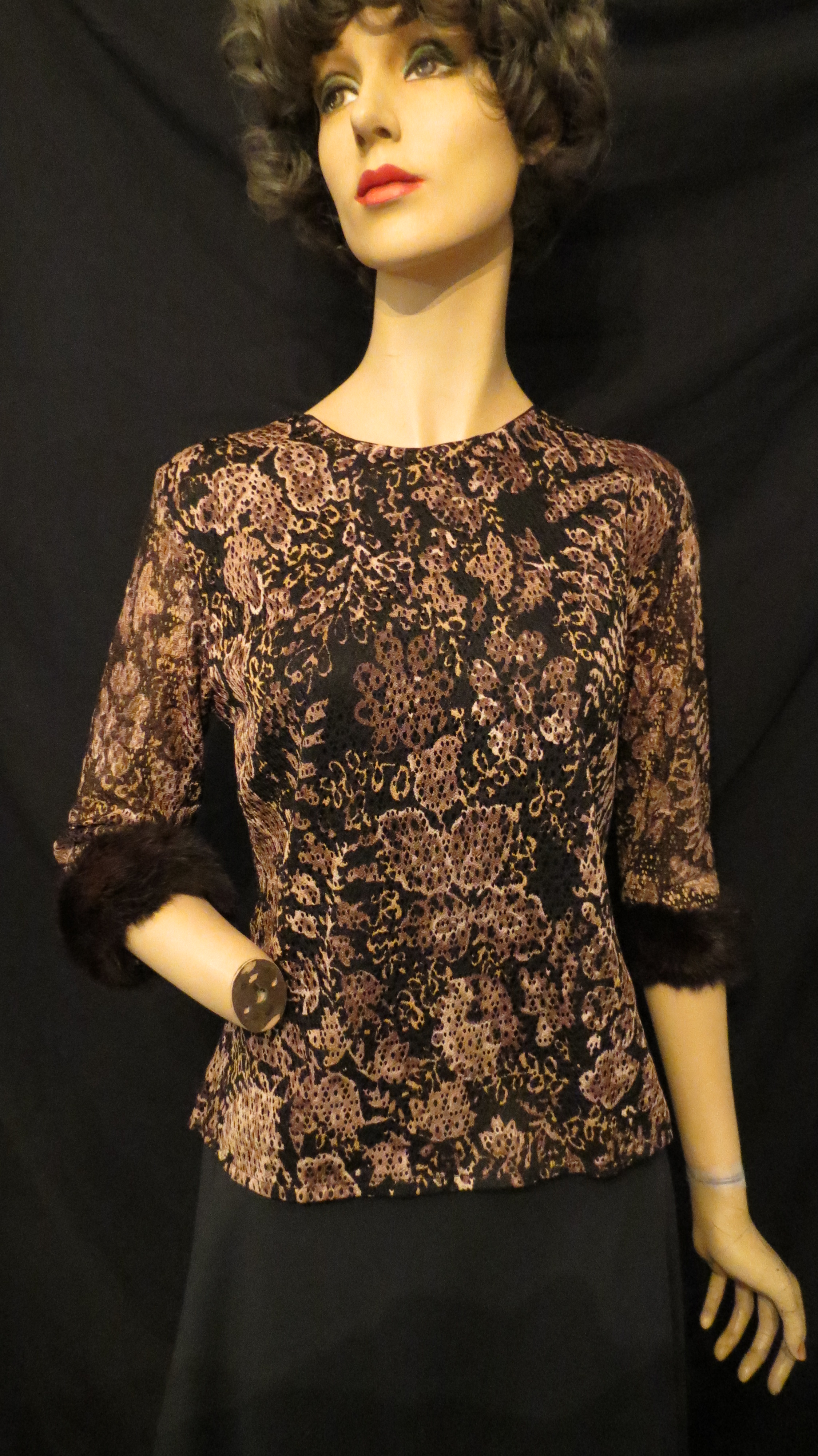
What a wonderful, unique and chic mid-century piece! Discovered during an investigation in Australia, this pretty top made in Britain (or by a British company) is made from semi-sheer fabric that has a woven-in contrasting pattern. It buttons up the back and has the distinctive feature of 3/4 length sleeves with fur cuffs. Great fit and gorgeous over a black skirt or dressy pants. Casual, but elegant.
Women’s semi-formal clothes were especially fabulous between the 1920’s and 1960’s. Although many dresses, skirts and blouses had lovely decoration in the years before, styles were too buttoned-up for my taste. After the 1960’s quality, creativity and elegance really seemed to take a dive. Give me styles from the Prohibition speakeasys, film noir and revolutionary Sixties any day. The Seventies had too much polyester, the Eighties had some great Forties retro and avante guarde New Wave but were overall too gaudy and the Nineties had an overabundance of black. Of course, great pieces were made during all these decades but seemed to be the exception. Just my opinion – you decide.
Thank goodness that modern faux fur and animal skin alternatives have become almost indistinguishable from real ones which, in my opinion, are an abomination. This also includes silk, tortoise shell, horn, coral, pearls and ivory. True vintage pieces made from these materials decades ago are an important part of fashion history and can be fun to collect and wear but I ask my viewers NEVER to support the market for these products by buying modern items made from them. This is how we can block the profit from breeding and slaughtering these wonderful creatures and stop it. If you are looking for clothing and accessories made from any of these, check at a secondhand thrift or antique store. Thank you and stay tuned for that 1940’s series . . . . . . . . . . . . . . . . . . .
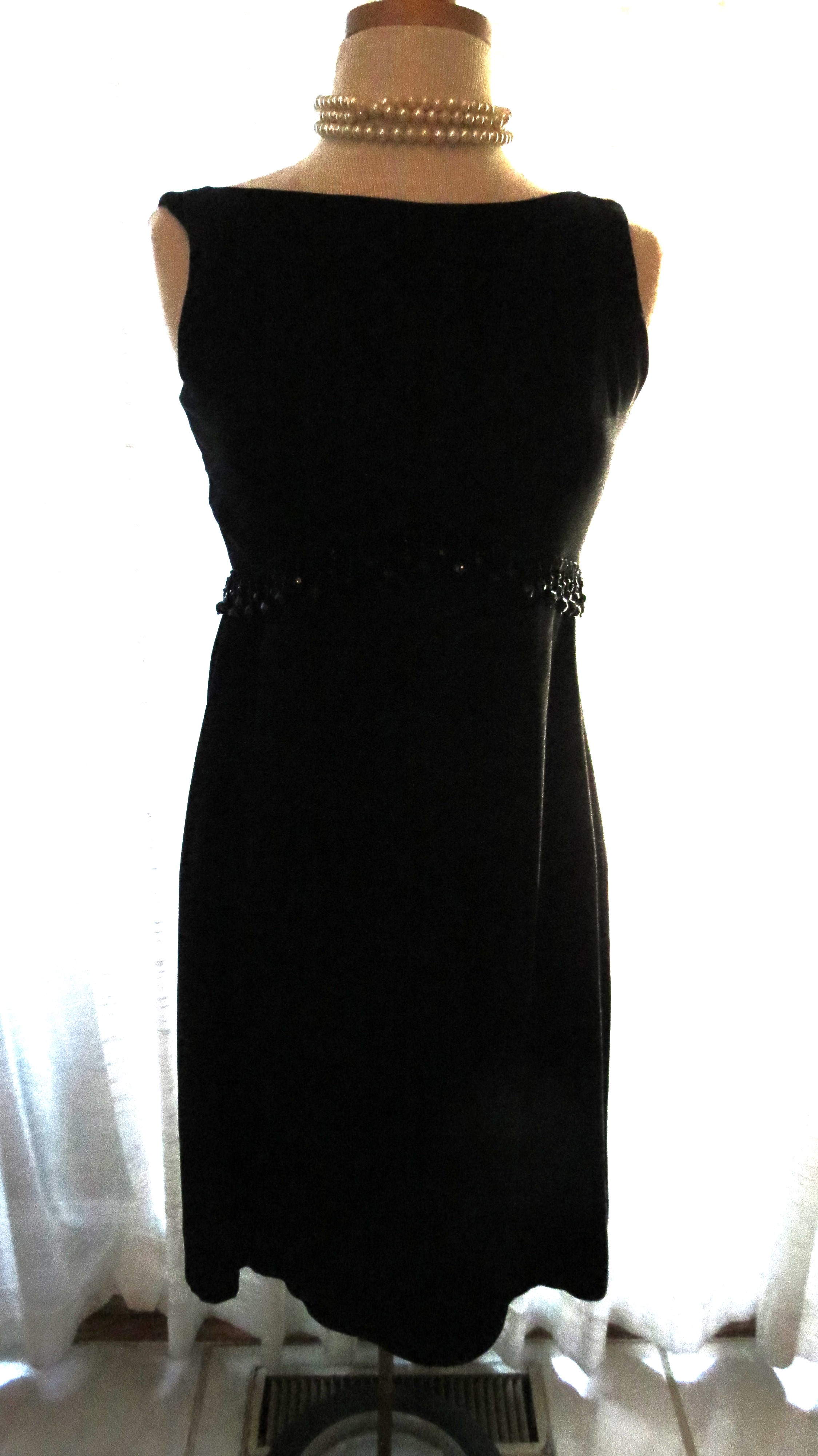
From the early to mid-1960’s, a sleek, sleeveless classic sheath style cocktail dress with a boat neckline, which I love. It’s knee to bottom-of-knee length, which is a very flattering hemline on most women and was common at that time right before almost everything had an above-the-knee or mini length. It’s so hard to get good detail on black clothing in photos, but this one is easier because the only decoration is a medium-width band of black beading at the waistline. Very well-tailored in a light-medium weight knit fabric with a very nice drape. This one factor takes it over the line from a Summer dress to one for Fall. Good quality, good fit – the signature features of well-made true vintage clothing.
I have more examples in the files of 1960’s LBDs but, in my images file, I ran across a large number of dresses of this type from the 1940’s. I’ll probably break the timeline to put these in the next posts before resuming to LBD’s from the more recent decades. I am traveling back to Headquarters as of tomorrow, so there may be a few days pause while I reorganize. Won’t be long so stay tuned . . . . . . . . . . . . . . . . . . . . . . . . . . . . . . . . .
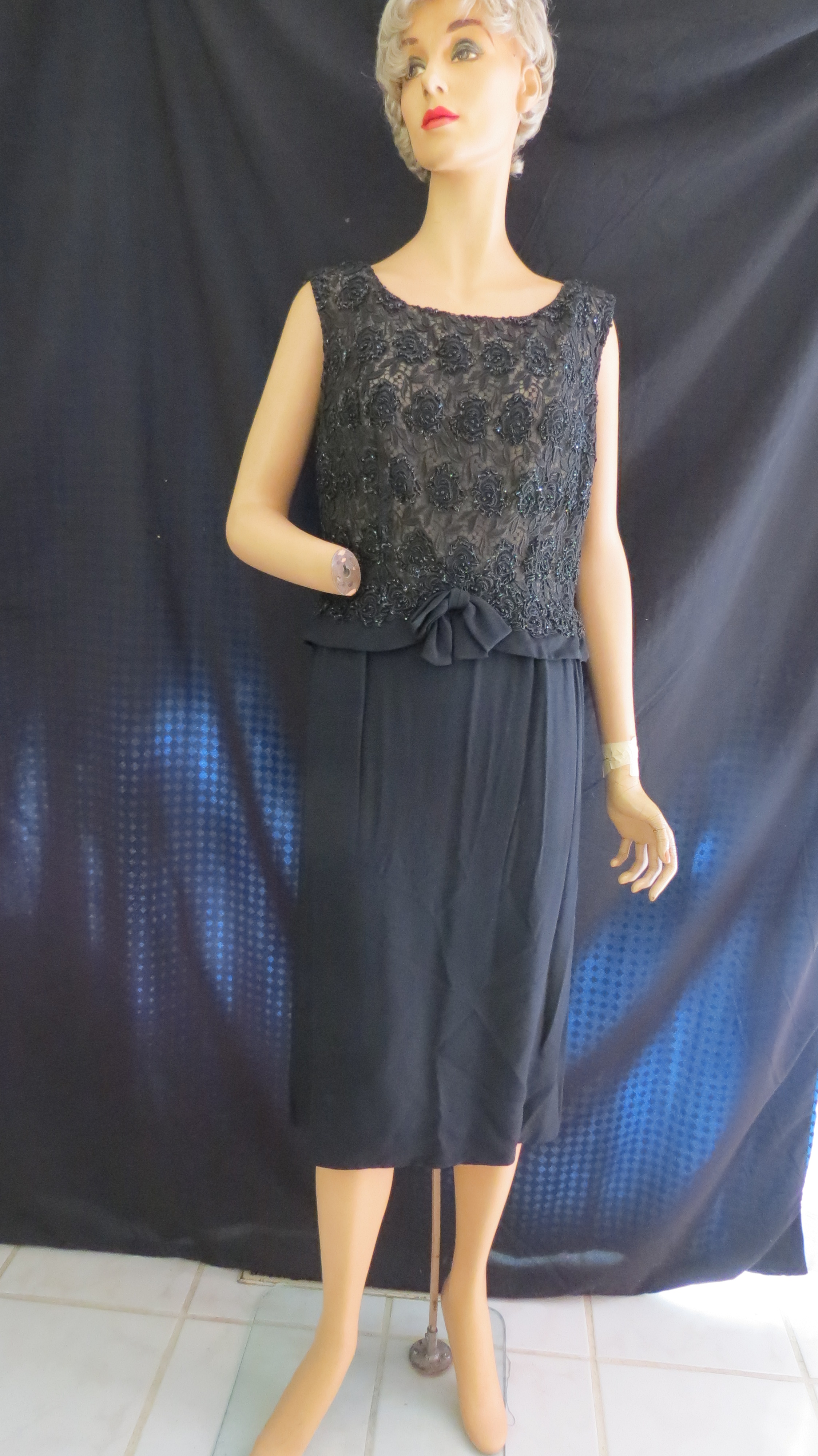
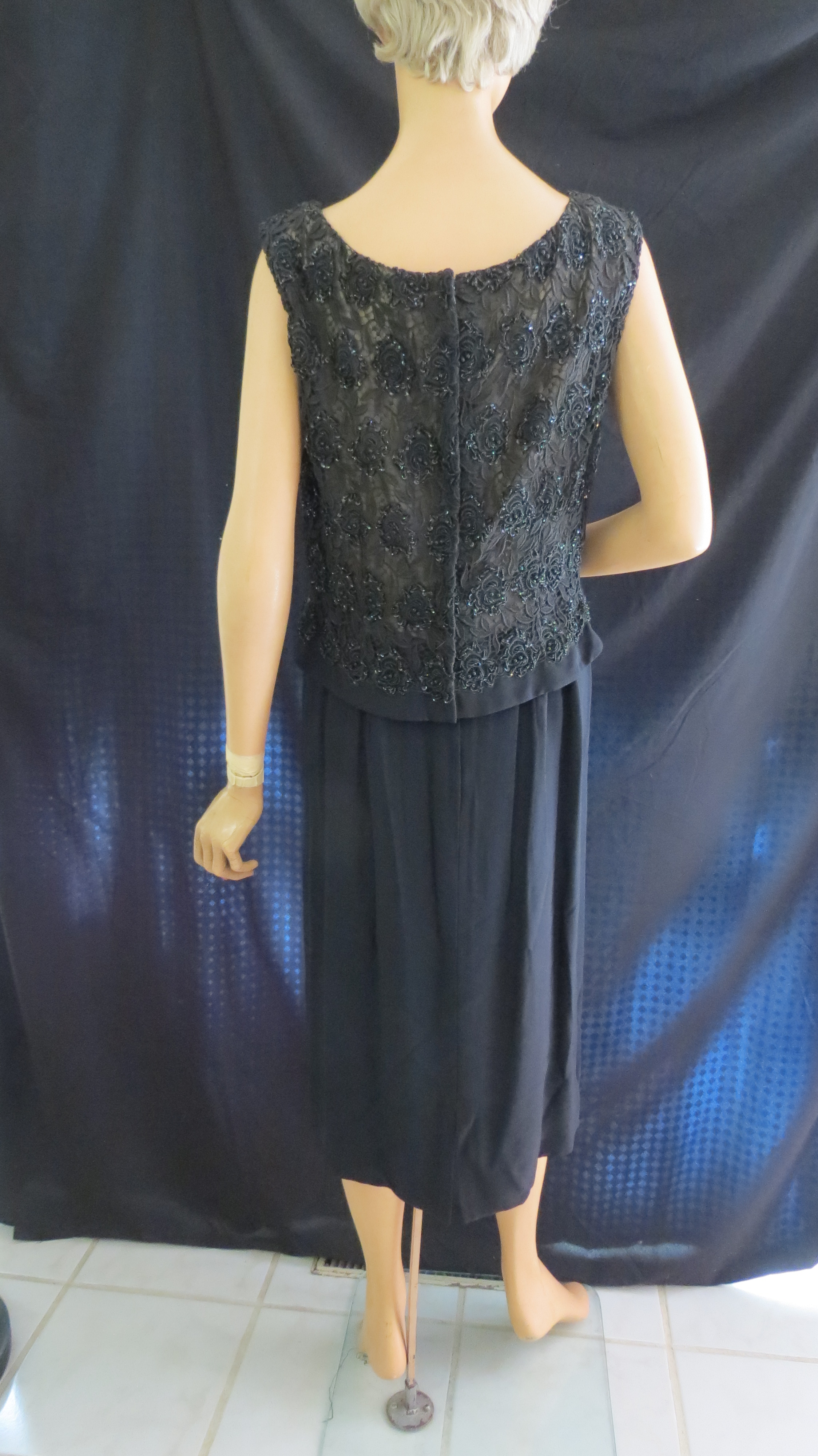
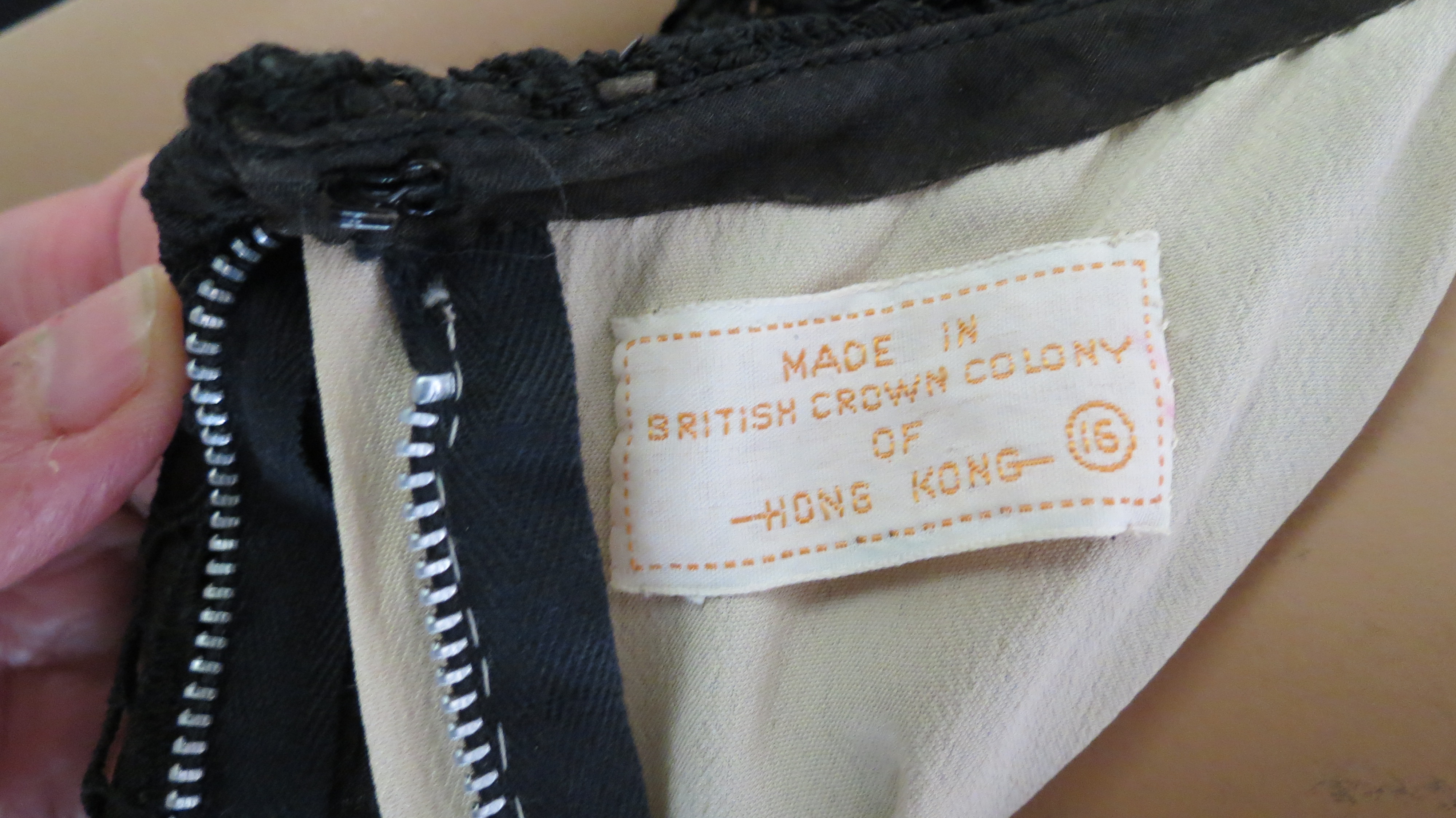
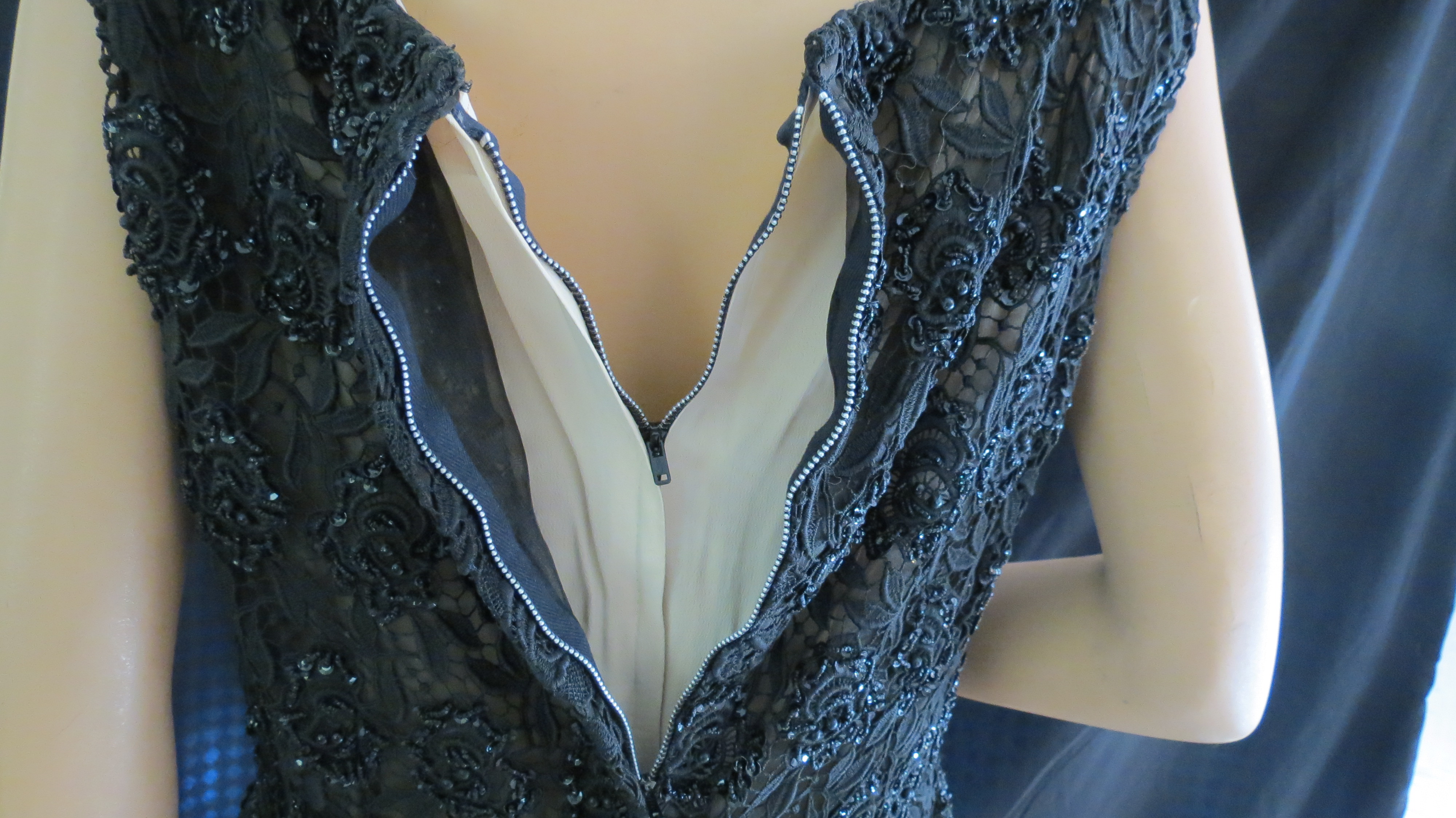
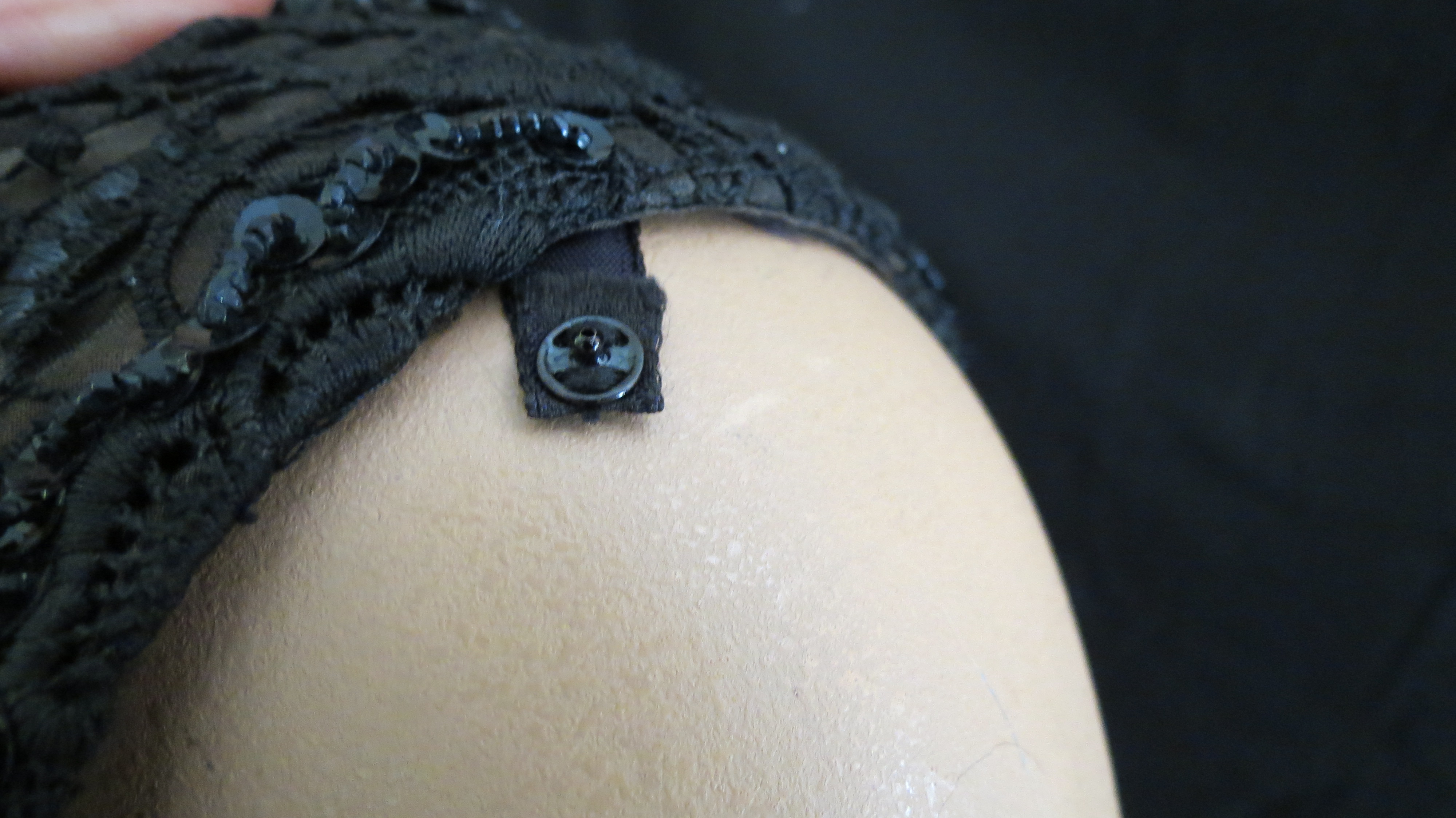
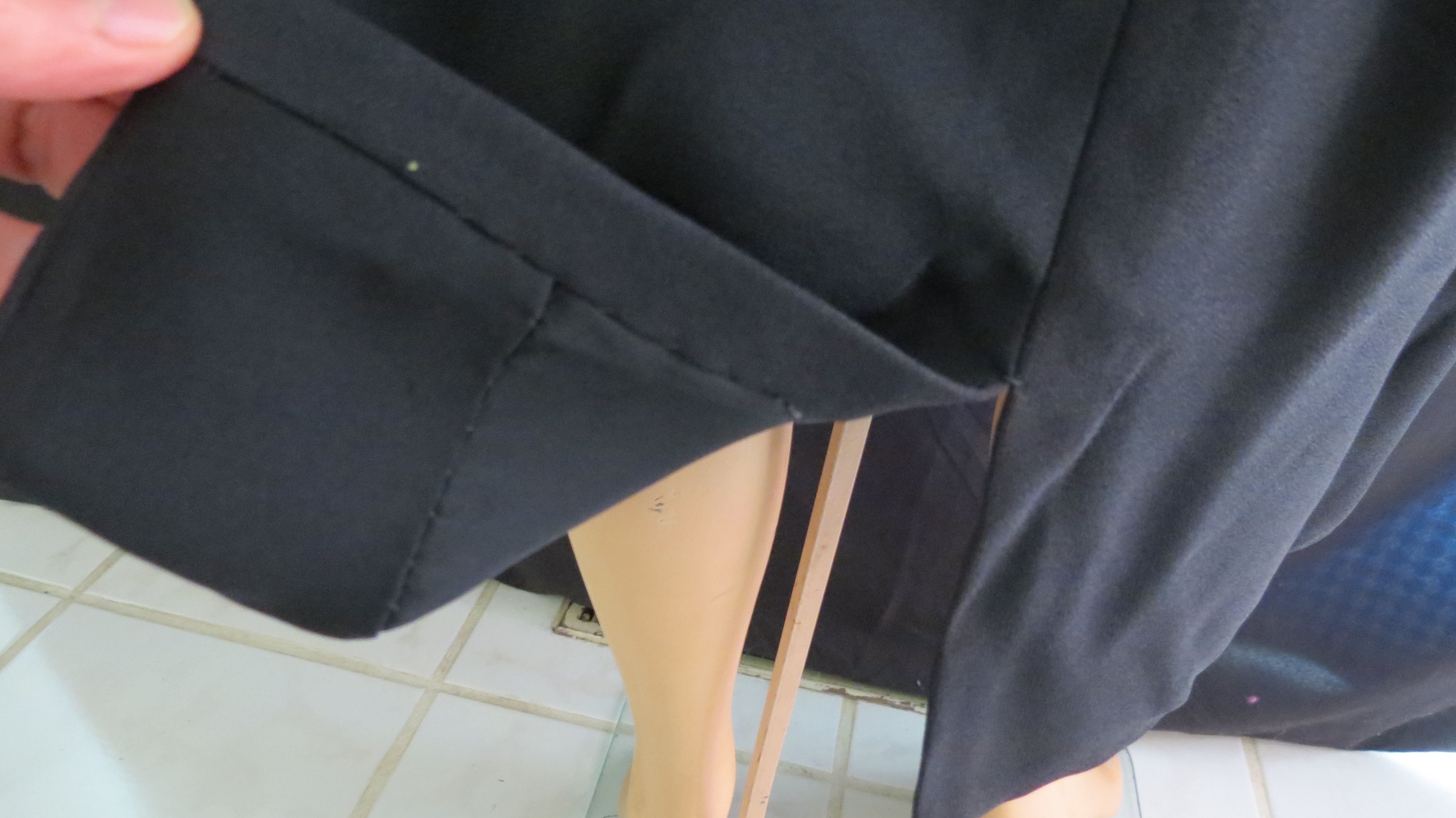
This dress is such a treat! I was so thrilled to uncover it. Look at the marvelous tailoring details and ingenious construction – A basic sheath style, with a heavily-decorated blouson top that appears to be separate, but is attached at the shoulders and fully-lined with a white silk under-blouse. Both layers close with a metal zipper. Hooks and eyes secure the neckline for good fit. The shoulders have strap-holders sewn in. The acetate skirt is also lined with black rayon and has a wide hem allowance plus a walking vent in the rear seam. Hand-finished all over.
In the ’50’s and 1960’s a woman of moderate means could save for the occasional purchase of clothing made this way and more prosperous women had closets full of nothing else. These were the standards of better-made garments during the mid-century. Now even very expensive clothing is sometimes constructed poorly and hardly ever as well as this dress is. The attention to detail and hand-done stitching made clothing fit better look more polished.
Tomorrow I’ll show you another frock from this decade. Stay tuned . . . . . . . . . . . . . . . . . . .
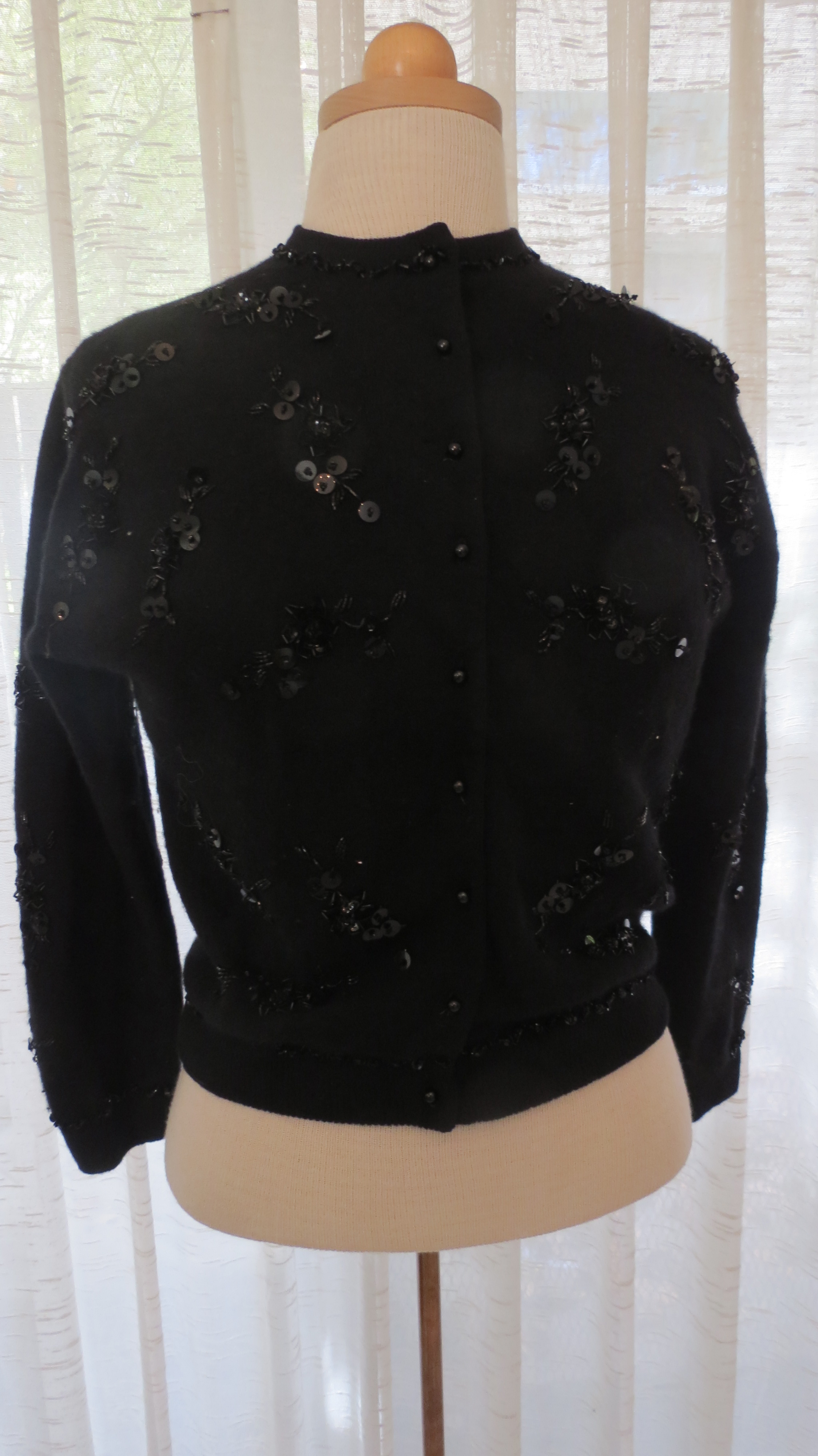
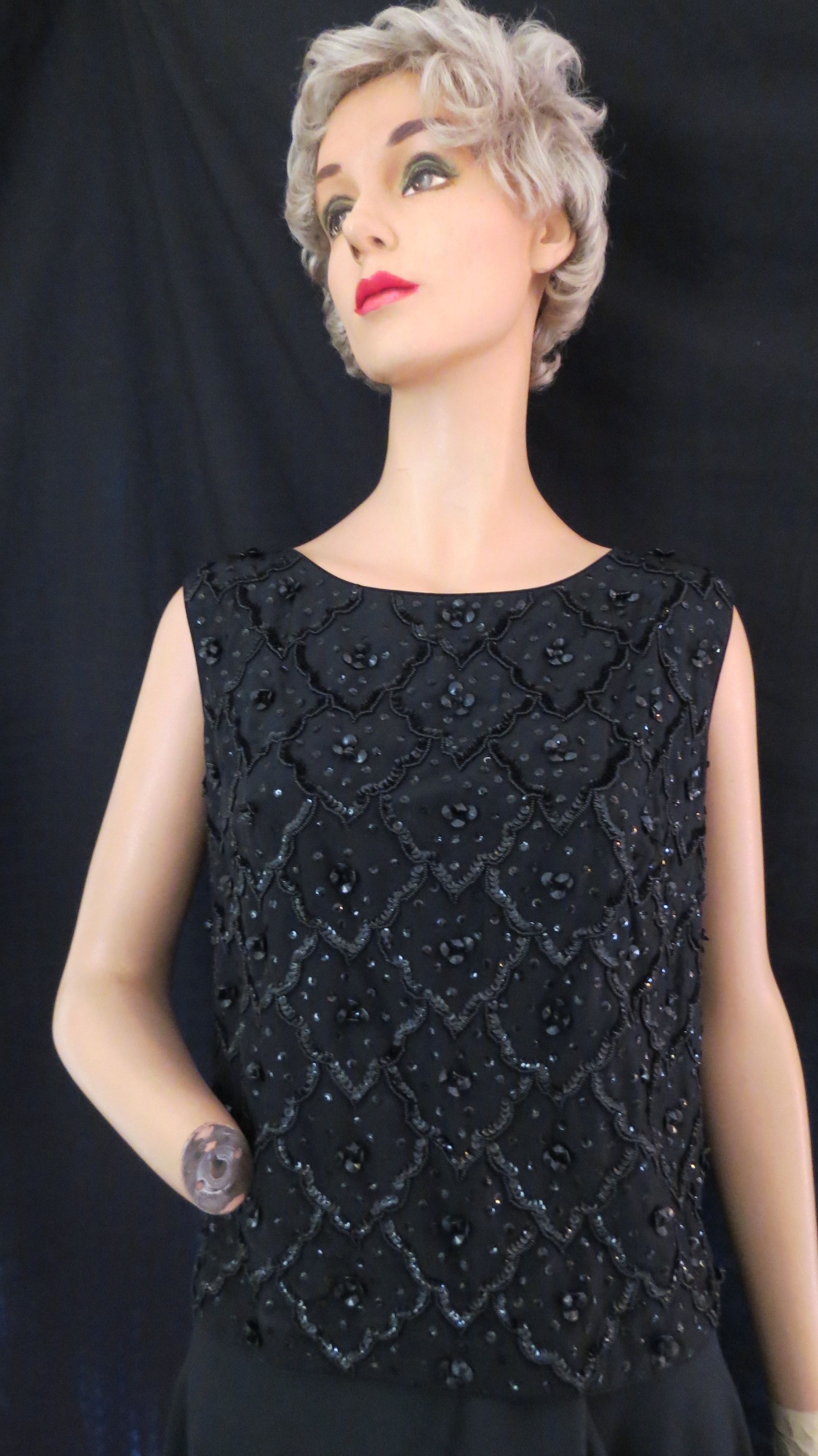
Here are two examples of the most iconic cocktail fashions of this era, which could be dressed down for a home-based cocktail party or dressed up with a well-styled skirt for a more formal type of party or event. The best were made in British Hong Kong – sweaters were made of fine lambswool or cashmere and shell blouses of rayon or silk. They would always be lined and have tiny sewn-in labels showing the bust measurement. Finer pieces had cloth labels from fine tailoring shops. These two are beautiful, but not the nicest I have discovered.
Although many tops similar to this were made in the ’80’s and ’90’s when retro “vintage” fashions became really hot, I never saw any as well-made as these are. There was a great variety of designs and types of beads; sequins, seed beads, jewels and, ribbon were all used. Like these, most were monochromatic but there were some with contrasting designs. Usually, the design was also on the back side and required some care when worn but that was not considered to be a hardship for women in the 1900’s.
Tomorrow I’ll start showing some dresses. This is a category of true vintage fashion that is a very big one! Stay tuned . . . . . . . . .
We’re now heading into the season for indoor parties, special occasions and events after the long, lovely summer; Cocktail parties, dinners, dances, recitals, holiday galas – you name it. I’ll be starting a series of posts of pretty, dressy and semi-formal garments in my collection from the 1950’s – 1990’s which will take us into the Fall and even Winter. Stay tuned . . . . . . . . . . . . . . . . . . . . . . . . . . . . . . . .