Photo # 2 -The colors are truer in the photo of the blouse, You can see how this skirt would swing, sway and billow during a dance. You ain’t got a thing if you ain’t got that swing.
Morgana Martin, the Magicvintagespy

Photo # 2 -The colors are truer in the photo of the blouse, You can see how this skirt would swing, sway and billow during a dance. You ain’t got a thing if you ain’t got that swing.
Morgana Martin, the Magicvintagespy

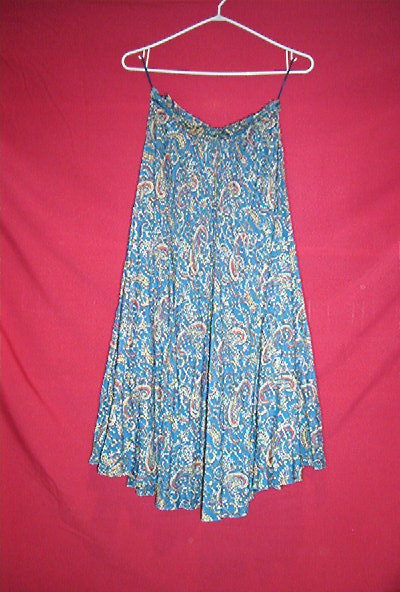
This blouse was a dress – the skirt is shown in the next post. (Wish I could figure out how to publish multiple photos!)
It actually came to me as a gift!
There was a bit of seam damage and the waist was too small, so I turned it into a circle skirt and blouse.The greatest thing about this dress is the fabric.
Substantial woven rayon with a paisley design and metallic thread accents. I certainly couldn’t toss it aside! Just made for the jitterbug.
I love the style, but the material is what makes it really special. That’s true with almost all of the true vintage that I own. It’s a study in itself, and a feast for the senses. I hope you’ll be able to get a close-up view.
Morgana Martin, the Magicvintagespy
Blog: Magicvintagespy.com
Google+, Facebook, Twitter & Pinterest
Book: How to Find the Best in Vintage Fashion
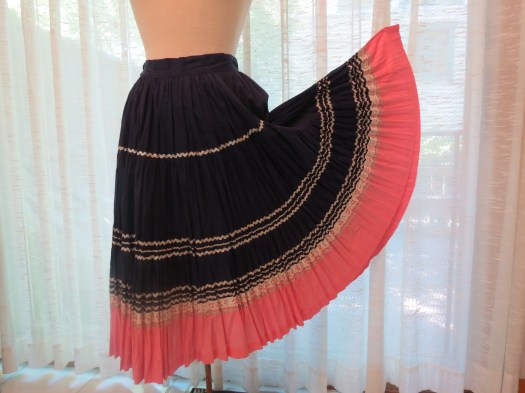
I just loved it when I found this! I still have two decorated circle skirts that relatives had picked up in Mexico. They were very popular in the ’50’s as souvenir items from a trip south of the border. Also, I’ve found several Native American blouse and skirt sets from that time. My mother had one which she, sadly, gave away without thinking I’d want it(!?#+!)
These were all the rage(?) in the late ’50’s – early ’60’s and lots of women bought them during a trip out west. Those who were fortunate to live out west often made them at home. They were made and sold by the Navajo tribe primarily, I believe – decorated in bright colors with yards of ric-rac, braid and ribbon.
If this one was not from the southwest, it was a take-off on that style. Always made of cotton,- this one is, too, with silver ric-rac and braid trim.
Tons of fun to wear! Although the native costumes would have a matching blouse, a sleeveless or short-sleeved white blouse looks really good. In the ’50’s, peasant blouses with elasticized necklines that could be worn off-shoulder were a big thing.
This is really an iconic style from back in the day. I’m glad to have several of them. As I said, they originated from aboriginal peoples in various countries and the gringos fell in love with them. Can’t argue with that!
Morgana Martin, the Magicvintagespy
Blog: Magicvintagespy.com
Google+, Facebook, Twitter & Pinterest
Book: How to Find the Best in Vintage Fashion available on Amazon.com
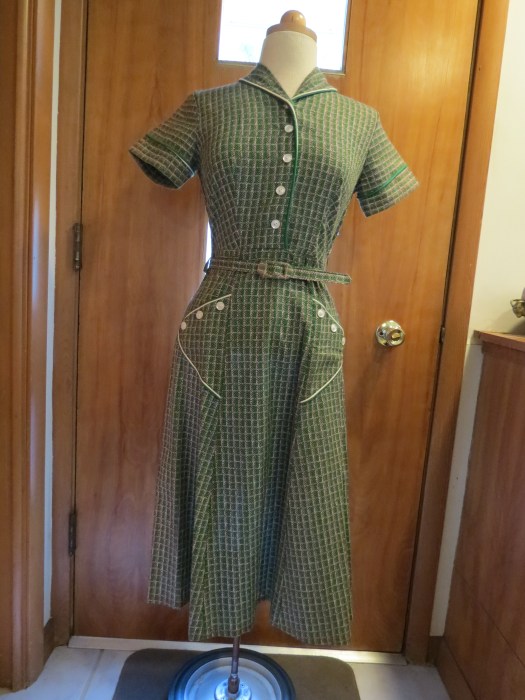
This one is just pure smiles, to me. It’s only an everyday dress, but so cute!
Love those pockets and all the little details. And also, so well-made. This is not a fine garment, but it’s a sturdy one!
I expect that this dress was worn during the war years. No shoulder pads, but it’s got a kind of no-nonsense way about it, as did a lot of the clothing during rationing. This is something that Rosie the Riveter might have worn at home.
Many looked similar later on and even into the ’50’s, but they tended to be a bit more feminine and “designed” after the war was over.
I’m no university-trained costumer, but I think I’m right. Undercover investigators learn on the job and I’ve trained in the field – hunting down the elusive cloak (no daggers, yet, but you just never know) . . . . . . . . . . . . . . .
Morgana Martin, the Magicvintagespy
Blog: Magicvintagespy.com
Google+, Facebook, Twitter & Pinterest
Book: How to Find the Best in Vintage Fashion available on Amazon.com
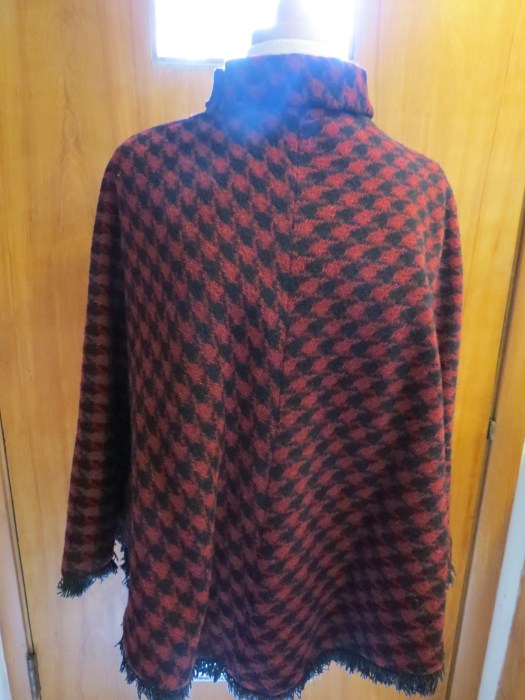
This one is really special (so what else is new) and great for cold-weather wear; anything from sitting through a football game, roasting marshmallows or chestnuts on the fire to dashing through the snow in a one-horse open sleigh.
It is of a nice wool or wool-blend material, with a heavy black lining and fringe all around. I love the metal zipper from the left shoulder to the neck. A couple of hooks and eyes close the collar. With a casual, hometown style that was so popular in the sportswear from that mid-century era.
I’m not sure if there had been a label inside – may have been home-sewn by a very good seamstress, which is not unusual in vintage from the ’70s and before. Finding this one was another “Aha! experience” that I hadn’t been specifically looking for – that’s what makes being a sleuth for vintage so much fun, because you just never know . . . .
Traveling tomorrow . . . . . . . . . . . ..
MORGANA MARTIN, THE MAGICVINTAGESPY
BLOG: MAGICVINTAGESPY.COM
BOOK: HOW TO FIND THE BEST IN VINTAGE FASHION – AVAILABLE ON AMAZON.COM
Autumn is here and winter’s coming, but I’m glad for any excuse to wear my lovely collection of coats, capes and jackets. This one is a great, sporty 3/4 length faux leopard from the 1950s that was a surprise find! Since I know where to go and what to look for, this happens to me a lot but still thrills me to pieces!
A really iconic ’50s thing, these faux leopard items in high quality clothing are a delight to wear. This coat is by Kilimanjaro, with a matching belt (not fastened), front patch pockets, a black satin acetate lining and that beautiful collar. Wear the collar down or hooked in front to form a warm cowl to protect your neck.
Picture it with black skinny stirrup pants and a black fur toque. I think there was some movie set in Switzerland in the very early 1960’s with Audrey Hepburn where she wore this type of clothing – Charade? . . . .
Morgana Martin, the Magicvintagespy
Blog: Magicvintagespy.com
Book: How to Find the Best in Vintage Fashion available on Amazon.com
 Magicvintagespy