A SMALL TROVE OF ANTIQUE JEWELRY PIECES FROM THE FAMILY ESTATE

Sorry not to be able to edit this photo. I think you can see what I’ll describe, from the top down, left to right. At top, a couple of gold-tone collar bars. Maybe men’s, but not sure. These could be from any time up to the 1920’s – not sure. At the left is a chain to hold a watch or other chatelaine such as the powder compact shown yesterday. A couple pairs of earrings – one clip-on and one screw-back. Below that is a pair of cufflinks. They are so delicate that I can’t tell which gender wore them. Below that are a couple of pendants – a cameo and one containing a small chunk of coral. Last is a small slide set with tiny pearl decoration. It is meant to wear on a neck chain – there are two holes in it for the chain to go through and it slides up and down.

Jewelry like this was commonly worn during the Victorian and Edwardian eras, late 1800’s to early 1900’s. Sorry I don’t have a camera that can take clear photos of small items like this and that WordPress doesn’t offer a better photo editing tool. However, I’m very grateful for the resources that I have because they’re great! Stay tuned for more true vintage jewelry and accessories. . . . .

MORGANA MARTIN, THE MAGICVINTAGESPY

BLOG: MAGICVINTAGESPY.COM

EARLY 1900’S FACE POWDER COMPACT CHATELAINE

This is really special – it comes from my family. Can’t say which of the grannies or aunties it belonged to, but one of them carried it before the 1930’s. Can you imagine – it still contains some of the powder and rouge that she used!

It’s a pretty messy deal, but you can see that there is an attractive little lever to hold one of the powder puffs in place, no doubt to prevent the two powders from mixing. Well, good luck on that, but I guess it worked well enough.

On top of that, the compact then fastened on to a clip somewhere on her belt or pocket or in a purse. Powdering one’s nose was an important beauty ritual for women at least until the end of the mid-century. They must have sprinkled cosmetic across the entire world. Take care, damsels of intrigue. If a clever investigator could suss out the exact shade and formulation of the evidence left behind, s/he might be on your trail . . . . . . . . . . . . . . . . . . . . . . . . . . . . . . . . . . . . . . . . . . . . . . . . . . . . . . . . . . . . . .

MORGANA MARTIN, THE MAGICVINTAGESPY

BLOG: MAGICVINTAGESPY.COM

TRUE VINTAGE POST-WAR SWEATER-DRESS? YES, APPARENTLY SO . . . . . . . . . . . . . . . . . . . .

Who would have thought? Until the mother of a friend gave me a 2-piece sweater-dress that she had made for herself in 1952, I never would have guessed it. That dress was a day-dress, whereas this one is dressy. It may even be from the 1940’s. It is hand-knitted from some kind of heavy synthetic yarn, which would make sense for that time period.

Previously, I would never have expected to see something like this before the 1960’s. It just goes to show that there is always more to learn and that clues often come from unexpected sources . . . . . . . . . . . . . . . . . . . . . . . . . . . . . . . . . . . . . . .

MORGANA MARTIN, THE MAGICVINTAGESPY

BLOG: MAGICVINTAGESPY.COM

ANOTHER MYSTERY GOWN AND A NON-TRADITIONAL IDEA

Two fabulous clues that I was never able to fit exactly into place. It’s pretty clear that they both originated somewhere between 1946 and 1962. The investigations they might have clinched have long-since been solved or placed into the dead file. At any rate, it’s clear that, if not a wedding, some gala event and prominent characters were involved.

Before my time, but would make great bases for a story. . . . . . . . . . . . . . . . . . . . . . . . . . . . . . . . . . . . . . . . . . . . . . . . . . . . . . .

MORGANA MARTIN, THE MAGICVINTAGESPY

BLOG: MAGICVINTAGESPY.COM

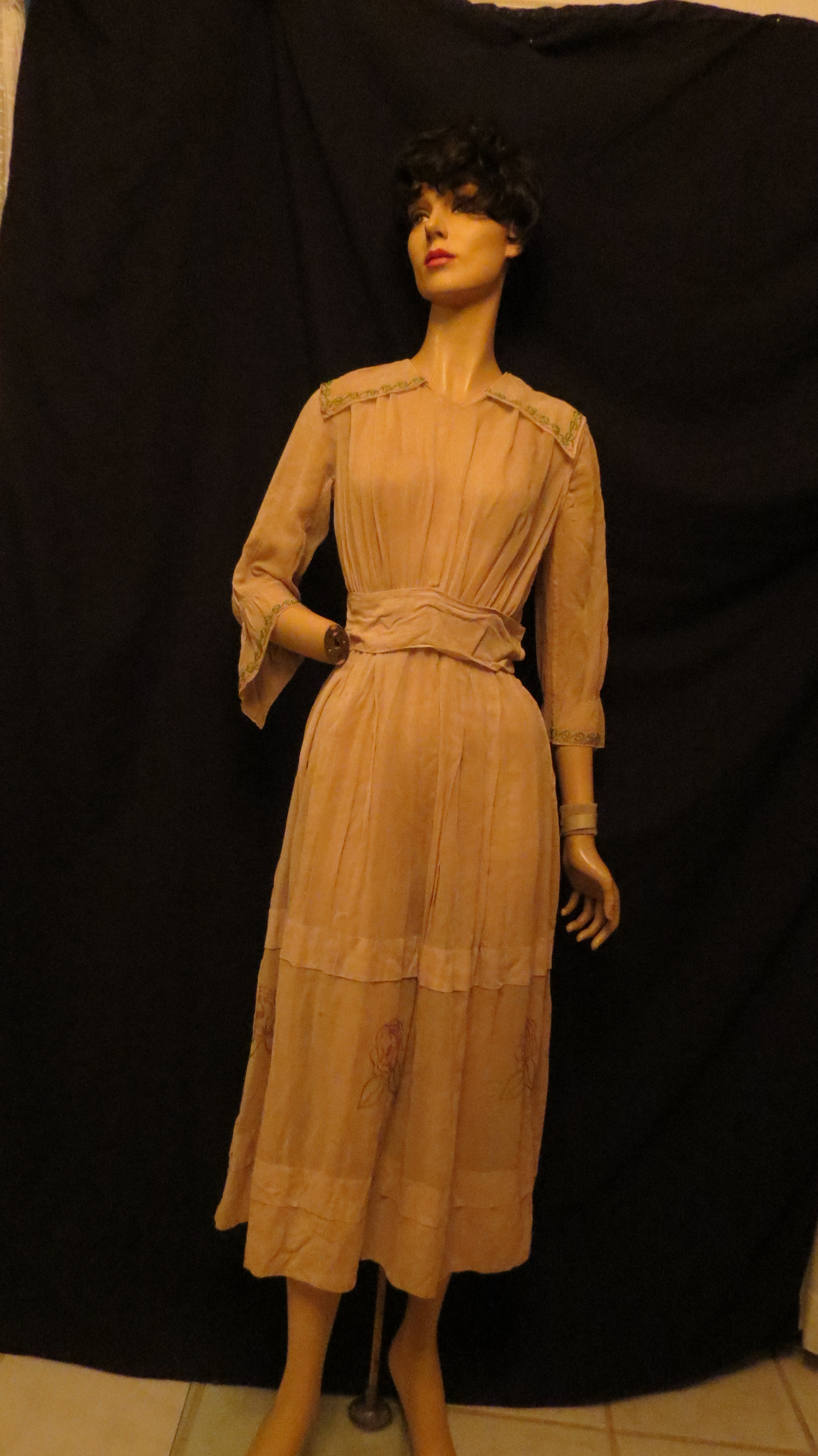
A MYSTERY DRESS THAT I STILL CAN’T DECIDE ABOUT – PROBABLY ’30’S, AND 2 FROM THE ’40’S

Yes, probably 1930’s there on the left, or maybe even ’20’s. It would look completely different with the appropriate undergarments, but still super-unstructured. What a difference 10 years can make. We go from shaped like a bag to built like a battleship in the 1940’s. Especially after a war – everything changes. This can certainly be seen in the fashion world and makes the sleuthing trade a little easier, but a LOT more fascinating . … . . . . . . . . . . . . . . . . . . . . . . . . . . . . . . . . . . . . . . . . . . . . . . . . . . .

MORGANA MARTIN, THE MAGICVINTAGESPY

BLOG: MAGICVINTAGESPY.COM

A REALLY RARE FIND – AN ART DECO 1930’S GOWN FOR A SLINKY EVENING OR A FASHIONABLE WEDDING

Another surprise find, as so many are. What would espionage be without the intrigue? A whole lot less fun, that’s for sure.

This dress is big on Stella, so the full impact of the fit isn’t evident. Though it’s not cut on the bias, it definitely has slinky fit potential. A nightgown wouldn’t be likely to have a long zipper down the side, especially when they were always metal, so this is obviously a dress designed for an Occasion. And, also, to be worn without much in the way of undergarments. Oh, the Flirty Thirties!

We’ll be in the Forties for at least a couple of days. Though I showed you Stella’s wedding outfit a little while ago, I may revisit it since it’s such an important part of the file. More to come Stay tuned . . . . . . . . . . . . . . . . . . . . . . . . . . . . . . . . . . . . . . . . . . . . . .

MORGANA MARTIN, THE MAGICVINTAGESPY

BLOG: MAGICVINTAGESPY.COM

IT’S A BIG FILE! LET’S KEEP LOOKING AT LATE 1930’S – EARLY 1950’S

Here’s a beautiful gown from 1942 which I discovered via clandestine information filtered through the espionage grapevine. It was a surprise and fabulous find and so wonderful to get first-hand intelligence about the history! This was originally a department store purchase imported from Europe. What a gorgeous veil, with excellent disguise potential . . . . . . . . . . . . . . . . ..

MORGANA MARTIN, THE MAGICVINTAGESPY

BLOG: MAGICVINTAGESPY.COM

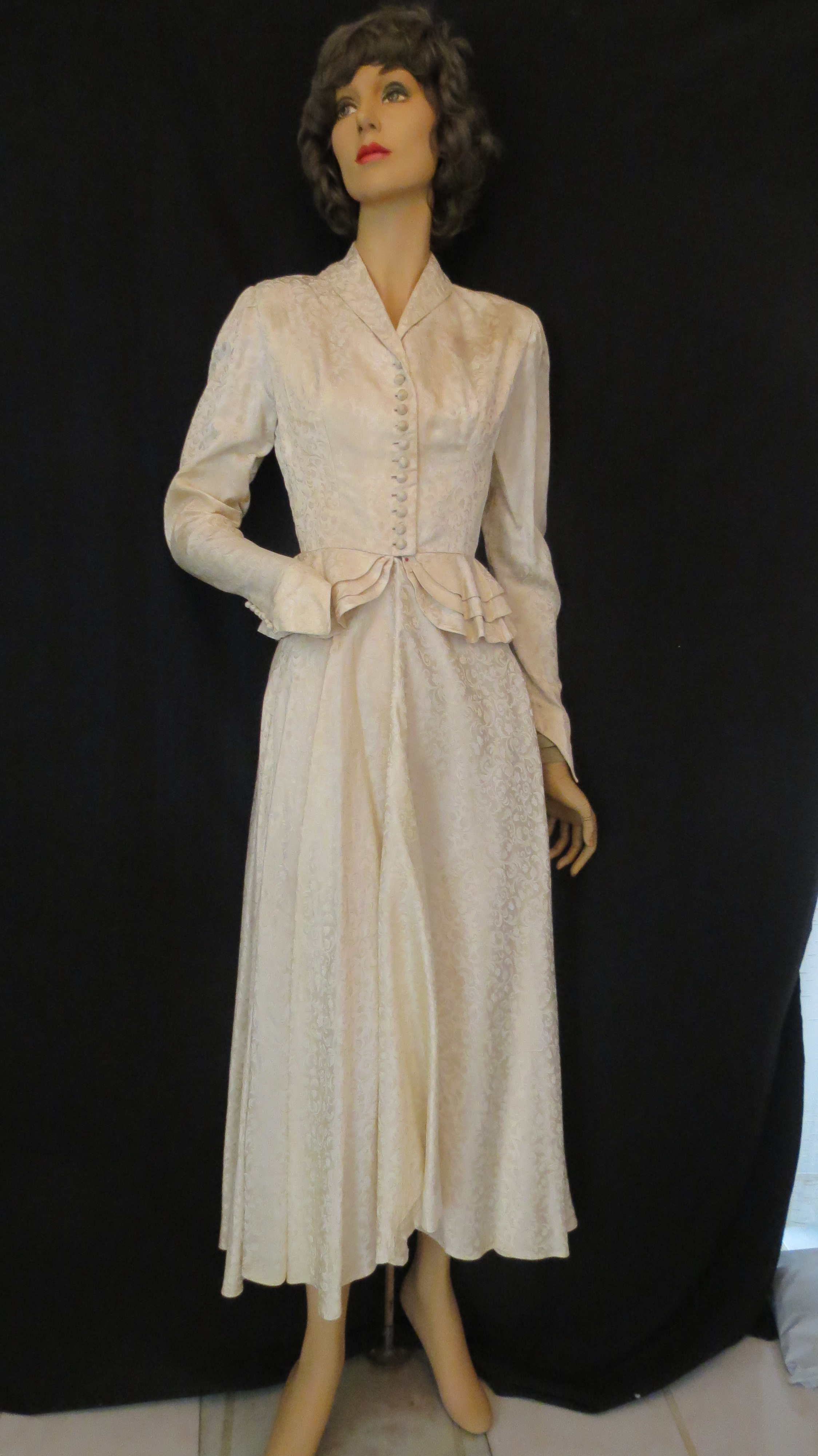
WITH VALENTINE’S DAY COMING RIGHT UP, I RE-OPENED THE WEDDING GOWN ARCHIVE

This is a heavy satin gown from the post-war 1940’s or maybe the very early 1950’s. The detail is incredible, while keeping the tailored, non-fussy style which was popular then. Take a close look at that cape collar. It is edged with beading all around. The buttons and loops in front are just for show. The bride gets into this dress by opening a long metal zipper on the left. So figure-enhancing! My first guess was that this frock had been custom-tailored – and perhaps a lot of custom-fitting did take place – but in truth it was sold by the high-end department store Harzfeld’s in Kansas City, MO. Part of an iconic chain of these stores, it was 11 stories high in the downtown. Undoubtedly, our blushing heroine received elite attention from the sales staff and tailoring department.

The skirt is very full, but there’s no crinoline underneath. That’s an easy thing to add, depending on taste. Just examining all the construction clues is a fascinating way to put together a picture of the era and the circumstances of this particular novia on the day of her wedding. We’ll get a chance to do some more similar sleuthing tomorrow . . . . . . . . . . . . . . . . . . . . . . . . . . . .

MORGANA MARTIN, THE MAGICVINTAGESPY

BLOG: MAGICVINTAGESPY.COM
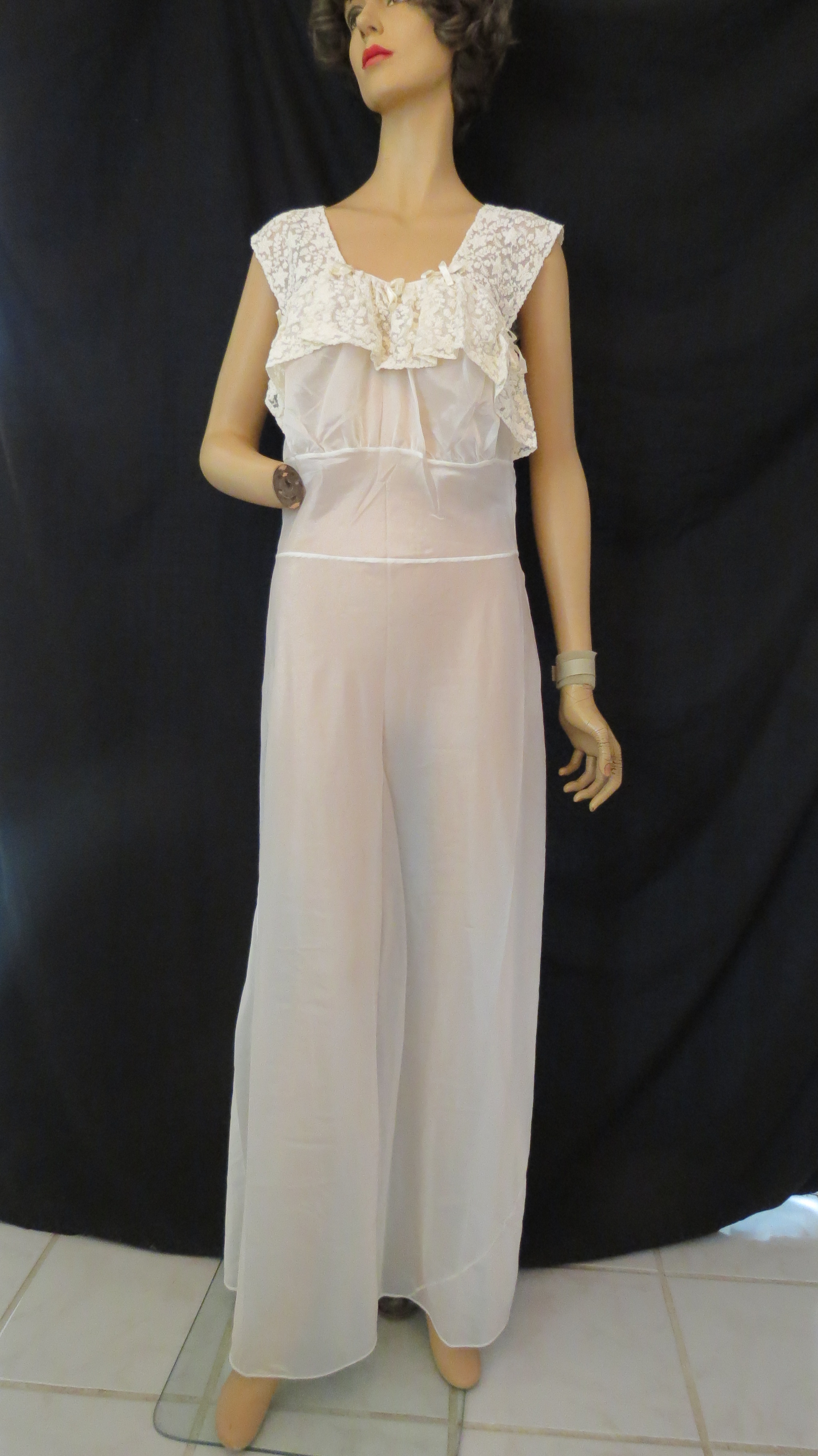
ANOTHER RARE FIND: 1940’S RAYON TEA DRESS FROM HAWAII

The Malihini company which made this garment may have been Japanese-owned. At that time, of course, Hawaii was not a part of the United States. The style is, therefore, traditional Japanese Tea Ceremony garb rather than the Hawaiian style that we began to see become very popular in the 1950’s. The rayon fabric is absolutely wonderful – you’d have to feel it to know. Rayons of that time often felt like silk.

This dress is even too tiny for Stella to get into. A very rare clue . . . . . . . . . . . . . . . . . . . . . . . . . . . . . . . . . . . . . . . . . . . . . .

MORGANA MARTIN, THE MAGICVINTAGESPY

BLOG: MAGICVINTAGESPY.COM

VERY RARE FIND: A HAND-TAILORED GARDEN PARTY DRESS FROM THE 1920’S OR BEFORE

The pictures are yellowed because of low light at the time of the photograph. However, you can see the exceptional detail in the design of this frock. The true color is a creamy white, with beaded embellishments depicting leaves and flowers. It’s rather intricate to put on, too, with panels that fold over but I finally figured it out. Can you imagine the time it took to fashion this garment by hand – but many women, before the 1950’s, did almost all their sewing that way and had very limited choices with regard to anything they could purchase ready-made.

And to think that now our landfills are overflowing with cheap polyester clothing that is discarded in a few weeks (if it lasts that long). Thank goodness that we can still come across clues like this one . . . . . . . . . . . . . . . . . . . .

MORGANA MARTIN, THE MAGICVINTAGESPY

BLOG: MAGICVINTAGESPY.COM